


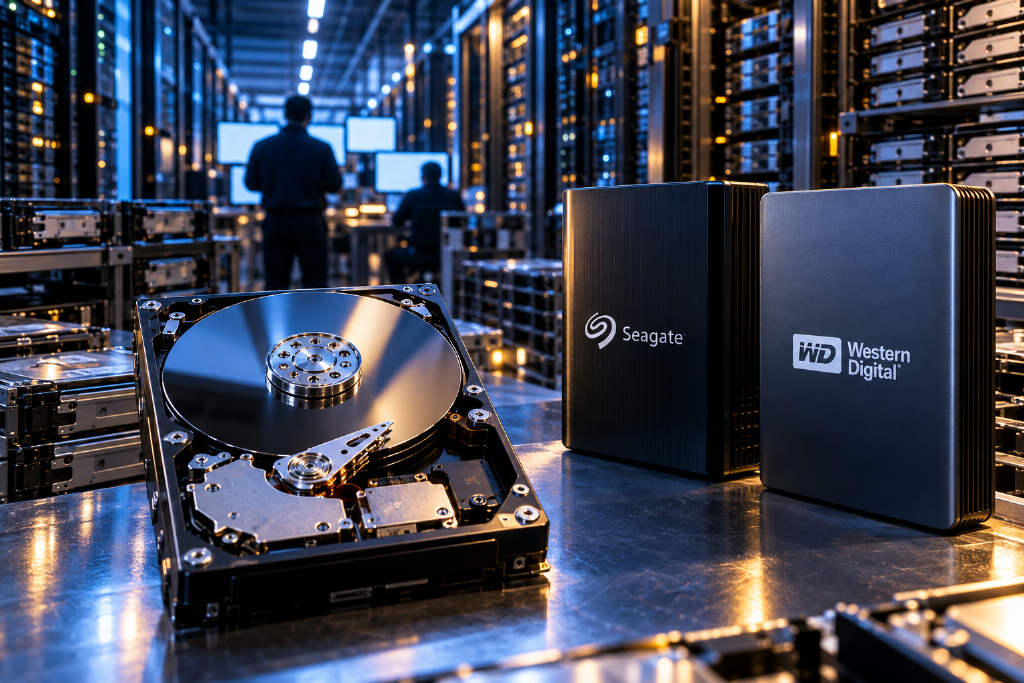
Morgan Stanley said in a report dated Oct. 20, 2026 that the market is valuing hard disk drive makers too harshly. At roughly 8x earnings, current pricing implies HDD profits peak in FY28. The bank took the opposite view and said the cycle has not ended.
8x earnings implies a FY28 peak, Morgan Stanley says
The bank said that, working backward from FY28 earnings and an assumption that solid-state drive, or SSD, prices fall 80% from C2Q26 levels, the market’s current valuation implies HDD earnings peak in FY28. Morgan Stanley said that assumption is too punitive.
It lowered its target multiples from 20x to 15x for Seagate Technology (STX) and 14x for Western Digital (WDC), citing market structure and uncertainty around AI funding. Even with those lower multiples, the bank reiterated Overweight on both names and restored STX as its top pick in IT hardware.
The resulting price targets are $1,200 for STX, based on 15x FY28 EPS of $80.10, and $643 for WDC, based on 14x FY28 EPS of $45.95. The report listed current prices of $660.81 for STX and $352.21 for WDC.
Spot pricing is running well above contract pricing
Morgan Stanley said HDD demand is accelerating while the supply gap is widening. Nearline HDD spot transactions are running at 4 to 7 cents per GB, compared with about 1.5 cents per GB for blended nearline contract pricing.
The bank estimated an industry supply shortfall of about 300 exabytes in CY26, widening to roughly 400 exabytes in CY27 and CY28. It said the customer base is expanding from core cloud service providers, or CSPs, to AI labs, with the latter looking to buy 100% of exabytes. Supply shortages are limiting procurement volumes, and tight storage capacity is pushing up spot prices.
Outside nearline products, non-nearline HDD pricing rose 15% to 30% month over month. Morgan Stanley said Seagate has been more aggressive than Western Digital in capturing spot pricing.
Demand is spreading beyond core cloud buyers
The report said the demand shift is showing up not only in pricing but also in the customer mix. What had been driven mainly by core CSP demand is now extending to AI labs. Morgan Stanley said those buyers want to purchase 100% of exabytes, but supply constraints are capping actual volumes.
On the supply side, Toshiba is constrained by media and equipment, and its CY27 capacity is already sold out. The bank said Toshiba has also been more aggressive on pricing and added that it is comfortable with the risk around the name.
Earnings estimates sit above consensus
Morgan Stanley’s earnings forecasts are above market consensus for both companies. For the September quarter, it estimated Seagate EPS at $7.50 versus consensus at $7.41, and Western Digital EPS at $4.13 versus consensus at $4.09.
For the December quarter, the bank forecast Seagate EPS of $9.54, which is 12% above consensus. It added that if spot pricing assumptions turn more aggressive, December-quarter EPS could be another 5% higher.
For Western Digital, Morgan Stanley forecast December-quarter EPS of $5.25, 10% above consensus. Under a more aggressive spot pricing assumption, December-quarter EPS could reach $5.67.
The report also laid out buy-side expectations for WDC at $4.75 billion to $4.95 billion in revenue, 59.5% to 61.0% gross margin, and EPS of $5.20 to $5.60. Morgan Stanley said WDC guidance is usually conservative, giving the company a better tactical setup because the buy-side bar is lower.
The cycle continues, but the path is less clear
Morgan Stanley said the HDD catalyst path is more uncertain than it was a month ago. The market still has questions about supplier discipline and the source of AI funding, and the bank said those issues will not be resolved by earnings alone.
It added that STX still trades 10% above its “shut-your-eyes-and-buy” valuation level, defined as 10x CY27 EPS or $595, while WDC is only 3% above that level at $343. In the bank’s view, part of the risk is already priced in.
Morgan Stanley said it is watching four issues: whether STX and WDC adjust capacity plans in response to Toshiba’s targets; whether they prioritize profit over share; whether the supply-demand gap widens; and whether pricing turns more aggressive.
The bank said the answers may not take the stocks back to the narrative seen four months ago, but they can help investors see that some risks are already reflected in valuations. Morgan Stanley reiterated Overweight on STX and WDC and restored STX as Top Pick. The market is pricing the end of the cycle; Morgan Stanley is pricing its continuation.