


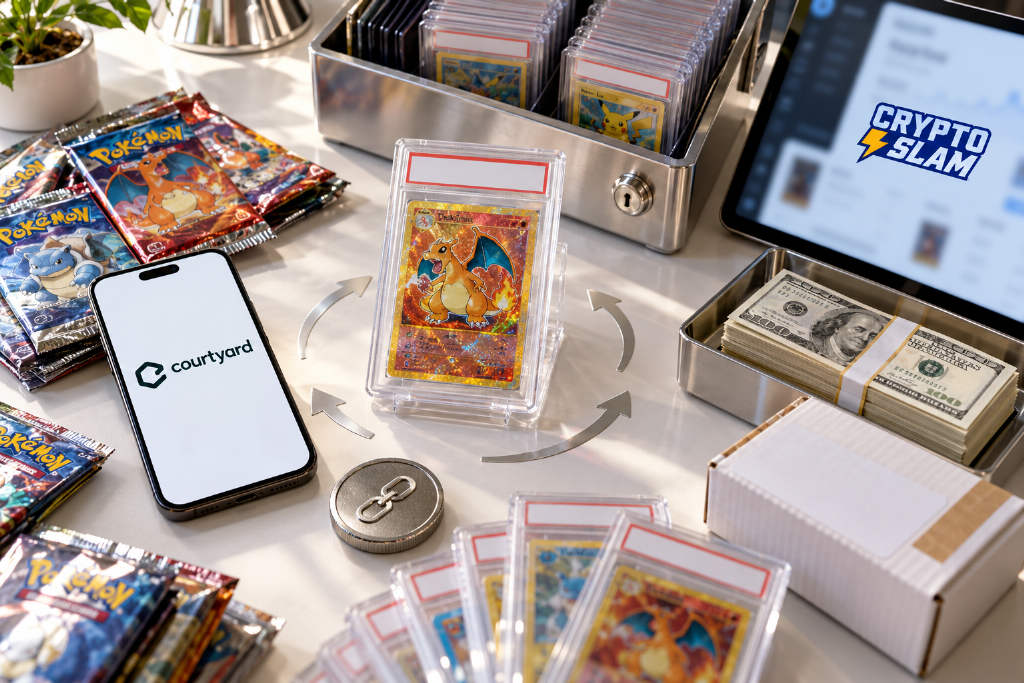
Putting trading card games on-chain changes more than just how trades settle, a BlockTempo analysis argues. The real change, it says, is the loop: pack opening, buybacks, and repeat sales can all get squeezed into one fast cycle. It points to a breakdown from X user danny saying a single card on Courtyard gets sold eight times a month on average. It also cites Sporting Crypto, using CryptoSlam data, showing Courtyard’s monthly sales jumped from about $449,000 in April 2024 to roughly $66 million in April 2025.
On Courtyard, a user can open a random pack, leave the card in a vault, ask for physical delivery, or take the platform’s quote and cash out. In that setup, the card itself may never move. Ownership does. And so does the price the next buyer will pay.
The report says this is the part that really matters. In the old model, a seller moved one pack and then sat around waiting for the next customer. Here, opening, quoting, buying back, and reselling can run one after another. Same card. Same capital base. Multiple transactions. No need to leave storage.
An 85 billion-card base and a $16.3 billion market
By the end of March 2026, cumulative Pokemon card production had passed 85 billion, with sales across more than 90 countries and regions, the article says. It also says the digital card app Pokémon TCG Pocket announced in October 2025 that total downloads had topped 150 million.
Straits Research, in an October 2026 update, put the global trading card game market at about $16.3 billion for that year. The article also points to a December 2025 Business Insider report based on eBay data saying trading cards were, at that moment, the most-purchased secondhand product category among Gen Z users in the US on the platform.
From hobby product to collectible and investment item
The piece traces TCG history back to 1993, when Magic: The Gathering launched. It says Wizards of the Coast co-founder Peter Adkison traveled up and down the US West Coast showing the game to stores with live demos, helping local shops turn into both retail outlets and gathering spots.
Now it is more than 30 years later. The kids who used to buy cards have money to spend. The article says cards have grown from game pieces into collectibles and investment items. Some buyers care about deck building. Some chase certain artwork and print versions. Some are just buying back the cards they wanted when they were young.
Hasbro’s 2025 investor materials, as cited in the article, put the average age of tabletop Magic players at about 35, with average engagement of more than five years. Wizards Play Network reached about 9,600 stores. In 2025, combined revenue from Magic tabletop and digital products hit $1.72 billion, up 59% year over year.
Why smaller, high-volatility products are drawing attention
The article ties some of this demand to wider financial strain. A 2025 survey from the National Association of Realtors found first-time buyers made up 21% of all homebuyers, while the median age of first-time buyers climbed to 40. A 2026 survey from Northwestern Mutual found that among US Gen Z respondents who were using or considering high-risk speculative tools, 80% said they were financially behind and hoped those tools could help them reach their goals faster.
So there are two realities sitting side by side, the report says. Big-ticket assets take a long time to build toward. Smaller products, with instant access and the chance of oversized returns, are fighting for attention right now. Cards also carry cultural familiarity. A buyer may not know how to read a company’s cash flow, but they probably know which character they like and which version the community wants.
The article also cites a 2025 Australian collectibles study commissioned by eBay and conducted by Deloitte. It found that 35% of surveyed collectors saw collectibles as a good investment. Among those collecting for investment purposes, 40% expected returns above 50%. The report also cited eBay data showing that One Piece OP-01 booster boxes had risen 200% in transaction price since 2022.
The friction in traditional card trading
Cards are non-standardized items, the article says, and in that sense they look a lot like NFTs. Pricing is harder to standardize. That can hold back volume, turnover, and liquidity. It also makes building a derivatives market around cards much harder. To juice spot demand and the appeal of outsized gains, sellers have long relied on blind-box and pack-opening mechanics.
Traditional resale is still messy. Sellers have to photograph cards, confirm condition, pack them up, and ship them. Cross-border deals can bring customs and tax headaches too. Using eBay US base fees as the example, the article says trading cards are charged 13.25% on the first $7,500 of total sale value per item, plus a per-order fee. On a $100 order with no taxes or shipping included, a seller would keep $86.35 after subtracting 13.25% and a $0.40 order fee.
Under that fee setup, a move from $100 to $110 may not be enough to make selling worthwhile. The article says the drag in the card market is not just about price movement. It is also about condition risk from handling and shipping. It points to custody-based setups such as Fanatics Collect, where cards can change hands multiple times in storage and leave the warehouse only when someone asks for delivery.
On-chain certificates widen the circulation layer
Custody fixes one problem: the card does not have to move every time it is sold. On-chain certificates add something else, the article says. When a product supports it, the certificate can move to an external wallet, work with other marketplaces and smart contracts, and connect to stablecoin payments. Put simply, custody cuts physical friction. On-chain rails widen the places where ownership claims can move and the kinds of services that can plug into them.
The report says two ideas sit at the center of this business: price discovery and turnover. A card listed at $100 and marked by a platform at $100 does not mean anybody is ready to pay that right now. The listing price is the seller’s expectation. The last sale is just what happened before. The bid tells the holder what they can get if they want out now. More independent buyers means a fuller pricing process. Simple as that.
Turnover answers another question entirely: how many times the same inventory can be used in transactions. The article gives a basic example. If inventory is worth $1 million and turns once a month, that supports $1 million in monthly transaction volume. If it turns 10 times a month, that supports $10 million. If the old rate was once every 10 months and the new rate is 10 times a month, the resulting flow is 100 times larger.
That is why the article uses Courtyard as its case study. It says founder Nico Le Jeune has said the same card is sold eight times a month on average. It also says Sporting Crypto, using CryptoSlam data, tracked monthly sales rising from about $449,000 in April 2024 to about $66 million in April 2025. The article presents that as a real example of what can happen when both transaction frequency and distribution widen.
Buybacks speed the loop but leave risk on the platform
Random packs and instant buybacks make the cycle even faster. If a user pulls a card they do not want, they do not have to wait around for another buyer. They can take the platform’s quote and turn that result back into balance. Then the platform puts the card back into inventory and can line up another sale.
The article gives a simple illustration. If a user spends $50, pulls a card valued at $100, and sells it back to the platform for $85, the card goes back to the platform and the platform’s cash position changes by $50 minus $85, or negative $35.
Then it gives a second stripped-down model. Say a pack sells for $50, the probability-weighted average card value is $45, and the buyback ratio is 85%. If every card is sold straight back at once and probabilities and valuations do not change, the average buyback cost per round is $38.25, leaving $11.75 in cash before any other costs. That $11.75 comes from two pieces: the $5 gap between the pack price and the average card value, plus $6.75 kept by buying back a $45 card at 85%.
Under that model, the average return ratio to the user is 76.5%. If capital can be split without limit, the return ratio stays fixed, all balance is reinvested, and there is no minimum purchase amount, then an initial $50 budget can theoretically support cumulative purchases of $212.77, calculated as 50 divided by 1 minus 76.5%.
But the article is careful here. Real products are not this neat. Pack sizes are fixed. Outcomes vary. Users do not sell every card back. Some keep the cards they like. Some ask for delivery. Some go hunting for a better price in the secondary market. Even if a card never leaves storage, once it belongs to a user, it is no longer inventory the platform can freely toss back into the prize pool.
And that leaves the platform with a very real job. It has to source fresh cards, keep the pool appealing, and handle buyback payouts when high-value outcomes bunch up.
Courtyard’s fee structure and the platform’s role
The article goes into Courtyard’s fee setup in some detail. Secondary trades between users carry a 0 platform fee. Buyback quotes on pack pulls come with a seven-day acceptance window. Valuations refer to recent sales, market trends, and grading differences. If a user accepts a pack-pull buyback, that transfer carries a 6% fee, while standard marketplace trades do not carry that charge.
That difference matters because, in the article’s view, a TCG platform is doing more than running a marketplace. It is also taking inventory risk through quoted buybacks.
From local game stores to a digitally coordinated trading table
The piece compares this structure with perpetual futures markets. Not because the products are the same. They are not. The point is the structural resemblance. Both cut trading friction and let very different motives exist in the same venue. In perpetuals, some traders make directional bets, some hedge, some collect funding, and some make markets. In cards, some users chase IP, some collect, some open packs for chance-based outcomes, some play the game, some look for arbitrage, and some manage inventory.
More than three decades ago, Magic brought people together through local game stores. Today, the article says, card platforms are trying to gather people with different goals around the same pool of physical items. Culture gives people a reason to recognize what is sitting on the table. Mechanism lets them trade faster. Custody and settlement mean the next round does not have to wait for shipping.
The article closes its business case by arguing that the most interesting part of on-chain TCG may be the link between two groups: people willing to spend a small amount for a shot at a different outcome, and people willing to pay a known amount for the exact result they want. Whether a platform can keep sourcing inventory, preserve fairness in randomization, continue buybacks, and offer competitive quotes may matter more than how many times a card changes hands inside a vault.
The Jirachi story at the end of the article
Outside the market analysis, the original piece ends with a personal story tied to Pokémon cards. It says a child named Avery had gone through cancer treatment since the age of four, and Pokémon cards became a source of comfort during that time. His favorite card was Jirachi, but he had never pulled one.
The article says that near the end of his life, he finally opened a Jirachi. In the video, he reacted in disbelief, saying, "I can hardly believe it..." The piece says that recording became his final pack-opening video. It closes with another line from the original text: "What moves people has never been the price or the card grade, but the thing you truly love from the bottom of your heart, the kind of beauty you would gladly treasure for a lifetime."