



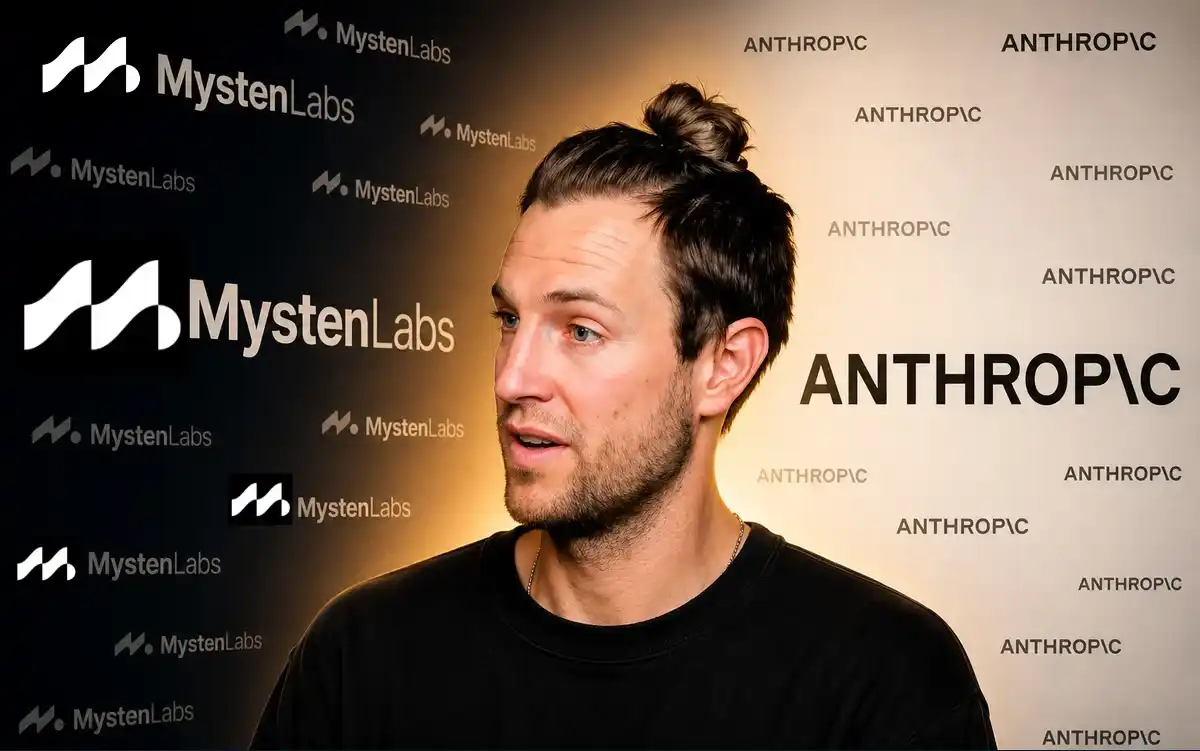
Sam Blackshear, the creator of the Move programming language and a central technical figure behind Sui, said on Aug. 5 in a post on X that he is leaving Mysten Labs and joining Anthropic to work on defensive AI security research.
His name may not be familiar to many retail users. The technology he built probably is. Move is the language at the base of Sui, and Blackshear has been tied to it since its earliest design phase.
From Libra to Sui
According to the source article, Blackshear was at Meta around 2018 when Mark Zuckerberg was pushing the Libra stablecoin project. Blackshear was part of the core technical team and designed a new programming language for that effort. That language became Move.
Libra was later renamed Diem, and the broader stablecoin project was eventually halted by regulators. Move survived.
In September 2021, Blackshear and four former Meta colleagues co-founded Mysten Labs, taking Move out of Meta’s abandoned crypto effort and building a new public blockchain around it: Sui. The article says he spent more than eight years working on the language from its conception to his departure.
A role the article compares to a protocol gatekeeper
The piece argues that crypto market participants often do not feel the weight of personnel changes, especially in a weak market, but departures like this are not minor.
It draws a rough comparison between Blackshear’s place in Sui and Move and Vitalik’s place in Ethereum and Solidity. The reasoning is straightforward: the design of a chain’s underlying language shapes security properties and defines what the network can and cannot support.
In that framing, people like Blackshear are difficult to measure by title alone. They may design the language, set the direction of protocol changes, or influence where resources are allocated. The article calls them “gatekeepers,” the people who define how high an ecosystem can grow.
Why AI is pulling technical leaders away
The article points to an earlier moment that hinted at Blackshear’s growing interest in AI.
At a roundtable on project security in April, he described an analysis tool he had written during his Facebook years. He later wanted to migrate that tool to Move and use it to scan Move code for possible vulnerabilities. He said the migration would normally take “a very, very long time” if done manually.
Instead, he gave the task to Claude. Claude completed the migration automatically and flagged a set of potential vulnerabilities. Blackshear’s reaction, as quoted in the article, was: “whoa, we’re entering a new world.”
The article treats that moment as important because the appeal of AI often becomes real when it starts doing the work a technical person knows best and does most often — and does it in a way that beats expectations.
Blackshear is not alone
The report lists other senior crypto figures who have moved into AI.
In February, Ethereum Foundation co-executive director Tomasz Stańczak announced his resignation less than a year after taking the role. Stańczak previously founded Nethermind, one of Ethereum’s most important clients, and was a core participant in protocol-level development.
When he left, he wrote in a blog post: “I now know that Agentic systems and AI-assisted discovery are reshaping the world.” The article places him in the same broad category of gatekeepers, though in his case the focus was not language safety but the direction of Ethereum protocol upgrades.
It also points to earlier examples:
- OpenSea co-founder Alex Atallah stepped down as CTO in 2022 during the peak of the NFT boom and later built AI model aggregation platform OpenRouter, which the article says is now valued at $500 million.
- Leopold Aschenbrenner left FTX’s Future Fund, wrote the 165-page Situational Awareness, and now runs a multibillion-dollar AI investment fund. The article says the fund has recently suffered heavy losses but that he remains active in the AI sector.
- His former colleague Avital Balwit also left the FTX orbit and now serves as chief of staff to Anthropic CEO Dario Amodei.
These departures came from different projects, at different times, and from different roles. The article’s point is that the work those people were doing lines up with what the AI industry now wants most.
Developer activity is shrinking while AI grows
The article then turns from people to data.
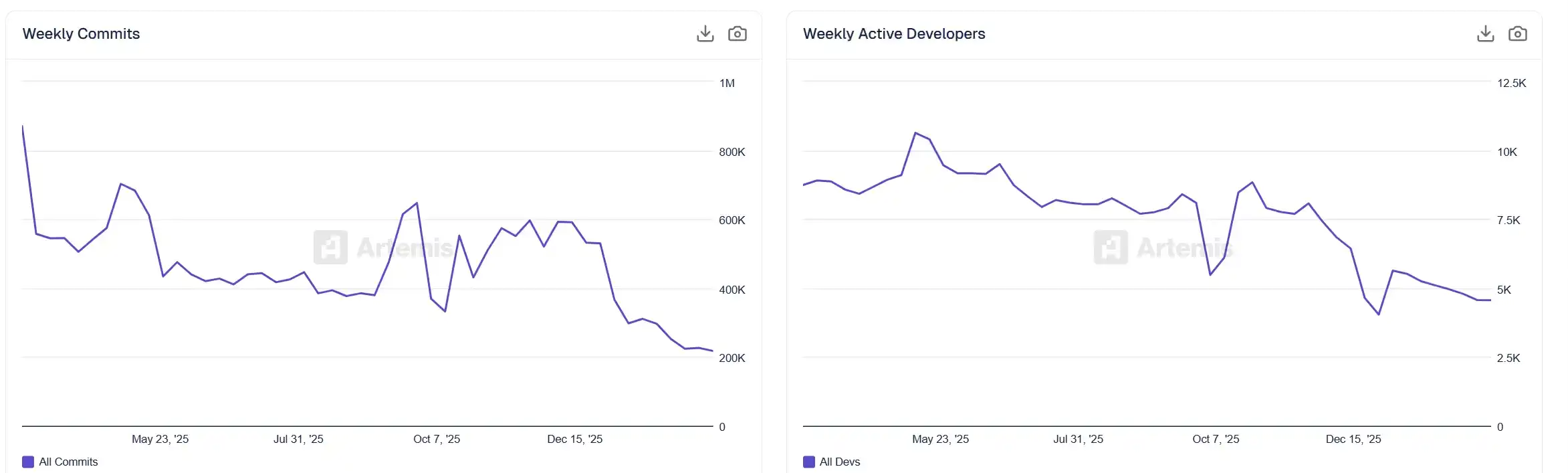
It cites Artemis figures from March showing that weekly GitHub commits across crypto projects fell from about 850,000 at the start of 2025 to about 210,000. That is a drop of roughly 75%.
Over the same period, weekly active developers fell from about 8,700 to 4,600, a decline of more than half. Within that, Ethereum developers fell 34% in three months, Solana developers fell 40%, and BNB Chain’s code commits dropped 85%.
The article says this is not a problem limited to one chain. Nearly every ecosystem is losing blood.
GitHub as a whole, however, is still expanding. In 2025, the platform added about 36 million developers, and overall commits rose 25% year over year. Citing the GitHub Octoverse report, the article says most of that growth went to AI projects. AI-related repositories topped 4.3 million, while imports of large language model SDKs rose 178% over one year.
Dragonfly investor Omar, as quoted in the piece, said the shift reflects attention moving toward AI, weaker token prices reducing economic incentives for developers, and some teams moving from open-source work to closed development. In that case, the code did not disappear; it just no longer shows up on GitHub.
The article argues that a more precise description is not that crypto is dying, but that it is shrinking. Peripheral contributors are falling away, and core teams are tightening. The complication is that the gatekeepers discussed earlier are not peripheral. They sit at the center.
Ethereum Foundation turnover and capital rotation
The report says that at least nine senior researchers and leaders have left the Ethereum Foundation this year, with five of them departing in May alone. It describes the protocol research group as having been nearly hollowed out. In that telling, Vitalik has, in some sense, become Ethereum’s last gatekeeper, still holding the project’s core direction.
The reasons for those exits vary. The article says some stemmed from disagreements over internal governance, some from compensation, and some from dissatisfaction with the layer-2 path. Whatever the reasons, the vacancies remain.
Capital is shifting as well.
Bloomberg reported in July that Paradigm closed a new $1.2 billion fund and, for the first time, expanded its mandate to include AI and robotics. Managing partner Palmedo said, “There’s too much happening out there to pretend not to see it.”
The article adds that Framework Ventures raised $400 million last month for AI and robotics, while Haun Ventures raised $1 billion in May and included AI for the first time.
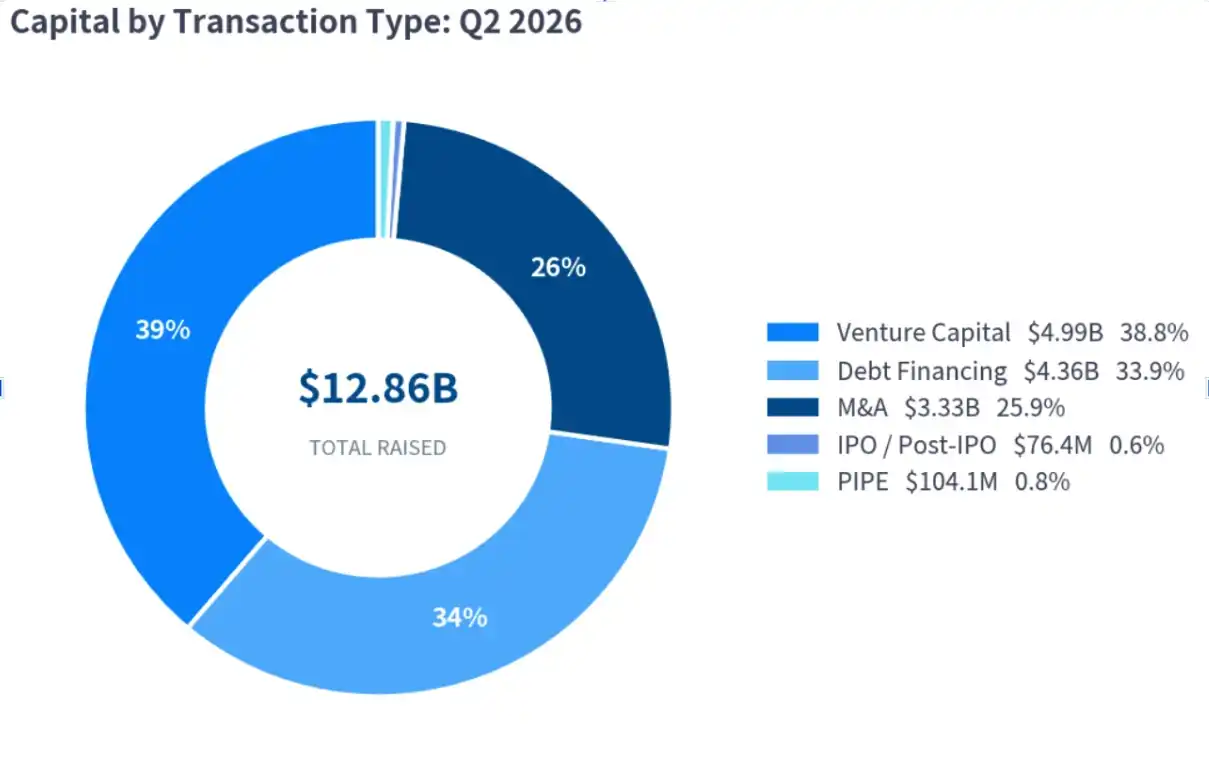
Crunchbase data cited in the piece shows global VC investment reached $510 billion in the first half of 2026. OpenAI and Anthropic together took in more than 40% of that total. Over the same period, the entire crypto sector accounted for less than 5% of that number.
As the article puts it, the people writing the code are leaving, and the money paying them is changing direction too.

Security risks are not fading
That shift is happening while crypto security problems remain severe.
The article points to a July 30 firmware vulnerability in hardware wallet maker Coldcard. It says 1,196 wallets were drained in 41 minutes, with losses topping 1,082 BTC, or about $70 million. The bug had been sitting in the code for more than five years without being found.
After the incident, a developer on Reddit reportedly fed Coldcard’s open-source code into Claude Code with a simple prompt to check for vulnerabilities. Eight minutes later, Claude identified the issue.
Dragonfly managing partner Haseeb Qureshi then said on social media that about “$2 of AI compute” could have prevented the attack.
The question left hanging
Placed side by side, these examples lead the article to a difficult conclusion for the crypto industry.
Security threats are getting more complex. AI-driven attack methods are getting stronger. At the same time, many of the people who define security boundaries, review foundational code, and steer protocol direction are being pulled into AI.
The article ends by suggesting that the more urgent question may not be when the next bull market arrives. In an environment where gatekeepers are leaving in batches, the harder question is what will stop the next black swan.