
MSCI has finalized a new index eligibility rule that will take effect with its November index review, putting crypto treasury companies at the center of the first wave of scrutiny. Under the new framework, listed companies that mainly derive value from holding assets rather than conducting meaningful operating activities may be classified as "non-operating companies," making them ineligible for inclusion in the MSCI Global Investable Market Indexes.
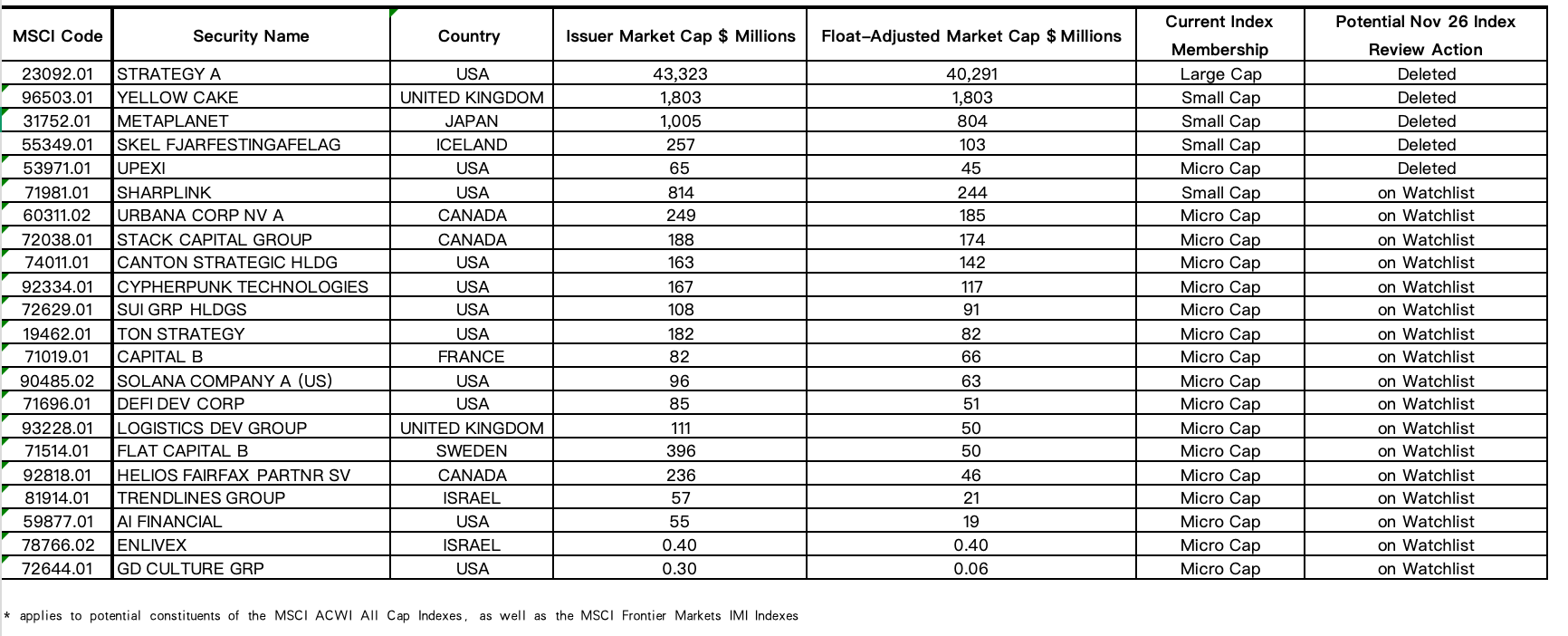
MSCI also released a list of companies that could be affected. Of the 22 names identified, 14 are directly linked to crypto assets. Strategy, Metaplanet and SOL treasury company Upexi were marked for potential deletion, while another 11 companies including SharpLink and Solana Company were placed on a watch list. Based on free-float market capitalization figures in MSCI's table, the 14 crypto-linked companies represent about $42.016 billion, or 94.5% of the aggregate free-float market value of all 22 potentially affected firms.
How the new rule works
MSCI's process starts with a review of whether a company holds a sufficient level of operating assets. If it fails that first test, it then faces a second screen based on five financial indicators, including operating expenses, operating cash flow, fair-value changes and reliance on external financing. A company that triggers four or more of those checks may lose index eligibility.
For companies already in MSCI indexes, removal is not automatic after a single review. MSCI requires that the company fail the screen in both of its two most recent annual reporting periods before deletion can occur. That is why the current list is only provisional. MSCI is scheduled to publish the final list on Nov. 11, and the new rule will become effective after the close on Nov. 30.
The issue now goes beyond whether a listed company holds too much crypto. The underlying question is broader: if a company's main activity becomes raising capital and buying tokens, should it still be treated as an operating company?
Which crypto companies were named
Among the five companies proposed for deletion, three are digital asset treasury firms:
- Bitcoin treasury company Strategy
- Bitcoin treasury company Metaplanet
- SOL treasury company Upexi
The other two are UK uranium investment company Yellow Cake and Icelandic investment holding company SKEL, indicating that the rule is not framed solely around crypto assets.
Another 11 crypto-related companies were added to the watch list:
- ETH treasury company SharpLink
- CC (Canton) treasury company Canton Strategic Holdings
- ZEC treasury company Cypherpunk Technologies
- SUI treasury company SUI Group
- TON treasury company TON Strategy
- BTC treasury company Capital B
- SOL treasury company Solana Company
- SOL treasury company DeFi Development
- WLFI treasury company AI Financial
- RAIN treasury company Enlivex
- GD Culture, which holds BTC and previously said it would allocate to TRUMP
According to the MSCI table data cited in the source report, the 14 crypto-linked firms have a combined free-float market capitalization of about $42.016 billion. Strategy alone accounts for about $40.291 billion, or 95.9% of the crypto group total. Most of the remaining companies are still thinly traded micro-cap stocks.
From a crypto-specific rule to an asset-neutral test
This is not MSCI's first attempt to address digital asset treasury companies. In October 2025, MSCI proposed a much more direct standard: if digital assets accounted for 50% or more of a company's total assets, the company would be treated as a digital asset treasury company. Those securities were not immediately deleted, but increases in shares outstanding, foreign inclusion factors and domestic inclusion factors were frozen, while new index eligibility and size-segment migrations were delayed.
That standard quickly ran into a problem. The debate was straightforward: why should a company holding large amounts of Bitcoin be treated like an investment fund, while a company holding large amounts of gold, uranium, securities or other non-operating assets could remain in mainstream equity indexes?
In January 2026, MSCI decided not to implement the proposed deletion approach for digital asset treasury companies and instead broadened the review to all listed companies primarily engaged in investment rather than operations. The new proposal released in August no longer singled out Bitcoin or other tokens. Instead, it evaluated a company's assets, cash flow and financing structure to determine whether it was actually running a business or mainly accumulating assets.
That is why this is not a standard quarterly rebalance. Regular index reviews usually deal with market capitalization, liquidity, free-float levels and size-segment changes. This rule addresses a prior threshold question: whether the issuer should qualify as an operating company at all. Even if a stock continues to trade and still meets size and liquidity requirements, it may no longer be included as a conventional operating business if its financial structure increasingly resembles an investment vehicle.
The August simulation list contained only three proposed deletions and three watch-list names. The latest document has expanded that to five proposed deletions and 17 watch-list companies. The crypto treasury universe captured by the screen has also widened from a handful of cases such as Strategy, Metaplanet and SharpLink to firms tied to BTC, ETH, SOL, SUI and ZEC.
If companies are removed, the first selling pressure would hit the stock
If Strategy is ultimately deleted from relevant MSCI indexes, the immediate effect would be in the equity market. Passive funds that track those indexes would need to sell Strategy shares and reallocate capital into other constituents. The company's Bitcoin holdings would not automatically be sold because of an index change.
Estimates of potential selling pressure differ sharply. JPMorgan previously estimated that a Strategy deletion from relevant MSCI indexes could imply about $2.8 billion in passive outflows. Strategy's own calculation said funds tracking the MSCI GIMI hold about 13 million shares, equal to roughly 3.1% of its basic share count and about 60% of its 30-day average trading volume. The first figure emphasizes concentrated selling pressure; the second points to the market's ability to absorb those shares. Neither can be treated as a direct measure of final losses.
By Strategy's own accounting, index-related holdings are less than one full trading day's turnover. For the micro-cap companies on the list, the issue may be more acute. Their ordinary daily trading volumes are smaller, so index money, even in limited size, can represent a larger share of marginal demand. Being placed on a watch list may also prompt investors to adjust valuation assumptions and positions ahead of any final decision.
An index adjustment would not directly force these treasury companies to sell BTC, ETH or SOL, but it could weaken their ability to keep buying. Digital asset treasury firms often issue stock or debt when their equity trades above the net asset value of the assets they hold, then use the proceeds to buy more tokens. If index-related selling pushes down the share price and compresses the valuation premium, financing costs may rise and the scale of future token purchases may shrink. For the crypto market, the more relevant risk is a reduction in future incremental demand rather than immediate forced selling.
MSCI and Strategy disagree on the definition of an operating company
During MSCI's consultation process, Strategy publicly opposed the line being drawn. The company argued that "operating" and "non-operating" are not established categories under U.S. accounting standards, International Financial Reporting Standards or existing legal frameworks, and that its Bitcoin business already appears as an operating segment in its financial statements. In Strategy's view, MSCI has simply rewritten its earlier digital asset treasury rule in different language.
MSCI's stated rationale is that global equity indexes already exclude ETFs, investment funds, business development companies and other passive investment vehicles. The new financial indicators are meant to identify issuers that still take the legal form of a listed company but have economic characteristics that increasingly resemble an investment vehicle.
The inclusion of Yellow Cake on the list shows that the rule is not directed exclusively at digital assets. Still, of the 22 potentially affected companies, 14 are directly tied to crypto and they account for more than 90% of the free-float market value. The framework is asset-neutral on paper, but the practical pressure falls mainly on crypto treasury companies.
For that reason, the final list due on Nov. 11 will be more than a routine constituent update. Whether Strategy and Upexi are removed, and whether companies such as SharpLink and Solana Company remain on the watch list, will show where MSCI intends to draw the line between an operating company and an investment vehicle.