
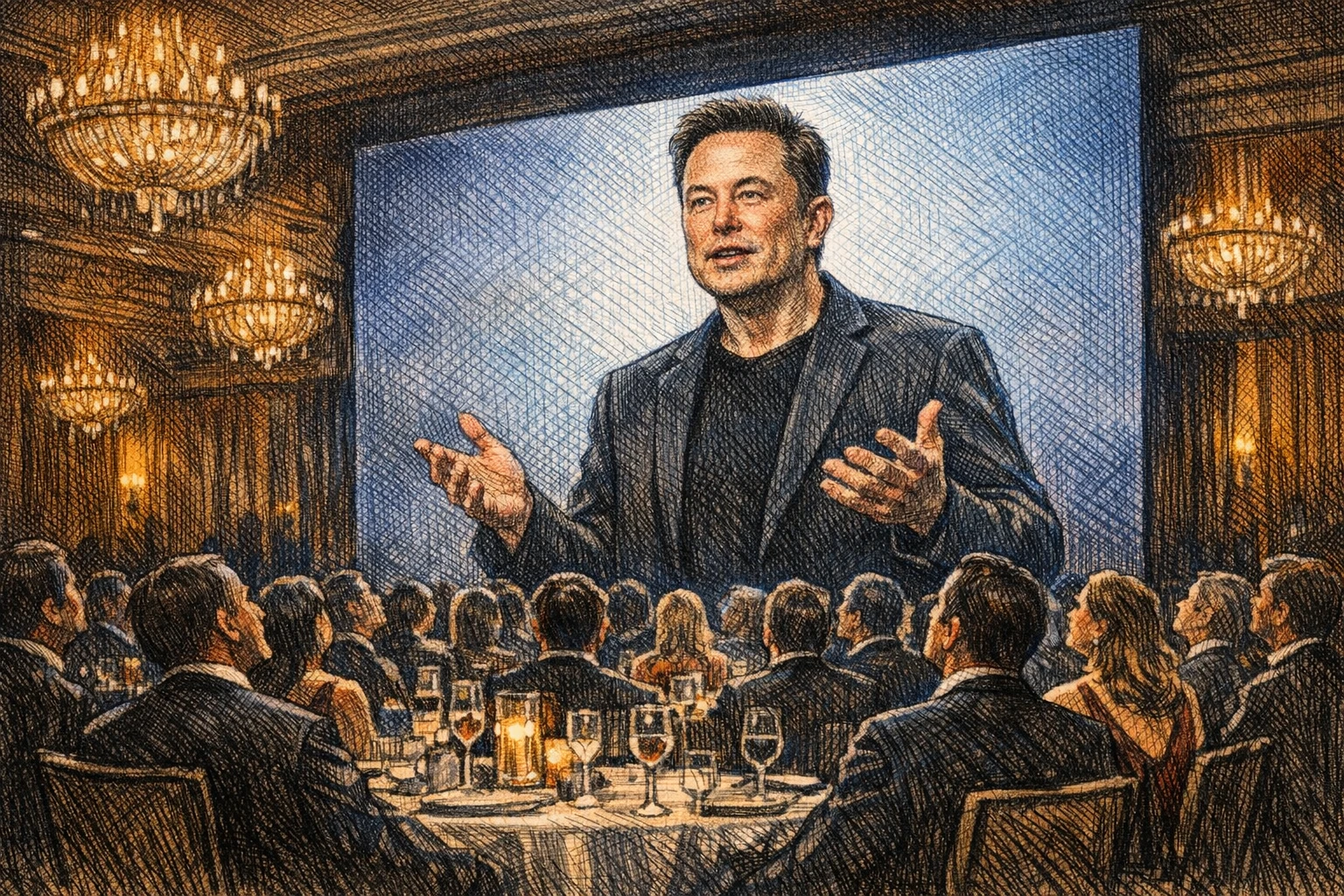
Elon Musk said during a video appearance at a Forbes event that the world could see at least 100 million humanoid robots within five years, and possibly as many as 1 billion. He also said digital intelligence would exceed the combined intelligence of all humans, while the global economy could double in 5 to 6 years.
The remarks were delivered at the May 2026 “Innovator 250” celebration hosted by Forbes at Hotel Nia in Silicon Valley. Forbes used the event to introduce its first “250 Greatest American Innovators” list, where Musk ranked first. He did not attend in person and appeared remotely on a large screen instead. The venue featured fighting robots on stage and a prototype flying taxi nearby, but Musk’s forecast quickly became the center of attention.
A forecast with a tenfold gap
The range in Musk’s estimate drew immediate notice. 100 million and 1 billion are separated by a factor of 10, making the projection unusually broad. According to the source material, his comment even prompted awkward laughter from the audience at the event.
“At least 100 million humanoid robots in five years, but maybe a billion.”
This was not the first time Musk had made a similar case. The article says he raised comparable ideas in January during a conversation at the World Economic Forum in Davos with BlackRock CEO Larry Fink, where he spoke about robots eventually outnumbering humans and AI surpassing total human intelligence by 2030 or 2031.
Old abundance forecasts still echo in the debate
The report also pointed to a much older prediction. In 1930, economist John Maynard Keynes wrote that technological progress could reduce the workweek to 15 hours by 2030 and open an era of broad economic abundance. With 2030 now close, that outcome has not materialized. The comparison highlights a basic tension: technological progress does not automatically mean less work or evenly shared gains.
Musk, according to the article, has also said the road to abundance could involve a painful transition lasting 3 to 7 years. The same report listed Tesla’s own Optimus targets as follows: external sales starting by the end of 2027, annual production capacity reaching 1 million units in 2030, and Musk’s broader global robot estimate of 100 million to 1 billion by 2031.