
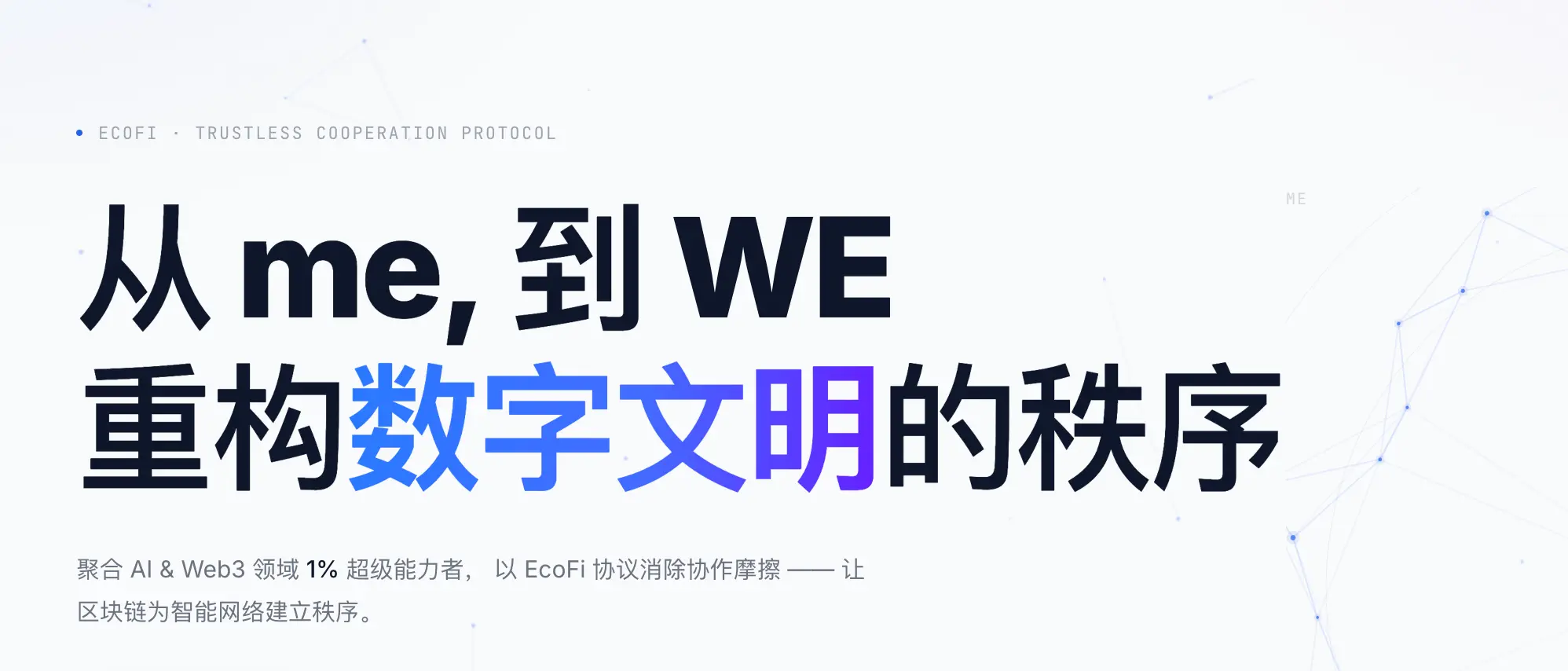
ChainCatcher published a long-form article arguing that the next phase of AI and Web3 will be defined less by raw productivity gains and more by a rewrite of economic relationships. As AI agents expand their role in digital work, the article says, more tasks are likely to be handled not by a single individual but by combinations of humans, AI agents, and multi-agent networks. That shift raises a basic problem: when unfamiliar humans and AI agents collaborate over time, how can they build trust, assess complex contributions, and share value in a way that remains stable and fair?
The article says Web3 spent the last several years building around identity, assets, organizations, and infrastructure, giving the digital economy a trust-minimized base. In an AI agent era, though, ownership and transaction rails alone do not solve the needs of a dense collaboration network. What future intelligent networks need, the piece argues, is a broader order built around identity, credit, coordination, and economic incentives.
Against that backdrop, the article places m&WDAO’s EcoFi concept in a different bucket from projects focused mainly on model capability, compute, data markets, or AI service exchange. EcoFi is presented as an attempt to start deeper in the stack, linking human cognitive assets, AI agent execution, and on-chain economic mechanisms into what the piece calls a new order model for a human-machine collaborative economy. In that framing, examining m&W is not just about comparing one project with another. It is also about reading where infrastructure for the AI and Web3 era may be heading, especially in how credit is formed, how collaboration is organized, and how value is captured over time.
Where existing approaches contribute, and where they stop
To explain that positioning, the article reviews several established lines of experimentation in the sector. Each, it says, solves a different part of the intelligent network puzzle: some focus on organizational coordination, some on AI capability exchange, and others on identity verification.
Colony: contribution-based coordination and governance
Colony is described as an early Web3 example of on-chain collaboration design. Its central idea is that power inside an organization should come from ongoing contribution rather than simple capital ownership. Through a Reputation mechanism, member contributions become an input for governance influence and resource allocation. The article says that breaks from the older model in which capital and formal position decide power, and it links that idea to m&W’s own interest in turning contribution credit into an asset-like layer.
The boundary is different, though. Colony is framed as a system for helping human organizations run more efficiently on-chain through smart contracts, contribution evaluation, and governance rules that lower collaboration costs. Once AI agents become meaningful participants in the digital economy, the article says, new questions appear that go beyond a traditional DAO governance frame: how to evaluate an AI agent’s long-term behavior, how to judge the unstructured value it creates, and how to give that agent a trusted identity and persistent credit standing inside an organization.
m&W’s answer, as presented in the article, is to use an SBT-based credit system, AI-assisted verification, and an EcoFi protocol so that contribution credit is not just an internal governance tool. It becomes a credit foundation for a broader human-machine collaboration economy. The piece reduces the contrast to a simple split: Colony explores how humans collaborate around contribution, while m&W tries to explore how humans and AI agents collaborate around credit.
SingularityNET (ASI Alliance): open exchange for AI capabilities
SingularityNET is described as a long-running representative in Web3 AI. Its direction is to build an open AI service ecosystem where different AI models, services, and agents can be discovered, called, and combined in a decentralized network. The article treats this as an effort to solve fragmentation in AI capability, letting intelligence move more openly, closer to the way digital assets move.
From the perspective of a future agent economy, the article says SingularityNET and m&W overlap to a degree because both are interested in cooperation among AI agents and between AI and humans. Their main questions differ. SingularityNET is focused on how intelligence can be discovered, called, and exchanged. m&W is focused on what happens when many agents take part in complex economic activity and need durable credit relationships.
The article lists the harder issues in that setting: whether an agent is worth working with over time, whether it has created value consistently, whether its creator has credible standing, and how responsibility and value should be divided when multiple agents complete a complex task together. m&W’s path, as described in the piece, starts with screening high-quality Builders in its 1.0 phase, turning their sustained contributions into SBT credit assets, and then mapping those into agent-like digital counterparts with a credit base. In that logic, long-term human contribution becomes an important source of trust when AI agents enter the economic network.
That leads the article to present the two systems as complementary but distinct. SingularityNET is closer to an AI capability exchange network, while m&W is trying to build a credit-based human-agent collaboration network.
Gitcoin Passport and Verax: identity authenticity and credential infrastructure
The article then turns to Gitcoin Passport and Verax as useful reference points for m&W 1.0, especially in credit screening and identity construction. Gitcoin Passport is described as combining Web2 identity data, Web3 behavior records, and third-party credentials to generate a Sybil Resistance Score. That score helps ecosystems identify real participants and reduce the impact of bots and fake accounts on public resource allocation.
In the article’s reading, Gitcoin Passport solves a basic digital-world question: whether a participant is real. That matters in decentralized systems, but the piece argues that once AI agents enter production networks, proving identity authenticity alone is no longer enough. A future collaboration network has to answer not only who a participant is, but also what value that participant can create.
Gitcoin, in this comparison, leans toward trusted proofs built from identity and historical behavior. m&W is described as focusing on dynamic productivity credit formed through sustained contribution. The article notes that Gitcoin is exploring more advanced identity technologies such as zero-knowledge proofs and third-party credentials, but says its main objective remains identity authenticity and participation eligibility. m&W, by contrast, is presented as trying to connect identity, credit, collaboration, and incentives so that credit can take part in value creation and resource distribution, not just identity proof.
Farcaster and Lens Protocol: open identity and information networks
Farcaster and Lens Protocol are used as examples of Web3 social and open identity networks. Through open identity systems, user relationship graphs, and content distribution mechanisms, the article says, they create new information infrastructure for digital society. Their value lies in addressing older internet problems in which identity is locked by platforms and user relationships are hard to move, giving individuals more control over digital identity and social ties.
Still, the article draws a line between information connection and value coordination. Farcaster and Lens are mainly about information flow and relationship building between people. A future AI agent economy, it argues, also has to solve how different intelligent actors form trusted working relationships, how cognition and productivity are recorded over time, and how information networks evolve into value networks.
m&W 1.0, the piece says, also pays attention to cognitive networks and high-quality content ecosystems. But its end goal is not a pure information distribution platform. Instead, it wants to use high-quality topics, professional contributions, and peer review to screen high-value nodes, then turn content and cognition into verifiable SBT credit assets. In that sense, Farcaster and Lens are described as open information networks, while m&W is exploring a path from information connection to value collaboration.
A three-step path from credit to intelligent order
After laying out those boundaries, the article describes m&W as an attempt to connect several layers that remain relatively fragmented today: human credit, collaboration mechanisms, and the AI agent economy. Its core logic is summarized as a progression from credit anchoring to collaboration economy to intelligent order. The three stages are presented not as isolated products but as a recursive credit system that evolves over time:
- m&W 1.0: credit anchoring, built around a high-purity Builder network
- Core driver: proton collision / SBT generation
- m&W 2.0: collaboration economy, built around an EcoFi protocol value loop
- Core driver: AI qualitative assessment / instant settlement
- m&W 3.0: intelligent order, built around a human-machine sovereign collaborative ecosystem
m&W 1.0: screening high-quality nodes and depositing credit up front
The article says any intelligent network needs trusted participants as its starting point. For that reason, m&W 1.0 does not use a standard Web3 growth playbook that prioritizes user count. It focuses instead on node quality and contribution density. Through what it calls a “proton collision” screening mechanism, Builders are expected to contribute around difficult topics through cognitive output, technical work, solution design, and peer review.
The purpose is larger than simple user filtering. At an early stage, the article says, this process is meant to build a high-quality contribution verification mechanism and establish community consensus for later AI and Web3 integration. The unstructured value created during ongoing collaboration is then meant to settle into non-transferable SBT credit assets. The difference from a traditional identity system is clear in the article’s framing: the key question is not only who someone is, but what value that person has created through long-term collaboration.
That credit deposit is then positioned as a trusted source for future Builder-linked AI agent participation in economic activity. In the article’s argument, it addresses the problem of how unfamiliar agents might earn durable trust.
m&W 2.0: an EcoFi protocol and a closed collaboration loop
If 1.0 solves the source of credit, the article says 2.0 tackles how credit assets are turned into productive capacity. Through an EcoFi protocol, m&W wants to connect high-quality credit nodes with real collaborative tasks so that contribution can be verified, priced, and translated into economic return.
The article spends time on the difficulty here. A large share of high-value work cannot be measured with simple metrics, especially strategy planning, investment research, protocol architecture design, complex code optimization, and business model design. These contributions are deeply unstructured. To handle that, the article describes a layered verification system:
- AI handles front-end task breakdown, information organization, and structured analysis.
- High-credit Builder nodes handle complex value judgment.
- If disputes arise, an OG arbitration network under m&WDAO handles final governance.
The article says this is not a system that depends entirely on AI, nor one that falls back to old centralized review. It is described as an attempt to match AI efficiency with higher-order human judgment. Each completed task, dispute resolution event, and governance action feeds back into the credit system, which allows the network to keep adjusting. The intended result is a loop of credit accumulation, more collaboration opportunities, value creation, and stronger credit. The piece treats that loop as the compounding mechanism at the center of EcoFi.
m&W 3.0: from human credit to an agentized economy
Once a credit system and collaboration network mature, the article says, m&W’s path extends into the AI agent economy. In that future, AI agents are not just tools. They can also become active economic participants. The central obstacle is trust: a new agent with no history is difficult for unfamiliar counterparties to trust over the long term.
m&W’s answer is to let long-term human contribution serve as a key source of credit when agents enter the network. According to the article, the SBT graph built from Builder credit can support the development of digital agent counterparts, giving AI agents a credit base tied to origin, background, and behavioral continuity rather than leaving them as isolated algorithmic entities.
The broader result, in the article’s framing, is a shift away from one-way human use of AI toward a human-machine collaborative economy in which both sides take part in production, coordination, and value creation.
Three execution challenges from theory to implementation
The article does not present this as an easy build. It says any infrastructure-scale innovation has to deal with the gap between theory and reality, and that m&W has chosen a high-complexity path. Its long-term value therefore depends not only on design logic but also on engineering execution and risk control.
Cold-start friction from high-quality node selection
The first challenge is growth at the start. Because m&W 1.0 uses a high-threshold admission model, the article says its early expansion may be slower than that of social platforms or identity tools. Compared with Gitcoin Passport, which can scale through identity credentials, or Farcaster, which can build network effects through content distribution, m&W puts more weight on node quality and depth of contribution.
The cost is slower early scale. The trade-off, as the article presents it, is substituting purity for blind volume. If high-quality Builders can generate deep collaboration through the EcoFi protocol, overall network value may come more from per-node creativity and high-ticket transaction flow than from simple traffic size.
Balancing AI verification with human governance
AI-assisted verification is described as a key part of m&W 2.0, but also as one of its biggest technical challenges. Complex value judgment cannot be fully delegated to algorithms. If AI misjudges a task or output, the article says, the result may be incorrect resource allocation and damage to the network’s credit system.
For that reason, m&W is described as using a layered governance model that combines AI and human experts. AI provides front-end efficiency, high-credit nodes provide complex judgment, and an OG arbitration network handles disputes. The article adds that this arbitration design includes an SBT reputation dynamic game decay mechanism and asymmetric anonymity design, all aimed at finding a moving balance between automation efficiency and final human judgment.
Long-term stability in the token economy
The article also points to token design as a major challenge. It describes $CMW as the ecosystem’s core asset, carrying several roles at once: collaboration incentives, value settlement, ecosystem governance, and a value medium for the future agent economy. That multi-role design opens more room conceptually, but it also raises the complexity of the economic model.
The article argues that a sustainable token economy has to rest on real demand and real business flow. To reach that point, m&W would need dynamic risk control, an efficiency dividend buyback mechanism, and support from real collaboration volume in the 2.0 stage so that the token model can move toward a positive and stable closed loop.
The broader claim: new order for identity, credit, collaboration, and distribution
In its closing section, the article returns to the larger comparison. Gitcoin is framed as strong at proving whether a participant is real. Colony is framed as strong at turning contribution into governance power. SingularityNET (ASI) is framed as exploring how AI capability can be exchanged through an open network. m&W, by contrast, is presented as asking a lower-level question: once humans and AI agents both become productive actors in the future digital economy, how should a new credit system, collaboration mechanism, and economic order be built?
The piece says this is not simply an AI app, nor a copy of an existing DAO model. It is described instead as an attempt to explore new production relations for the AI era. If AI agents become important participants in the digital economy, the article argues, infrastructure built around identity, credit, collaboration, and value distribution will be indispensable.
In that positioning, m&W is not trying to become another model platform, algorithm marketplace, or agent service tool inside the AI ecosystem. The aim, according to the article, is to connect long-term human contribution credit, AI agent collaboration capacity in digital counterpart form, on-chain constraint mechanisms, and economic incentives into a more reliable base for coordination rules and economic order in human-machine networks.
The article ends by saying m&W hopes to keep extending the role of EcoFi on top of its own practice, helping the AI and Web3 ecosystems form a more open, trusted, and sustainable intelligent network relationship, with blockchain used to establish order for that network.