
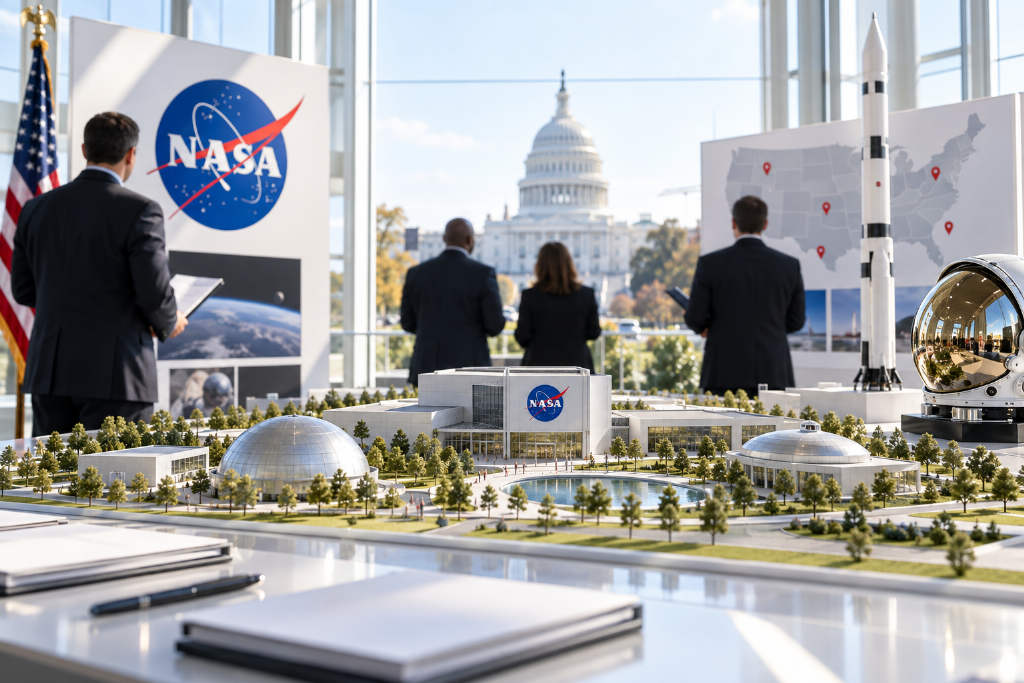
NASA has launched the site-selection process for the first U.S. Space Academy, asking states to compete for the right to host the new institution. Under the current schedule, the first 300 students could move into a temporary campus in 2028, with a permanent campus planned for 2031.
Commission begins work after Trump executive order
NASA announced the plan in an official news release on Sept. 10. The initiative traces back to an executive order signed by Donald Trump on Aug. 28 at Johnson Space Center in Houston. A presidential commission led by NASA Administrator Jared Isaacman has now started formal work on the project.
Isaacman chaired the commission’s first meeting on Sept. 9 at NASA headquarters in Washington alongside Deputy Administrator Anderson. Representatives from multiple government bodies attended to discuss the governance structure, curriculum planning, service requirements, partnerships, and implementation. The group included the U.S. Secretary of War, the director of the National Economic Council, the Secretary of the Air Force, and representatives from the White House Office of Science and Technology Policy, the White House Office of Management and Budget, and the National Security Council.
After the meeting, Isaacman said, 「Our first commission meeting made clear how much talent and determination stand behind President Trump’s vision for the U.S. Space Academy.」
NASA requests proposals from states
NASA followed the meeting by issuing a request for information, or RFI, inviting governors or their designated representatives to submit bids to host the academy. Anderson said the location decision would be critical to the institution’s success and that states would need to present their strongest plans. He said proposals should show that their infrastructure, partners, and community support can compete with the top alternatives available to elite students and match the ambitions of future space leaders.
According to the RFI, state responses must be submitted by 6 p.m. Eastern Time on Oct. 26. Each state is limited to one proposal, filed through a representative designated by the governor. The submission must cover the proposed location, site readiness, environmental and regulatory considerations, and the surrounding industry ecosystem.
Tight construction and opening timeline
The schedule laid out by NASA is compressed. Construction must begin no later than 2027. The first cohort of 300 students would be received at a temporary site in 2028, and the permanent campus would open in 2031.
White House says existing pipeline is insufficient, critics question need for a new academy
According to a White House background document, the commission was created because space competition is intensifying and current U.S. talent-development channels are not enough to support long-term space goals. The White House said graduates would go on to serve in the U.S. Space Force, NASA, and the private space industry.
The White House also said Artemis II completed the first crewed lunar flyby in nearly half a century in April 2026, and set a goal of carrying out more than 1,000 launch and reentry missions annually by 2030.
The commission has 120 days from the Aug. 28 executive order to submit recommendations to Trump, which puts the deadline at the end of December.
Questions remain. Critics have noted that the U.S. Air Force Academy has long trained officers for the Space Force, while multiple universities already run aerospace-related programs. On top of that, the academy would still need congressional legislation and appropriations before it can be formally established, leaving the timetable uncertain.