

U.S. stocks went through an unusually volatile session on the last full trading day before Thanksgiving. The Nasdaq 100 fell nearly 5% within 15 minutes of the open, putting the index 20% below its Oct. 6 record high and briefly touching the technical bear-market threshold. The Dow Jones Industrial Average plunged more than 1,100 points at one stage, while the S&P 500 was down more than 3%.

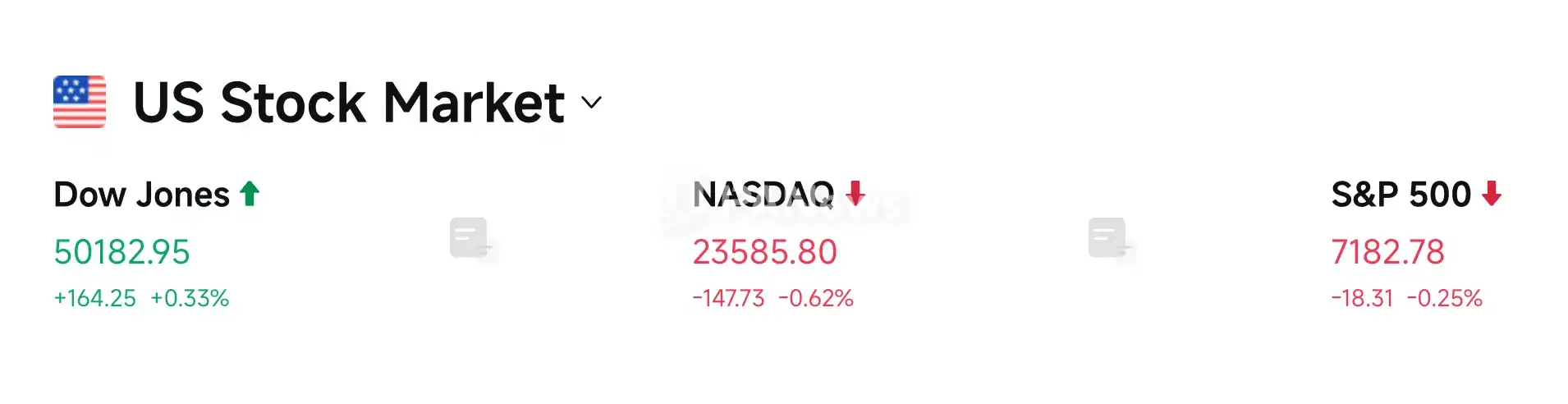
The move reversed after the dollar suddenly came under selling pressure. U.S. stocks, gold and Bitcoin all moved away from their session lows. The Dow finished up 0.33%, recovering its 1,100-point decline. The S&P 500 fell 0.25%, and the Nasdaq Composite lost 0.62%. The session marked the largest intraday rebound in U.S. equities since April 2025.
There was no single market explanation for the reversal. Volatility in the dollar-yen exchange rate was cited as a possible trigger, potentially linked to speculation that Japan could intervene in the foreign-exchange market. Short covering after the Nasdaq 100 reached the bear-market line may also have amplified the rebound. Michael Burry, known as the “Big Short” investor, said on social media that he had closed his Nasdaq 100 put options, moved to an almost fully long position and planned to short Nvidia again if the shares approached $200. The Federal Communications Commission’s approval of SpaceX’s space data-center project was also treated by some trading desks as a possible catalyst, although the report said the explanation remained unconfirmed.
Historical bear-market signals
Bloomberg data shows that the Nasdaq 100 has gone through six complete bear markets since 2000, split evenly between recessionary and non-recessionary periods. In non-recessionary bear markets, the median decline was 23% and the average duration was 80 trading days. Once the index had fallen 20% in those episodes, 92% of the eventual decline had already taken place. The median 12-month return after a bear market was confirmed was 43.1%.
BTIG analyst Jonathan Krinsky warned that the historical pattern remains mixed. The Nasdaq 100 has recorded 12 instances of a one-day decline of at least 5% followed by a gain of at least 5% the next day. In 11 of those cases, the index fell over the following three trading days, and all 12 produced another pullback within 30 trading days.
Inflation keeps the high-rate debate alive
October personal consumption expenditures data strengthened expectations for a hawkish Federal Reserve. Headline PCE inflation rose 3.8% year over year, while core PCE inflation rose 3.3%, the highest reading since November 2023. Third-quarter U.S. GDP growth was revised sharply higher, from an initial annualized estimate of 3.4% to 4.3%.
The Federal Reserve’s latest Beige Book said economic activity grew slightly to moderately in eight of its 12 districts. Consumer spending was broadly flat, households had become more sensitive to prices, and residential activity weakened. Wage and benefit growth accelerated somewhat, while cost pressures remained. The data reinforced market pricing for high interest rates in December and potentially for a longer period.
Fed Chair Waller faces a difficult choice between continuing to raise rates to uphold the inflation fight and allowing a stock-market decline to deliver part of the tightening. The Trump administration is considering tariffs on more than 10 major trading partners. Greg Daco, chief economist at EY, warned that a new tariff shock could force the Fed to keep rates high for longer or raise them earlier.
The 10-year Treasury yield nevertheless fell 6.8 basis points to 4.862%, extending its decline to an eighth straight trading session, the longest such losing streak since 2024. The dollar index dropped 0.5% from its intraday high and finished down 0.14%.
Spot gold fell below $3,500 and reached a session low of $3,426 before rising more than $160. It finished up 0.92% at $3,588.41 an ounce. Spot silver fell 6% at one point but ended 1.15% higher. Ray Dalio, founder of Bridgewater Associates, repeated his view that investors should keep a 10% to 15% gold allocation in their portfolios regardless of market conditions, as a hedge against large debt burdens and potentially worsening geopolitical and capital conflicts.
Oil moved independently of the macro backdrop as geopolitical supply risks lifted prices. West Texas Intermediate rose 2.5% to $84.13 a barrel, while Brent gained 3.51%. Yemen’s Houthi movement claimed that it had carried out precision strikes on Saudi Arabia’s largest refinery, Ras Tanura, and on Jizan port. Ras Tanura has capacity of 550,000 barrels a day. The risk of attacks on tankers in the Strait of Hormuz was described as being at a record high, adding a large premium to an already tight global supply picture.
AI credit stress moves to the foreground
Credit-market volatility was more pronounced than the equity rebound. Before Thanksgiving, concern increased over AI companies using debt to fund expansion, exposing what the report described as a credit crack in the AI trade.
CoreWeave’s five-year credit default swap spread jumped 2.09 percentage points in one day to 15.34 percentage points, its largest daily increase on record. The level implied a default probability above 70%. A CDS acts like insurance on corporate debt: the higher the quote, the more the market is charging for protection against a future failure to repay. At that quote, one year of protection on $100 of CoreWeave debt would cost about $15.34.
Five-year CDS spreads for Nvidia, Oracle, Alphabet and SpaceX also reached record highs. Goldman Sachs’s data-center CDS basket reached a record level as well. S&P Global Ratings placed Nvidia’s AA credit rating on CreditWatch with negative implications, citing a lack of board oversight and excessive reliance on individuals; a one-notch downgrade could come within 90 days. The CDX Investment Grade index, a measure of risk in U.S. investment-grade corporate debt, reached its highest intraday level since March 31. Some CoreWeave bonds approached an 18% yield and fell to about 72 cents on the dollar.
JPMorgan estimated that AI-related investment-grade bond issuance would total $368 billion this year and rise to $450 billion next year. It expects AI capital spending to reach $1.4 trillion in 2027, while growth could slow sharply in 2028 as the industry enters a more stable phase.
GPU rental prices raise capital-spending questions
Falling computing rental prices have added to doubts about the durability of AI capital spending. SemiAnalysis said SpaceX had cut rental prices for small Blackwell GPU clusters by roughly 20% to 35%. In the secondary cloud-rental market, rental indexes for the B200, H200 and Blackwell Ultra B300 had all declined from recent highs.
Ramp data showed signs that corporate token spending had stopped growing, fueling debate over whether computing supply had become excessive or whether commercial pricing was simply returning to normal. Lower GPU rents have reduced the value of collateral, prompting lenders to cut some financing advance rates from 80% to 50% and increasing pressure on mid-sized computing-rental companies.
Goldman Sachs said the medium-term risk was not limited to the pace of data-center construction. Faster gains in inference efficiency could also reduce demand for computing capacity per unit of work. Hedge funds were reducing AI exposure and leaving capital-intensive hardware supply chains for traditional defensive sectors such as materials, energy and real estate, where cash flow is stronger and less cyclical.
AI risk has expanded beyond stock valuation to financing costs, collateral values and corporate debt-servicing capacity. Joseph Zidle, chief market strategist at Cresset Capital, said credit investors were the real lifeline of the AI trade and had become extremely nervous. Christian Mueller-Glissmann, head of asset-allocation research at Goldman Sachs, said it was not time to buy the dip. He said the market needed to see AI capital spending translated into actual profits and that positioning had not yet been reduced to levels normally associated with a bottom.
Company and sector moves
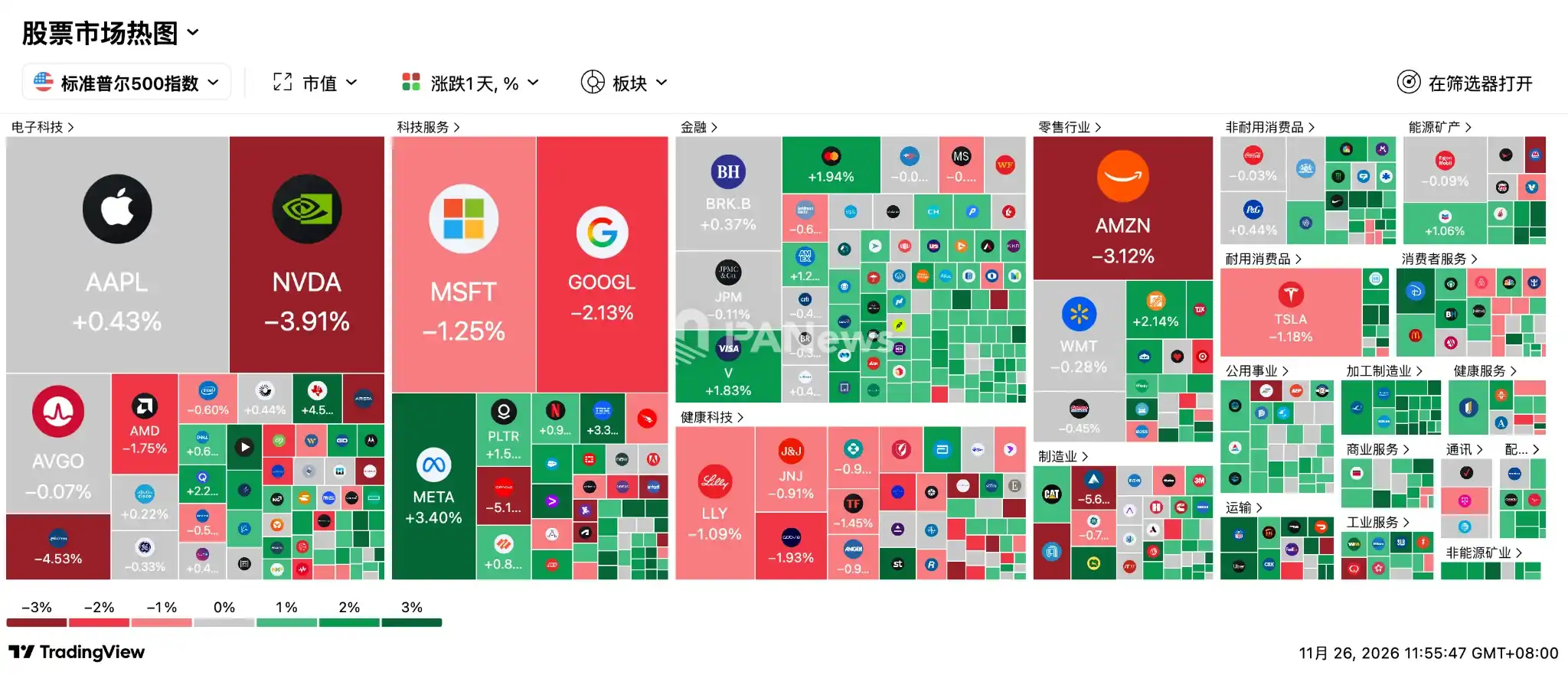
- Oracle: The stock fell 5.13%. The company remained under pressure from heavy AI borrowing. Yields on some ultra-long bonds approached 9%, and its five-year CDS spread jumped to 356 basis points, a record. The market lost confidence in the sustainability of Oracle’s large off-balance-sheet guarantees and data-center financing, sending the shares close to a three-year low.
- Ambarella: The stock plunged 19.77% after its third-quarter results and revenue and profit guidance for the current quarter all missed expectations. Morgan Stanley cut its rating, citing higher memory-chip costs that were squeezing edge-computing margins.
- HP: The stock rose 11.49% after fourth-quarter results beat expectations by a wide margin. Its ability to absorb higher memory costs and its strong cash flow made it a defensive refuge within traditional IT hardware.
- SpaceX: The stock gained 1.30% after the FCC approved a plan allowing up to 1 million satellites for a space data center. At the same time, reports said SpaceX had cut small Blackwell GPU-cluster rents by as much as 35% and was re-renting about 50,000 H200 GPUs returned by Anthropic at roughly $5 per hour. AST SpaceMobile rose more than 10%, Lockheed Martin gained more than 2%, and Rocket Lab also rose more than 2%.
- Semiconductors: The Philadelphia Semiconductor Index fell 0.65%, with 19 of its 30 constituents declining. Lam Research fell nearly 6%, Applied Materials lost 3.89%, TSMC fell 1.96%, and Advanced Micro Devices dropped 1.75%. Analog Devices rose 6.44% and Texas Instruments gained 4.55%. Analog Devices had plunged 17% the previous day after disappointing guidance, while Texas Instruments’ gain looked more like an oversold rebound than a trend reversal.
- Memory and optical communications: Micron closed down 4.53% and SanDisk fell 5.57%. Goldman Sachs warned that technology-company earnings could be peaking and that excess AI-hardware risk was eroding the premium attached to the memory cycle. HBM and DRAM, which had risen sharply earlier, faced selling at elevated levels. Seagate fell 2.10%, SK Hynix lost 0.75%, Western Digital fell 0.55%, Lumentum declined 2.16%, and Corning lost 1.60%.
Within the Magnificent Seven, Nvidia fell 3.91%. President Donald Trump and Vice President JD Vance publicly backed Jensen Huang, saying he was not under federal investigation and did not need a presidential pardon. S&P Global Ratings nevertheless placed Nvidia’s AA rating on negative watch, pointing to board independence and an executive-succession crisis. Reports from SemiAnalysis that SpaceX was sharply cutting small Blackwell-cluster rental prices, together with Nvidia’s record CDS, added to the pressure.
Meta rose 3.40%, the strongest performer among the seven. Hedge fund Third Point listed it as a top-sized position, and Meta was in talks to connect its AI agent Muse to Amazon’s marketplace. Apple edged up 0.43% despite reports that it had cut the team working on the old Siri architecture and delayed advanced AI until 2027.
Microsoft fell 1.25%. After a 24-hour service outage, the company activated a “Code Red” emergency response and required global teams to deploy key fixes within one hour. Cloud-service reliability and AI capital spending were both under review. Tesla fell 1.18% as high-valuation growth stocks came under pressure from stronger rate expectations. Alphabet fell 2.13% after its CDS reached a record high, with antitrust litigation and the premium attached to AI debt weighing on its valuation. Amazon dropped 3.14% after a U.S. federal court backed a product-safety claim brought by the U.S. Consumer Product Safety Commission. The broader technology selloff also pressured the shares, while investors began watching the Black Friday sales season and retail-promotion competition.
After-hours moves and the next data points
All three major stock-index futures rebounded after the close. Dow futures rose 0.33%, S&P futures gained 0.30%, and Nasdaq futures added 0.13%. Nvidia rose 1.38% after hours as reports that the Justice Department had not charged Jensen Huang gained attention. Memory stocks also recovered: SanDisk rose 2.49% after hours, Seagate gained 1.41%, Micron rose 1.21%, and SK Hynix added 1.02%. The report characterized the moves as technical rebounds driven mainly by pre-Thanksgiving short covering. Trading was light, so the moves did not carry a clear directional signal.
On Nov. 26, U.S. cash equity markets will close for Thanksgiving. Equity-index, Treasury, crude-oil and precious-metals futures at CME Group will close early. Holiday trading is expected to reduce global volume and liquidity, leaving derivatives more vulnerable to late-session moves and slippage.
At 07:30 on Nov. 27, Japan will release November Tokyo CPI, an early indicator for national inflation. The market will focus on whether core CPI can remain elevated. The withdrawal of energy subsidies and a weak yen have pushed up import costs. If inflation stays high, expectations for a Bank of Japan rate hike in December could strengthen, lifting the yen and potentially triggering another round of cross-asset carry-trade unwinding.
Meituan is scheduled to release its Hong Kong-listed earnings at 19:00 the same day. Investors will focus on the strength of its core local-commerce business, margin resilience, the competitive position of its in-store business and progress in reducing losses in new businesses. U.S. markets will close early at 13:00 Eastern time for Black Friday. High-frequency retail data will offer a signal on consumer resilience. With the AI narrative under pressure, a crack in consumption data would put additional pressure on the sentiment case behind U.S. economic exceptionalism.



