
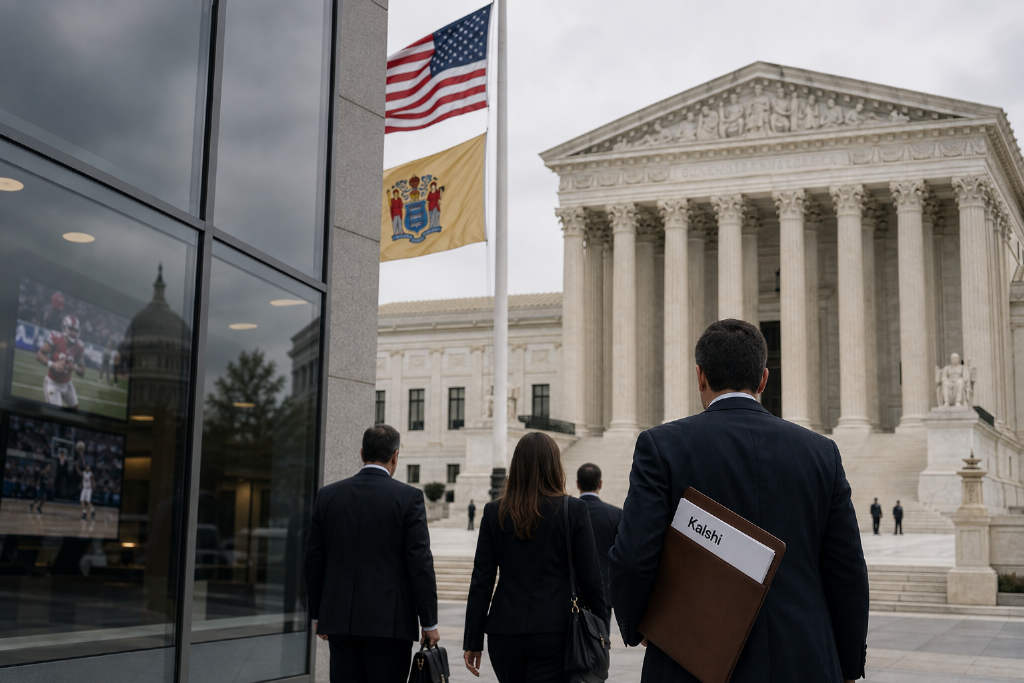
New Jersey on Sept. 2 Eastern Time formally asked the U.S. Supreme Court to review its legal fight with prediction market platform Kalshi, seeking clarity on whether a platform regulated by the U.S. Commodity Futures Trading Commission can offer contracts tied to sports outcomes across the country without complying with state gambling laws.
At the center of the dispute is a basic classification question: are these event contracts derivatives, or are they sports wagers?
In its petition, New Jersey asked the court to decide whether the 2010 Dodd-Frank Act stripped states of regulatory authority, leaving them unable to police sports betting conducted within their borders when the products are offered by a CFTC-registered market.
Kalshi says the contracts fall under federal derivatives law
Kalshi describes the products as sports event contracts and argues that they are swaps or event-based derivatives governed by the Commodity Exchange Act. Because Kalshi is a CFTC-registered designated contract market, the company argues that the trades should be regulated exclusively by the CFTC, with no room for states to impose gambling restrictions.
New Jersey takes the opposite view. The state argues that these binary contracts pay out entirely based on game winners, player performance, or other sports results, and that for ordinary users they are not meaningfully different from traditional sports betting. The state also said Congress, when it enacted Dodd-Frank after the financial crisis, did not clearly transfer long-held state authority over sports gambling regulation to the CFTC.
Third Circuit previously backed Kalshi at the injunction stage
The case stems from a cease-and-desist order issued by the New Jersey Division of Gaming Enforcement in 2025. The state said Kalshi’s sports event contracts violated New Jersey gambling law, including restrictions on betting on college sports.
Kalshi then sued in federal court to block state enforcement. In April 2026, the U.S. Court of Appeals for the Third Circuit upheld a preliminary injunction against New Jersey by a 2-1 vote. The majority said Kalshi’s sports event contracts were likely to satisfy the Commodity Exchange Act definition of swaps and that swaps traded on a CFTC-registered market generally fall within the CFTC’s exclusive jurisdiction. On that view, New Jersey law was likely preempted by federal law.
That ruling did not resolve the full merits of the dispute. The Third Circuit was addressing whether Kalshi had a reasonable chance of success at trial and whether the state could enforce its rules while the litigation was pending.
Ninth Circuit reached the opposite result in Nevada case
Days before New Jersey filed at the Supreme Court, the U.S. Court of Appeals for the Ninth Circuit issued a contrary decision in a separate case between Kalshi and Nevada regulators, widening the legal split.
On Aug. 28, the Ninth Circuit held that Kalshi had not shown that the Commodity Exchange Act preempted Nevada gambling law. The court said that, based on the structure of the statute and ordinary meaning, contracts that simply turn on the outcome of sporting events should not automatically be treated as swaps under federal law. It also said current CFTC rules place limits on event contracts involving gambling. The ruling allowed Nevada to keep taking regulatory action against Kalshi’s sports products.
New Jersey told the Supreme Court that the Third and Ninth Circuits are now in direct and difficult-to-reconcile conflict. In the state’s telling, the Third Circuit found that federal law likely displaces state regulation, while the Ninth Circuit found that states may still enforce gambling laws. New Jersey said the dispute has already drawn at least 20 states into separate litigation.
State points to age limits and problem gambling safeguards
New Jersey said licensed sports betting operators in the state must comply with a minimum age of 21, geolocation checks, financial and operational reviews, and self-exclusion and problem gambling support systems. State law also bars athletes, coaches, referees, and team-related personnel with insider information from placing bets, and restricts wagering on games involving New Jersey college teams.
According to the state, if a platform can avoid state gambling licenses, age restrictions, and consumer protection rules simply by registering as a CFTC designated contract market, that would rewrite the long-standing U.S. model of state-led gambling regulation.
The CFTC has taken the opposite position. The agency has filed court papers in multiple lawsuits this year arguing that event contracts traded on CFTC-registered markets fall within its exclusive regulatory domain and that states cannot reclassify those contracts as gambling in order to intervene in the federal derivatives market.
Supreme Court has not yet decided whether to hear the case
New Jersey has filed a petition for certiorari, and the Supreme Court must first decide whether to take the case. The court reviews a large number of petitions each week, and only selected cases move on to full briefing and oral argument. There is no hearing date or final decision timetable at this stage.
If the court takes the case and sides with New Jersey, state licensing rules, age limits, and product restrictions could again apply to sports event contracts, forcing platforms such as Kalshi to adjust services state by state. If the court sides with Kalshi, state gambling regulators could see their room to directly enforce against CFTC-registered prediction markets shrink sharply, making it easier for platforms to offer sports event contracts nationwide under a single federal license.
The dispute now before the court directly concerns sports-related event contracts. It does not mean the Supreme Court is already prepared to rule on whether all political, economic, cryptocurrency, or other prediction markets are lawful. Still, how the court defines event contracts, swaps, and gambling could have broad implications for the regulatory boundaries and business models of prediction markets in the United States.