
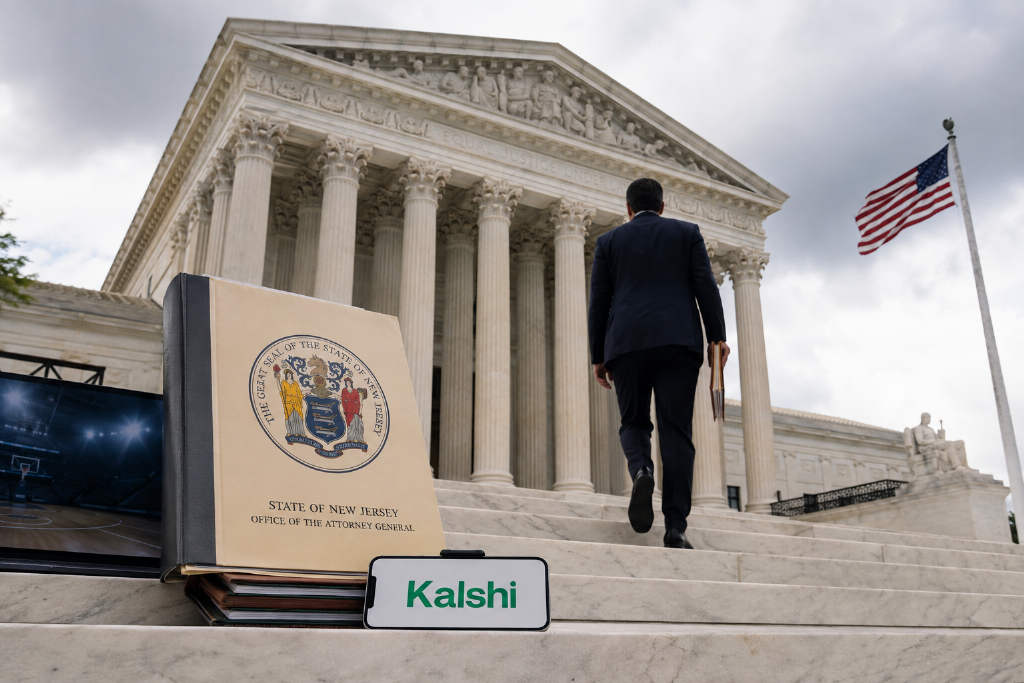
New Jersey asked the U.S. Supreme Court on Wednesday to decide whether states can still regulate sports betting conducted within their borders when the bets are offered on a federally registered exchange.
Attorney General Jennifer Davenport and Division of Gaming Enforcement interim director Mary Jo Flaherty filed a 332-page petition for a writ of certiorari. It is the first petition to reach the justices over the legality of Kalshi’s sports contracts.
The core legal question
The petition asks whether the 2010 Dodd-Frank Act preempted states from regulating sports bets placed inside their borders when those bets trade on markets registered with the Commodity Futures Trading Commission, or CFTC.
Davenport said in a statement, “Congress did not silently make the sports-betting industry immune from state law,” adding that states have long written gambling rules to address compulsive betting, minors, and insider trading on games.
Kalshi’s self-certification path
Kalshi self-certified its sports contracts with the CFTC, telling the agency that the products complied with federal law instead of seeking approval in advance.
The answer to the case could determine whether sports betting operates as a 50-state licensing business or as a single federal derivatives business. A win for Kalshi would allow one CFTC registration to override state gaming statutes across the country, cutting the cost of nationwide distribution. A win for New Jersey would force Kalshi and rivals back into state licensing, tax, and compliance systems wherever they want to take a wager.
Split rulings and expanding litigation
The litigation has already spread to at least 20 states. Dozens of suits are pending, and several state gambling laws are now enjoined by federal courts.
Two federal appeals courts have reached different answers. In April, the Third Circuit ruled 2-1 that Kalshi’s products fell under the Commodity Exchange Act, or CEA, and that the law preempted New Jersey’s gambling rules.
Last Friday, the Ninth Circuit found that the CEA likely does not preempt Nevada’s rules and denied injunctive relief sought by Kalshi and Crypto.com against the Nevada Gaming Control Board. That ruling came months after a Nevada judge extended a ban.
CFTC’s role in the broader dispute
The CFTC has also sued at least nine states over restrictions on event contracts. The agency separately ordered Kalshi not to comply with a Michigan court demand to void executed trades.