


This article was originally published by Bit.Fan. For more cryptocurrency news and market insights, visit www.bit.fan.
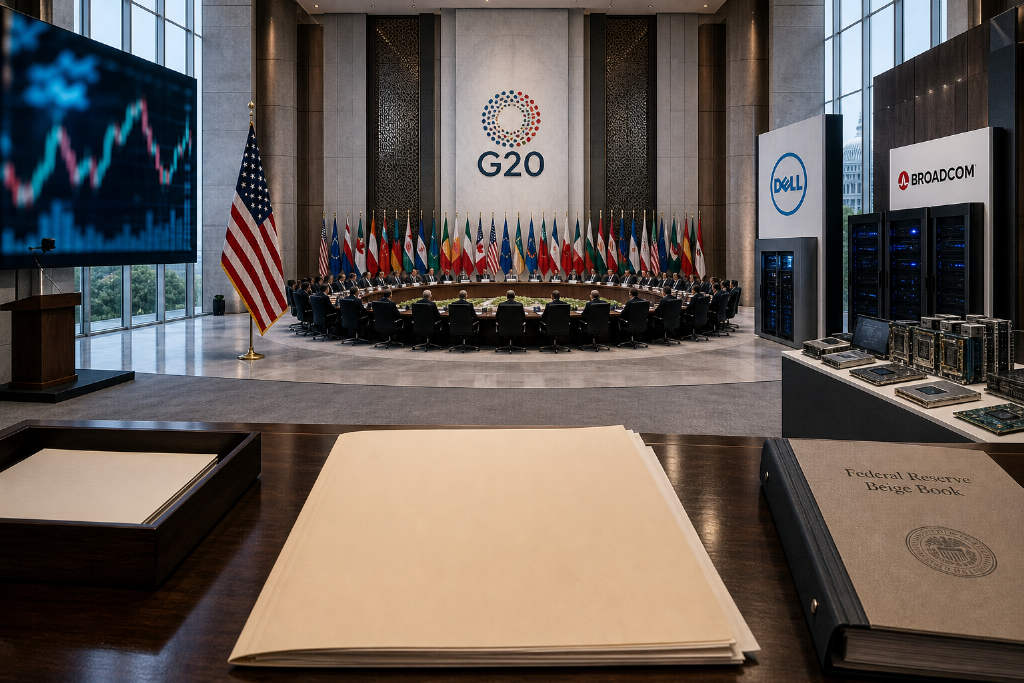
Next Week’s Macro Calendar: Nonfarm Payrolls, G20 Central Bankers, and Dell and Broadcom Earnings
N
News EditorMarkets will get a packed U.S. macro calendar next week, led by the August nonfarm payrolls report, the G20 finance ministers and central bank governors meeting, and the Federal Reserve’s Beige Book. Reuters poll data points to a 58,000 rise in payrolls, an unemployment rate held at 4.1%, and a 0.2% monthly gain in average hourly earnings.
The jobs report will land on Friday, making it the last nonfarm release before the Fed’s Sept. 16 policy meeting and a key test for expectations around a September rate hike. Current pricing shows the odds of a September move near 60%, with the probability of a hike by December above 90%.
The G20 gathering will be held Monday and Tuesday in Asheville, North Carolina, where central bankers will speak again after Jackson Hole. The Beige Book will also be released before the Fed’s next meeting.
Several other U.S. data releases are scheduled through the week, including final S&P Global manufacturing PMI, ISM manufacturing and services PMIs, ADP employment, and weekly jobless claims. The Bank of Canada will announce its rate decision on Wednesday; markets expect it to keep rates unchanged at 2.25%.
Earnings season adds another layer. Dell reports Tuesday after the U.S. close, with adjusted EPS expected at $4.91. Broadcom follows Wednesday after the close, with revenue seen at about $29.4 billion and EPS at $3.24. Their guidance will be watched for signals on demand for AI servers, custom chips, and networking gear.
Next week opens with a heavy macro calendar. The U.S. August nonfarm payrolls report arrives on Friday and will be the last jobs print before the Federal Reserve’s Sept. 16 policy meeting, making it a key test for expectations of a September rate hike.
A Reuters survey expects nonfarm payrolls to rise by 58,000 in August, with the unemployment rate holding at 4.1% and average hourly earnings up 0.2% month on month. If the labor market continues to soften, traders may reassess how urgent a September hike really is. If the data still show resilience, the case for a move could harden further. Current market pricing already puts the odds of a September hike near 60%, while the probability of one by December is above 90%.
The G20 finance ministers and central bank governors meeting is set for Monday and Tuesday in Asheville, North Carolina. It comes after Jackson Hole and gives central bank chiefs another chance to speak on inflation and monetary policy. The Fed will also release its Beige Book before the September meeting.
The week is filled out by a string of U.S. releases: final August S&P Global manufacturing PMI on Tuesday at 9:45 p.m. Beijing time, ISM manufacturing PMI at 10:00 p.m., August ADP employment on Wednesday at 8:15 p.m., weekly jobless claims on Thursday at 8:30 p.m., and August ISM services PMI at 10:00 p.m. On Wednesday at 9:45 p.m., the Bank of Canada is expected to leave its policy rate unchanged at 2.25%. Fed Governor Waller is also scheduled to be interviewed that day, while Cleveland Fed President Beth Hammack, a 2026 FOMC voter, speaks early Friday.
Earnings will add a second test for the market’s AI trade. Dell reports Tuesday after the U.S. close, with Wall Street expecting adjusted EPS of $4.91. Broadcom reports Wednesday after the close, with consensus estimates calling for revenue of about $29.4 billion and EPS of $3.24. Their results and outlook will be watched for signs of demand across AI servers, custom chips, and networking equipment.
12900
Disclaimer:
The market information, project data, and third-party content displayed on this platform are for industry information sharing only and do not constitute any form of investment advice or return commitment.
Cryptocurrency trading carries high risks. Users should fully assess their risk tolerance and make independent decisions. All profits, losses, and legal responsibilities are borne by the users themselves.