
NIGHT climbed about 100% over the past week, rising from $0.024 to $0.05, hitting a six-month high and pushing its market capitalization to roughly $800 million. The move marked a sharp rebound after the token’s 87% slide in July, when a Wanchain cross-chain bridge exploit involved about 515 million NIGHT.
Cardano founder Charles Hoskinson recently said Midnight “may be bigger than Zcash.” That comment helped push NIGHT into the privacy-coin conversation, but the source article argues that the project’s key feature is not privacy alone. Midnight splits public capital from private data handling, and NIGHT itself is not a privacy token.
What Midnight is trying to build
Midnight is a programmable-privacy Layer 1 blockchain developed by Shielded Technologies, an engineering group made up of former IOG members. It runs as a partner chain to Cardano.
The chain uses zk-SNARKs as its core technology. Developers write private smart contracts in Compact, a language built for the project, on top of the Kachina protocol.
Unlike Zcash or Monero, which are usually framed around hiding transaction information, Midnight is aimed at a narrower problem: how to protect commercial data while still fitting within regulatory requirements. Its approach is selective disclosure. In practice, that means a user can prove compliance without exposing the underlying data. The article gives one example: proving a deposit meets KYC requirements without revealing to the whole chain where that deposit came from.
Midnight’s mainnet went live in late 2025, and the NIGHT token launched in December 2025.
Three developments lined up at the same time
The latest rally was not tied to one headline alone. The article points to three developments that arrived in the same window.
On Sept. 28, Midnight said permissionless mainnet smart contract deployment was open. Before that change, developers had to pass a Preprod security review before deploying contracts on mainnet. Removing that requirement lowered the barrier to building directly on Midnight.
On Oct. 1, CTO Sebastien Guillemot shared the roadmap. Under that plan, the v8 upgrade will enable private smart contracts on mainnet, while v9 will focus on composability so private contracts can call one another. The article says Midnight will not have a full private DeFi stack until those two steps are completed.
The third catalyst came from institutional work. In March this year, UK-licensed lender Monument Bank announced a partnership with the Midnight Foundation and said it planned to tokenize up to £250 million in retail customer deposits on Midnight. Those tokenized deposits are designed to be backed 1:1 by pounds sterling, continuously interest-bearing, and protected by the UK Financial Services Compensation Scheme. The launch has been delayed to November, but the article describes it as the first case of a regulated bank tokenizing retail deposits on a public blockchain.
The NIGHT-DUST model
The article spends most of its time on Midnight’s two-layer token and resource design.
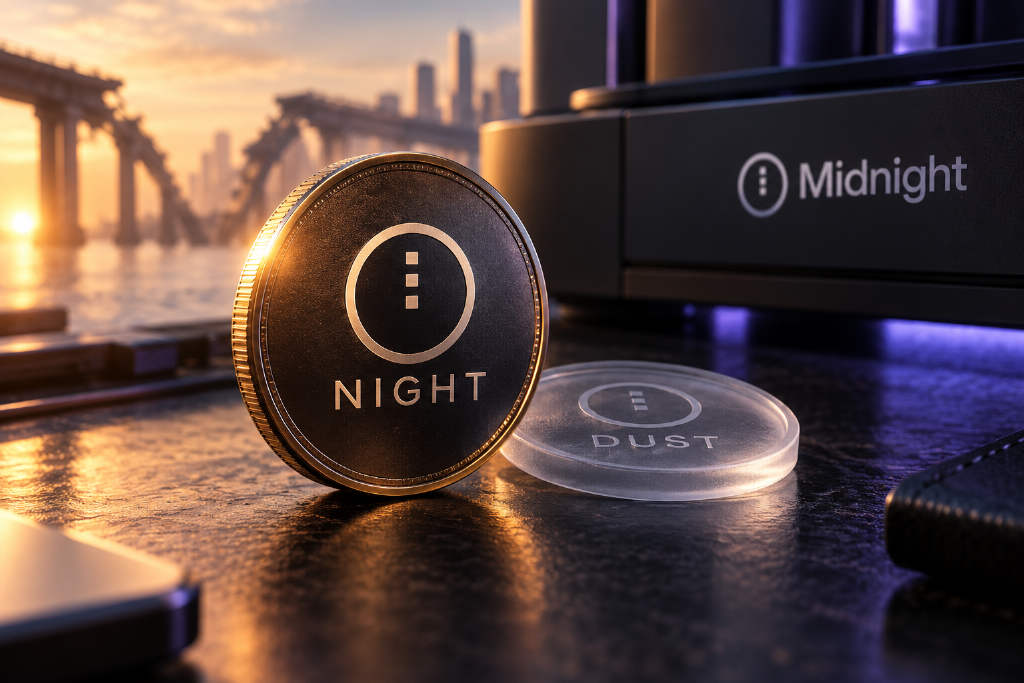
NIGHT sits at the capital layer. It is public, tradable and non-private. Holding NIGHT automatically generates DUST. NIGHT is used for governance, network security and value storage. On-chain, it is fully transparent: sender, receiver and amount are all visible.
DUST sits at the operating layer. It is private, non-transferable and subject to decay. Every on-chain action, including transaction fees and smart contract execution, is paid in DUST. It cannot be sent between wallets, cannot be used to buy goods, cannot be traded, and does not appear on exchanges. After use, it regenerates based on how much NIGHT a holder owns. If it is left unused for a long time, it decays naturally.
Midnight compares the setup to a rechargeable battery: NIGHT is the battery itself, while DUST is the charge. Users spend the charge to do things on the network, but they do not spend the battery.
Why the structure matters
One consequence is that users do not have to burn capital to use the network. On Ethereum, every transaction consumes ETH. On Midnight, holding NIGHT is enough because DUST is generated automatically to cover operating costs, while the NIGHT principal remains intact.
Another consequence is that developers can cover resource costs for users. A dApp team can hold a large amount of NIGHT, generate DUST, and use that DUST to pay transaction costs on behalf of users. In the framing used by the article, that means end users could interact with Midnight applications without holding any token themselves.
The third point is regulatory. The article says DUST’s non-transferability is one of the most carefully engineered parts of the system. Privacy coins face pressure because they enable anonymous transfers of value. DUST, while private, cannot do that. Midnight can offer data privacy through zero-knowledge proofs while stopping short of offering capital privacy, because the NIGHT layer remains fully public.
That split makes the architecture easier for regulators to accept, according to the article: capital flows remain traceable at the NIGHT layer, while business data can stay private at the DUST layer. The same article says Monument Bank’s willingness to work on tokenized deposits on Midnight is tied to the fact that this design can function within a compliance framework.
From the July bridge exploit to the current rebound
In July, a Wanchain cross-chain bridge exploit involved about 515 million NIGHT and sent the token down 87%. The article says Midnight’s core network was not affected, but the market damage was real.
Even after the rebound to $0.05, NIGHT remains about 50% below its all-time high of $0.1179. In that sense, the “doubling in a week” reflects a recovery from oversold levels rather than a break to fresh highs.
NIGHT has a circulating supply of about 17 billion tokens and a total supply of 24 billion. Glacier Drop, an airdrop for holders across chains including ADA, BTC, ETH and SOL, is still being released. Its 450-day unlock schedule is distributed in quarterly tranches. That means supply-side selling pressure remains part of the setup until the unlock is complete.
Key launches are still ahead
Private smart contracts under the v8 upgrade have not gone live yet, and composability under v9 comes after that. Monument Bank’s tokenized deposit launch has also been pushed back to November.
The article also mentions that Google Cloud operates Midnight nodes and Worldpay is exploring USDG stablecoin merchant payments. Both efforts, however, are described as being in early stages and still some distance from producing meaningful on-chain transaction volume.
As for Hoskinson’s comment that Midnight could be “bigger than Zcash,” the article frames that as a multi-year vision. It also notes that Zcash currently has a market capitalization above $20 billion, compared with NIGHT at about $800 million. The gap is not only about price upside. It also reflects how much product delivery and ecosystem development still has to happen.
How the article frames NIGHT’s value logic
The article reduces the investment case to one line: NIGHT’s value depends on how much real operating demand exists on the Midnight network.
If operating demand grows, more DUST gets consumed. If DUST is consumed faster, the incentive to hold NIGHT in order to generate DUST increases. If demand for NIGHT rises, price support follows.
The reverse also applies. If there are not enough applications and users on Midnight to consume DUST, then much of the DUST generated by NIGHT holders will sit idle and decay, weakening the economic reason to hold NIGHT.
The article compares that logic with Ethereum, where ETH’s value is tied to on-chain activity. Midnight adds another layer. Ethereum users spend ETH directly; Midnight users spend DUST, while NIGHT principal is left untouched. That makes NIGHT look more like a productive asset in the framing used by the source, because holding it produces the resource needed to run activity on the network.
Even so, the article says Midnight’s on-chain activity is still at a very early stage. At the moment, NIGHT’s price reflects expectations about future activity more than a valuation of current usage.
It points to two things that could determine whether the story turns into fundamentals: whether private smart contracts after the v8 and v9 upgrades can attract real DeFi builders, and whether Monument Bank’s tokenized deposits launch in November and generate sustained on-chain volume.
Until then, the article says NIGHT’s price swings are best understood through the lens of expectations.