
NIGHT jumped about 100% over the past week, rising from $0.024 to $0.05 and reaching a six-month high. Its market capitalization climbed to about $800 million, marking a sharp rebound from the 87% selloff that followed a cross-chain bridge exploit in July.
Cardano founder Charles Hoskinson recently said Midnight 「可能会比 Zcash 更大」. That comment has led many traders to file NIGHT under the privacy-coin theme. The source article takes a different view: reducing it to a “next ZEC” label leaves out the project’s most unusual feature, because NIGHT itself is public and transparent, and its value-capture model differs from standard privacy coins.
What Midnight is
Midnight is a Layer 1 blockchain focused on programmable privacy. It is being developed by Shielded Technologies, a team made up of former IOG members, and runs as a partner chain to Cardano.
Its core stack uses zk-SNARKs. Private smart contracts are written in Compact, the project’s in-house language, and the base layer is built on the Kachina protocol.
The article contrasts Midnight with privacy coins such as Zcash and Monero, which are centered on hiding transaction information. Midnight is framed as addressing a narrower problem: how to protect business data while still meeting regulatory requirements. Its answer is selective disclosure, which lets users prove compliance without exposing the underlying data. One example in the piece is proving that a deposit satisfies KYC requirements without revealing to the entire chain who sent it.
Mainnet launched in late 2025, and the NIGHT token was issued in December 2025.
Three catalysts arrived in the same window
The report says the latest rally was not driven by a single event. Three developments landed close together.
On Sept. 28, Midnight announced that smart contract deployment on mainnet had become permissionless. Before that change, developers had to pass a Preprod security review before deploying contracts to mainnet. With that restriction removed, any developer can now build directly on Midnight mainnet, lowering the barrier to entry.
On Oct. 1, CTO Sebastien Guillemot outlined the next steps in the roadmap. The v8 upgrade is set to enable private smart contracts on mainnet, while v9 is focused on composability, allowing private contracts to call one another. The article says Midnight will not have full privacy DeFi capability until both steps are in place.
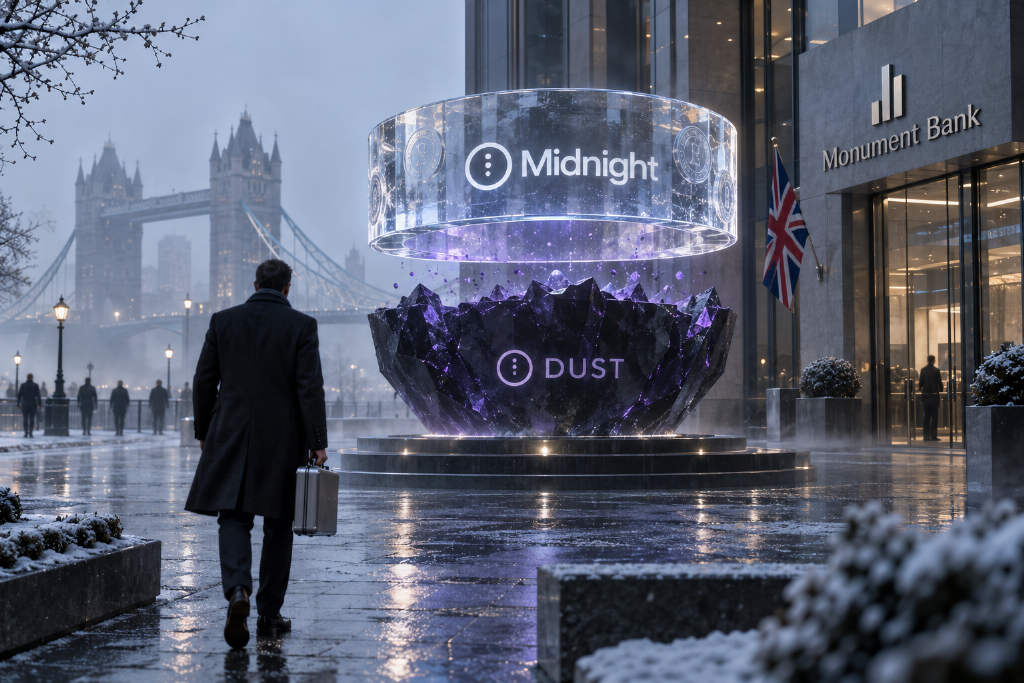
The third catalyst is institutional cooperation. In March this year, UK-licensed lender Monument Bank announced a partnership with the Midnight Foundation to tokenize up to £250 million in retail customer deposits on Midnight. The bank, which is regulated by the Bank of England, manages about £7 billion in deposits. Those tokenized deposits are designed to be 1:1 backed by the pound, interest-bearing, and protected by the UK Financial Services Compensation Scheme. The launch has been delayed to November, but the article describes it as the first case of a regulated bank tokenizing retail deposits on a public blockchain.
The NIGHT-DUST design
The article spends most of its attention on Midnight’s two-layer token and resource model.
NIGHT sits at the capital layer. It is public, tradable, and non-private. Holding NIGHT automatically generates DUST. NIGHT is used for governance, network security, and value storage. On-chain, it is fully transparent: sender, receiver, and amount are all visible.
DUST sits at the operating layer. It is private, non-transferable, and decays over time. All on-chain actions, including transaction fees and smart contract execution, are paid in DUST. It cannot be sent between wallets, cannot be used to buy goods, cannot be traded, and does not appear on exchanges. After it is used, it regenerates automatically based on how much NIGHT the holder owns. If it is left unused for too long, it decays naturally.
Midnight compares the model to a rechargeable battery: NIGHT is the battery itself, and DUST is the charge. Users spend the charge to do things on the network, and the charge slowly refills. The battery itself is not spent.
What that structure changes
First, users do not need to spend their capital to use the network. On Ethereum, each transaction consumes ETH. On Midnight, holding NIGHT is enough because DUST is generated automatically to cover operating costs. The principal position in NIGHT does not shrink simply because the network is being used.
Second, developers can absorb resource costs on behalf of users. The article says dApp teams can hold large amounts of NIGHT, generate DUST, and then use that DUST to pay transaction fees for their users. In practice, that means end users could interact with Midnight applications without holding any token at all.
Third, DUST’s non-transferability is presented as a way to avoid part of the regulatory dispute around privacy coins. The article argues that privacy coins face pressure because they allow anonymous transfer of economic value. DUST does not. It is private, but it cannot be transferred. In that setup, Midnight offers data privacy through zero-knowledge proofs while not offering fund privacy, because the NIGHT layer remains fully public.
That split is also used to explain why Monument Bank is willing to work on tokenized deposits on Midnight. The article says the layered design makes it possible to operate inside a compliance framework: value flows remain traceable at the NIGHT layer, while business data can stay confidential at the DUST layer.
From the bridge exploit to the rebound
In July, a Wanchain cross-chain bridge exploit involved about 515 million NIGHT. The incident sent the token down 87%. Midnight’s core network was not affected, but the price damage was real.
The current rebound started from that low. Even at $0.05, NIGHT is still down about 50% from its all-time high of $0.1179. The article says the “doubling in a week” is better understood as a recovery from an oversold move rather than a push to new highs.
NIGHT’s circulating supply is about 17 billion tokens, with a total supply of 24 billion. Glacier Drop, an airdrop program for holders across chains including ADA, BTC, ETH, and SOL, is still being released. The unlock schedule runs for 450 days and is distributed quarterly. That means supply-side selling pressure remains in place until the unlock process is complete.
Still an early-stage network
The report also lists what has not happened yet. Private smart contracts under the v8 upgrade are not live. Composability under v9 comes after that. Monument Bank’s tokenized deposit product has already been pushed back to November.
It also mentions that Google Cloud is operating Midnight nodes and that Worldpay is exploring merchant payments for the USDG stablecoin. Those partnerships are still in the early stage, and the article says they remain some distance away from producing meaningful on-chain transaction volume.
As for Hoskinson’s comment that Midnight could be bigger than Zcash, the piece frames that as a multi-year vision. It notes that Zcash currently has a market capitalization above $20 billion, while NIGHT is around $800 million. Moving from $800 million to more than $20 billion would require more than price appreciation; it would also require product delivery and ecosystem buildout.
How the article frames NIGHT’s value
The report reduces the investment case to one line: NIGHT’s value depends on how much real operating demand exists on the Midnight network.
If operating demand rises, more DUST gets consumed. Faster DUST consumption increases the need to hold NIGHT in order to generate more DUST. Higher demand for NIGHT, in turn, supports the token’s price.
The reverse also applies. If Midnight does not attract enough applications and users to consume DUST, then the DUST generated by NIGHT holders will sit idle and decay, weakening the economic reason to hold NIGHT.
The article compares that logic with Ethereum, where ETH’s value is tied to on-chain activity. Midnight adds a buffer layer: users spend DUST rather than NIGHT itself. On that basis, the piece describes NIGHT as a productive asset, one that generates the resources needed to operate on the network.
For now, though, on-chain activity on Midnight is still at a very early stage. The article says NIGHT’s current price reflects expectations about future activity more than a valuation of present activity. It describes the token as being in a phase where the narrative is ahead of the fundamentals.
Whether that changes depends on two things named in the report: whether private smart contracts after the v8 and v9 upgrades can attract real DeFi developers, and whether Monument Bank’s tokenized deposits can launch on schedule and generate sustained on-chain transaction volume.
Until then, the article says NIGHT’s price swings should be read through the lens of expectations.