
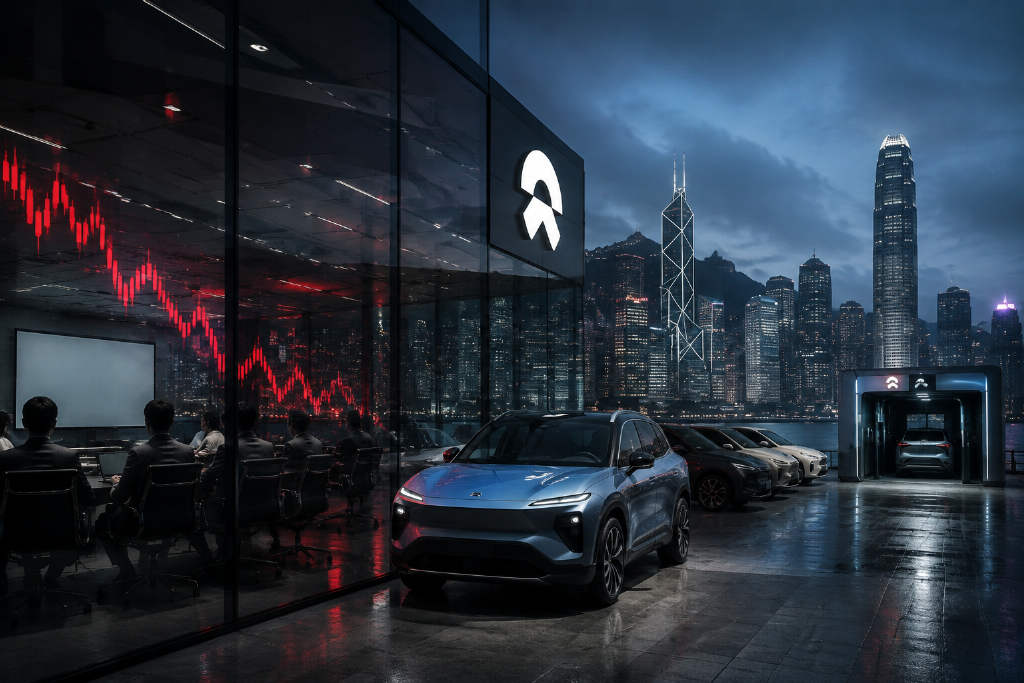
NIO’s latest quarterly report showed a company with stronger numbers but little relief in the stock.
In the second quarter, NIO posted sharp gains in revenue, gross profit and deliveries, and said it has now recorded profits for three consecutive quarters. Yet its Hong Kong-listed shares stayed under pressure. On Sept. 1, the day the second-quarter report was released, the stock fell as much as 10% intraday before closing down 6.39%. It dropped another 3.35% the following day and lost 1.07% again on Sept. 3.
The contrast framed the key question around the company: not whether it can keep operating, but how it improves business quality as competition remains intense.
Revenue and gross profit jumped, but pressure remains in quarterly earnings
NIO reported second-quarter revenue of RMB 32.1369 billion, up 69.1% from a year earlier. Gross profit reached RMB 5.9065 billion, up 211.3% year over year. Gross margin and vehicle margin came in at 18.4% and 18.5%, compared with 10% and 10.3% in the same quarter last year.
Operating performance improved sharply as well. Second-quarter operating loss narrowed to RMB 347.2 million from RMB 4.9089 billion a year earlier. Excluding share-based compensation expenses, adjusted operating profit was RMB 206.9 million.
At the net level, NIO reported a second-quarter net loss of RMB 528 million, compared with RMB 4.9948 billion in the prior-year period. Excluding share-based compensation, adjusted net profit was RMB 26.1 million, versus an adjusted net loss of RMB 4.1267 billion a year earlier.
Those figures suggest NIO has largely restored its ability to generate cash from its own business, even if profitability is still thin.
Compared with the first quarter, though, the report had weaker spots. Revenue and gross profit rose 25.9% and 21.6% quarter over quarter, but margins slipped as scale expanded. First-quarter gross margin and vehicle margin were 19% and 18.8%, both slightly above the second-quarter readings.
Adjusted net profit also fell sequentially, dropping from RMB 43.5 million in the first quarter to RMB 26.1 million in the second. In other words, a larger revenue base did not translate into stronger bottom-line performance.
Higher costs and heavier spending weighed on margins
NIO’s filing and earnings call pointed to cost and expense pressure as the main reasons second-quarter margin and profit trailed the first quarter.
Research and development expenses rose 13.8% from the first quarter. The company said the increase came from higher design and development spending tied to new products and new technologies, as well as higher personnel costs in R&D functions.
Selling, general and administrative expenses climbed 26.5% quarter over quarter, mainly because of higher sales and revenue-related costs tied to new product launches. NIO did introduce multiple new models during the quarter, pushing up marketing and sales spending.
Management said on the earnings call that cost pressure has been significant this year. Since March, prices for memory, bulk materials and batteries have all increased. Per-vehicle cost in the second quarter was RMB 14,000 higher than a year earlier, adding pressure to gross margin.
To stabilize profitability, NIO said it worked through supply-chain optimization, commercial negotiations and other measures on the cost side. The result, management said, was stable pricing across its three brands and an overall vehicle gross margin of 18.5%.
Cash flow improved. NIO achieved positive cash flow from operating activities in the second quarter of 2026. As of June 30, 2026, cash reserves had risen to RMB 56.7 billion from RMB 48.2 billion at the end of the first quarter. The company said that cash position is sufficient to support normal operations over the next 12 months.
That shifts the main issue for NIO. The focus is no longer the operational sustainability concerns that dominated discussion last year, but how to lift the quality of earnings.
Brand mix improved, while Onvo still faces an awareness gap
NIO tied much of its second-quarter improvement to a rebuilt and more complete product lineup.
The company delivered 107,658 vehicles in the quarter. Of that total, the NIO, Onvo and Firefly brands contributed 60,945, 29,124 and 17,589 units, representing 56.6%, 27.1% and 16.3% of deliveries, respectively.
In the first quarter, the three brands sold 58,543, 13,339 and 11,583 vehicles, accounting for 70.1%, 16.0% and 13.9%. On that comparison, the NIO brand held its sales level, Onvo posted more than 100% incremental growth, and Firefly delivered more than 50% sales growth.
The brand mix looked more balanced than in the first quarter, though it still remained well short of the company’s original 3:6:1 expectation.
Within the NIO brand, second-quarter performance was driven largely by the ES8 and ES9 large SUVs. Those two models helped NIO rank No. 1 in China’s passenger vehicle market priced above RMB 350,000 during the quarter.
William Li said on the earnings call that ES8 was especially strong. After contributing to second-quarter sales, it reached 140,000 in deliveries in August, and the 150,000th unit is scheduled for delivery in September. On ES9, Li said three-quarters of customers currently come from outside the NIO community, showing a clear ability to reach new buyers.
On Firefly, Li said the brand currently has only one model, though special editions and later technical iterations will continue. He described the approach by saying Firefly is somewhat like the iPhone, with new special editions to keep coming.
Onvo drew more outside attention. The refreshed Onvo L90 passed 60,000 in deliveries, and together with the L80 helped the brand rank first among large SUVs priced below RMB 300,000 by transaction price. The upgraded Onvo L60 also supported total sales, though management indicated that support is still not strong enough.
Li said competition in Onvo’s segment is much tougher than in NIO’s and Firefly’s, with more brands and more models. The main challenge remains brand awareness. He said Onvo’s current recognition level is roughly where the NIO brand was five or six years ago.
To address that, Li said the company will push harder through crossover partnerships, offline events and deeper community work. It also plans to accelerate the buildout of shared Sky stores for the NIO, Onvo and Firefly brands, expanding the sales network to reach more family users in lower-tier cities.
Li added that Onvo will keep rolling out new products for a broader family user base, but will maintain its positioning as a high-quality family car brand. It will not move too far downmarket, and it will balance volume and margin. He also said Onvo has another strategic new product set for next year to deepen the lineup.
Management said on the call that material costs may continue to rise in the second half, potentially adding RMB 2,000 to RMB 3,000 per vehicle. Even so, the company’s goal is to keep vehicle gross margin in the third and fourth quarters close to the second-quarter level.
Battery swap moves toward a lighter-asset model, while smart driving starts to monetize
For NIO in 2026, the heavy new-model launch cycle has largely passed, leaving sales execution as the near-term focus. Outside the product line, the company is still pushing several broader initiatives.
Battery swap is one of the main ones.
Management said the target for this year remains 1,000 battery swap stations. What has changed is the financing structure. Since launching its Power Up Partners program in 2024, NIO said it has made substantial progress this year, working with more than 40 local state-owned capital groups and financial institutions across 25 provinces and cities nationwide. The company said all funding targets for this year’s charging and battery swap network construction plan now come from partner investment.
That marks a shift away from NIO’s earlier heavy-asset approach, at least in station construction and operation, and toward a lighter-asset model.
Chief Financial Officer Qu Yu said the construction cost of a fifth-generation battery swap station is RMB 1.4 million per station, down from RMB 1.5 million for the prior generation. The first-attempt swap success rate has improved 50% from the same period for the previous generation.
On external cooperation, the company said some launched projects and ongoing discussions are still moving ahead. It also said Robotaxi development is highly compatible with battery swap as supporting infrastructure, and that the commercial framework will generally use an access-fee model.
Qu said more automakers are recognizing the advantages of battery swap and want to join.
At this stage, NIO is trying to expand the network, cut costs and find ways to monetize the asset at the same time. Management signaled that the process remains complicated and will take time.
NIO also disclosed progress in intelligent driving. In the quarterly report, the company said shares in Shenji have been subscribed by investors at a post-money valuation of RMB 12.25 billion. A NIO subsidiary will hold a controlling 59.95% stake in Shenji.
Li added on the earnings call that the smart driving subscription rate among used-car users of NIO and Onvo is close to 20%. The paid user base is still small, but the business has already generated subscription revenue in the tens of millions of yuan this year. As the user base grows, he said, subscriptions could become an important source of service revenue over the long run.
The contribution is still limited for now. Even so, it points to a new monetization channel for NIO’s investment in intelligent features.
NIO backs an embodied AI startup, but will not build humanoid robots itself
The earnings call also touched on Ren Shaoqing’s embodied intelligence startup. Li confirmed the matter and said Ren remains head of NIO’s smart driving business. NIO will support the venture as a strategic shareholder.
Li said that arrangement allows the company to stay focused on its core business while maintaining strategic exposure to embodied intelligence and physical AI, without affecting NIO’s profit and loss statement.
That makes the company’s position clear. Even as a growing number of automakers publicly move into humanoid robots, NIO is choosing to keep its attention on smart electric vehicles instead of entering the embodied intelligence field directly.
As Li had said previously in a communication meeting, NIO will simply keep selling cars.
The broader picture is that NIO, one of the automakers in China still insisting on a pure EV route, has moved past the phase where survival was the central concern. The next stretch is about converting that survival into better business quality and more effective execution. The market may not reward that immediately, but the company’s current direction is explicit.
This article is based on a post from the WeChat public account Timelines, written by Wang Zhi.