
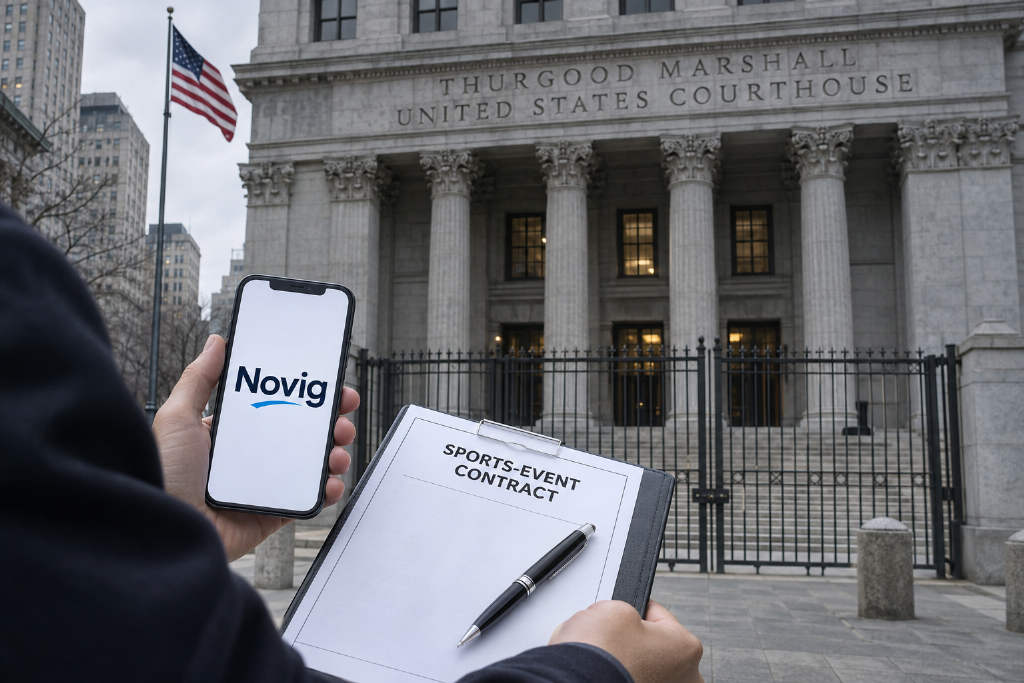
A federal judge in New York on Tuesday rejected Novig’s request for a preliminary injunction against the state attorney general and gaming regulators. At this stage of the case, U.S. District Judge Colleen McMahon found that the sports prediction exchange’s contracts are not swaps under the Commodity Exchange Act (CEA).
The Commodity Futures Trading Commission (CFTC), the federal derivatives regulator, has exclusive oversight of swaps when they trade on a federally designated exchange. The ruling leaves New York free to require Novig to obtain a state gambling license or stop listing the contracts.
Judge challenges CFTC rules and Kalshi order
McMahon gave no deference to the CFTC’s position. In October, the agency issued an interim final rule that excludes sportsbook bets and other casino-style gambling from the definition of a swap. It also proposed a rule that would define sports event contracts as swaps.
「The two rules are inherently contradictory and cannot be reconciled,」 McMahon wrote. The CFTC’s sudden departure from its longstanding position that sports wagering is a matter for the states, she added, appeared calculated to influence the outcome of ongoing litigation on that issue.
She was more critical of an Aug. 11 CFTC order directing Kalshi to continue operating normally while New York pursued it. The order, McMahon wrote, 「smacks of a collusive effort between a regulator and regulatee to generate a claim for conflict preemption.」 That claim holds that federal law overrides state law because a company cannot comply with both.
Even if the court deferred to the agency, McMahon said, Novig’s listings would be unlawful under the CFTC’s own current rule, 17 C.F.R. § 40.11, which bars the listing of event contracts related to gaming.
Discussing the CFTC’s emergency orders for Kalshi on Unchained’s DEX in the City in August, co-host Jessi Brooks warned about the use of such actions. 「If we use emergency orders or actions in this way, and yeah, it might be a sympathetic case now, but that’s how it’s gonna get normalized,」 she said.
How the court read the swap definition
The CEA covers contracts tied to an event or contingency associated with a potential financial, economic or commercial consequence. McMahon agreed with Novig on the first part: the result of a game is an event.
On the second part, she sided with New York, reasoning that the statute addresses the hedging of price risk rather than recreational betting. 「From the perspective of the customer, there is no qualitative difference between Novig’s product and FanDuel’s traditional sports bet,」 she wrote.
Appeal and related cases
McMahon also rejected Novig’s claim that it could not comply with both state and federal law, calling the argument 「ridiculous.」 Novig could seek a New York license and use geofencing to serve only customers physically located in the state, she wrote.
The court docket lists a notice of interlocutory appeal filed on the day of the ruling. An interlocutory appeal is taken before a case ends.
According to the opinion, the CFTC’s two October actions were first released on Oct. 9 and updated on Oct. 19. Earlier this month, the Second Circuit declined to pause actions by New York and Connecticut against Kalshi and Coinbase. The court has said a merits panel—the panel that will decide the appeal itself—will take up the same question.



