
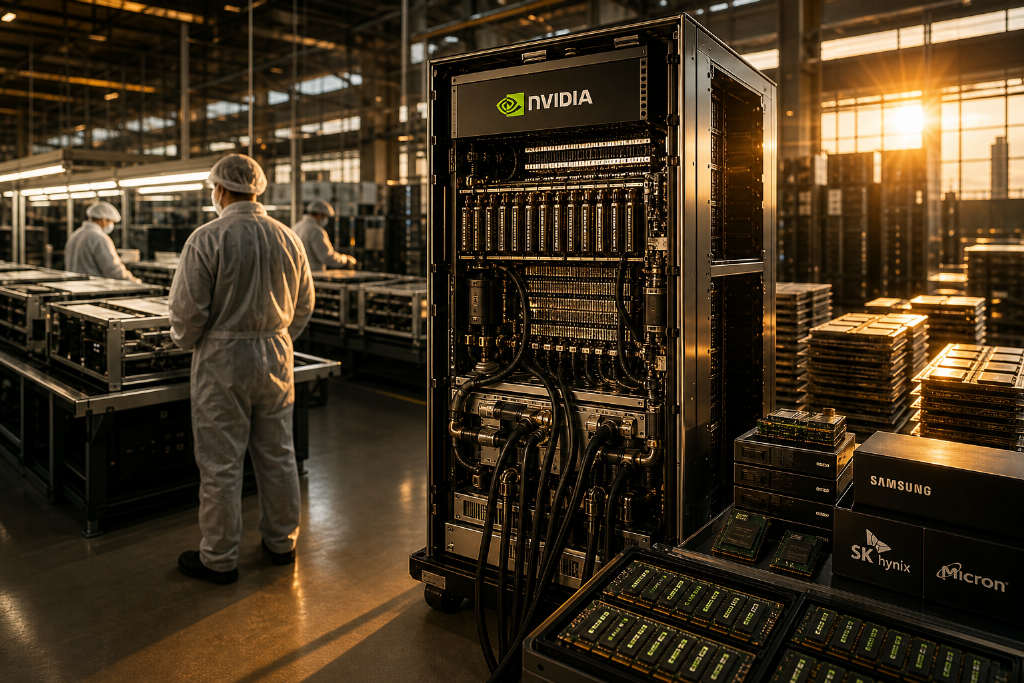
Nvidia has notified contract manufacturing customers that prices for AI servers shipping early next year will increase by more than 15%, Bloomberg reported, with BlockTempo citing the report. Bloomberg tied the move to a sharp rise in memory chip costs. Nvidia did not respond to Bloomberg’s request for comment.
Vera Rubin and Grace Blackwell systems are included
Bloomberg, citing people familiar with the matter, said Nvidia has placed AI server systems due to ship early next year on the price increase list. The reported changes cover systems based on Vera Rubin and Grace Blackwell. The people asked not to be identified because the discussions were not public.
According to the report, the size of the increase will vary depending on the Nvidia chip generation and the memory configuration. Manufacturers that assemble servers for large data center operators such as Microsoft, Google, and Oracle have already begun informing customers about the coming price hikes.
Nvidia did not comment on Bloomberg’s request.
Not the company’s first pricing move
This is not the first time Nvidia has adjusted pricing. Earlier this month, Tom’s Hardware reported that Nvidia had raised prices on PC graphics cards aimed at gamers, with increases reaching as high as 39%.
Top-end AI servers are currently priced at about $3 million per unit, according to the report. Another increase for enterprise systems would raise the spending threshold again for buyers building out AI capacity.
Memory costs are the central issue
Bloomberg framed DRAM as a key driver behind the latest increase. Dynamic random-access memory is a core component in AI computing systems. However strong an accelerator chip may be, performance cannot be fully delivered without enough DRAM alongside it.
The report said Samsung, SK Hynix, and Micron account for nearly all global production capacity for this class of chips. Even after years of capacity expansion, supply has still lagged the surge in demand tied to AI infrastructure, pushing memory prices sharply higher and giving those suppliers greater pricing power across the technology supply chain.
HBM, or high-bandwidth memory, was another focus in the report. It is a high-speed memory format built by stacking multiple DRAM layers and is widely treated as a critical part of Nvidia GPU performance. Bloomberg noted prior market expectations that SK Hynix’s 2026 HBM4 supply agreement with Nvidia was priced at about $560 per unit, more than 50% above earlier levels. Industry estimates cited in the report said HBM4 could account for as much as one-quarter of the total chip cost in Nvidia’s next-generation GPUs.
Even a 75% gross margin has limits
Bloomberg said Nvidia’s current gross margin stands at 75%. On that basis, every 100 yuan of product sales leaves 75 yuan after production costs. The report linked Nvidia’s high margin structure to persistent supply tightness at Taiwan Semiconductor Manufacturing Co. (TSMC), which has helped support pricing that can run into tens of thousands of dollars per chip.
Nvidia’s accelerator business started from PC gaming graphics cards that once sold for only a few hundred dollars. As demand kept climbing and substitutes remained scarce, prices moved steadily higher. Bloomberg’s framing was that even with margins at elevated levels, Nvidia is still passing part of the cost pressure through to full-system pricing.
The pressure goes beyond AI servers
The report also said Apple and Qualcomm have recently indicated that chip shortages forced them to raise prices on their own products. That suggests the impact from rising memory prices is no longer limited to the AI server production line.
Amazon, Microsoft, Google, and Meta are all pushing internal chip development efforts in an attempt to reduce reliance on Nvidia. Even so, current data center expansion still depends on Nvidia procurement. The report added that the path for in-house chips also depends on whether those companies can secure enough memory supply from Samsung, SK Hynix, and Micron. In that sense, bargaining power still sits with the memory makers.
Higher costs complicate data center expansion
Bloomberg said there had already been market expectations that memory chips used in servers could double in price by the end of 2026. It also said Nvidia and Advanced Micro Devices had reportedly been raising GPU prices in stages since early this year, with the upward trend expected to run through the full year.
AI data centers were already dealing with engineering delays, labor shortages, tighter funding conditions, and opposition from nearby communities to development projects. Adding higher component costs on top of that makes expansion plans across the sector harder to execute.
Attention now shifts to Nvidia’s upcoming earnings
Bloomberg said Nvidia is set to release its latest quarterly earnings next week. As the world’s most valuable listed company, its results remain closely watched by the technology industry and investors.
After the latest pricing report, attention is not only on Nvidia’s revenue figures. The other question is whether memory suppliers can keep their position at the center of pricing negotiations.