
Nvidia’s general-purpose coding agent AVO posted a perfect score on ARC-AGI-3, clearing all 183 levels across 25 game environments in 6,624 steps and reaching an RHAE of 100.00.

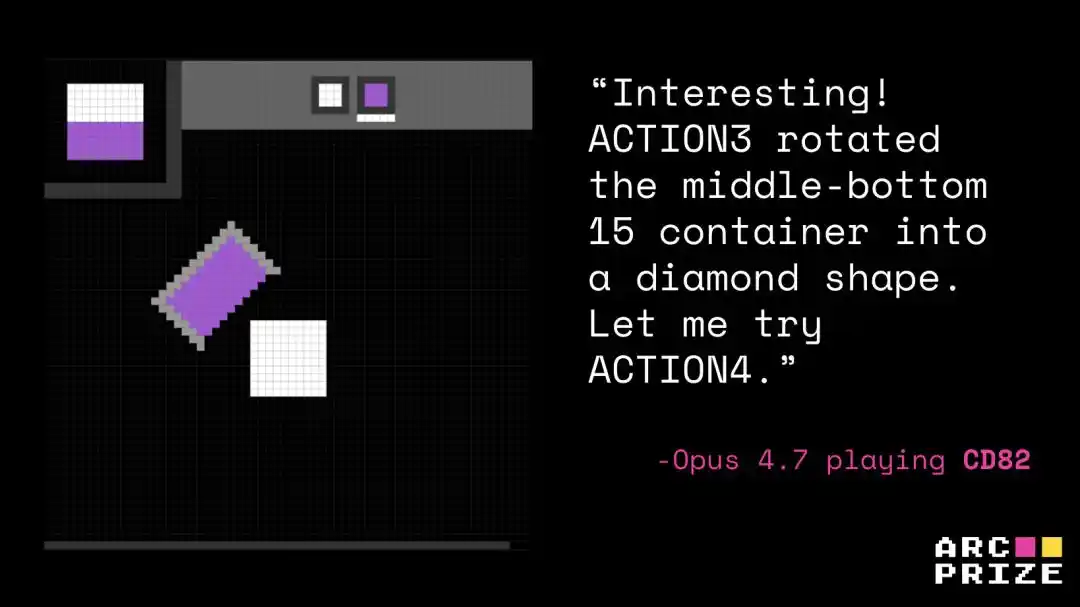
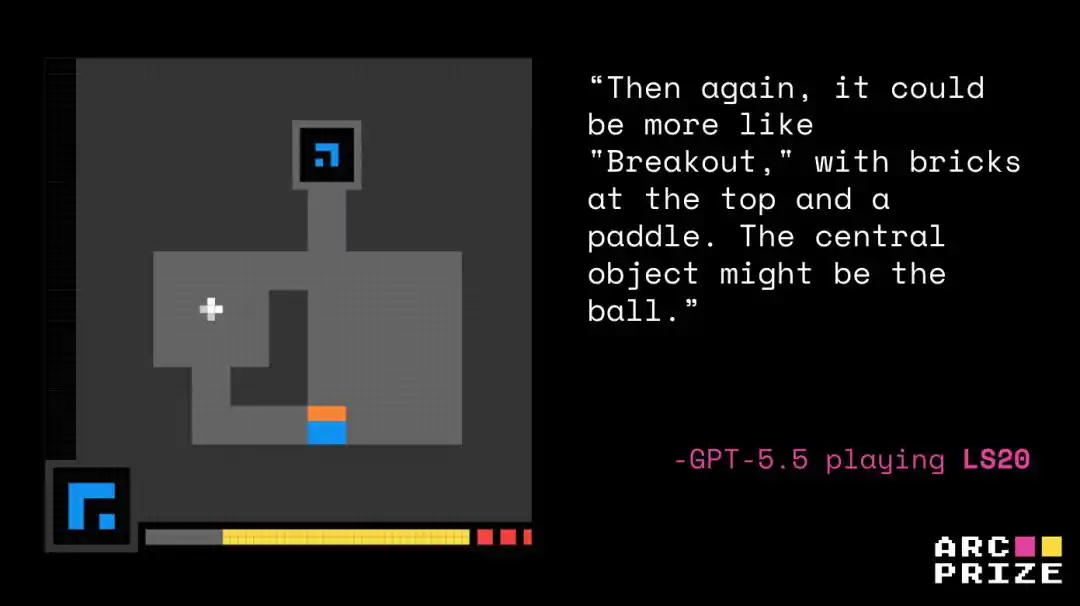
ARC-AGI-3 is designed to be harsh. The agent is dropped into an unfamiliar game with no rules and no explicit goal, then has to act, observe, and infer what is going on. In some environments, the agent can move up, down, left, and right through corridor-like layouts, and the whole screen rotates 90 degrees after it hits a blue-black block. In others, movement is disabled and the agent can only click, cycling cell colors until they match a target pattern.
Each environment contains at least six levels, and the tasks get tougher as the run goes on. A first level may take five steps, while a sixth can require 50. The agent only has a 64×64 grid and a few control buttons to work with.
The same model moved from 30.16% to a full score
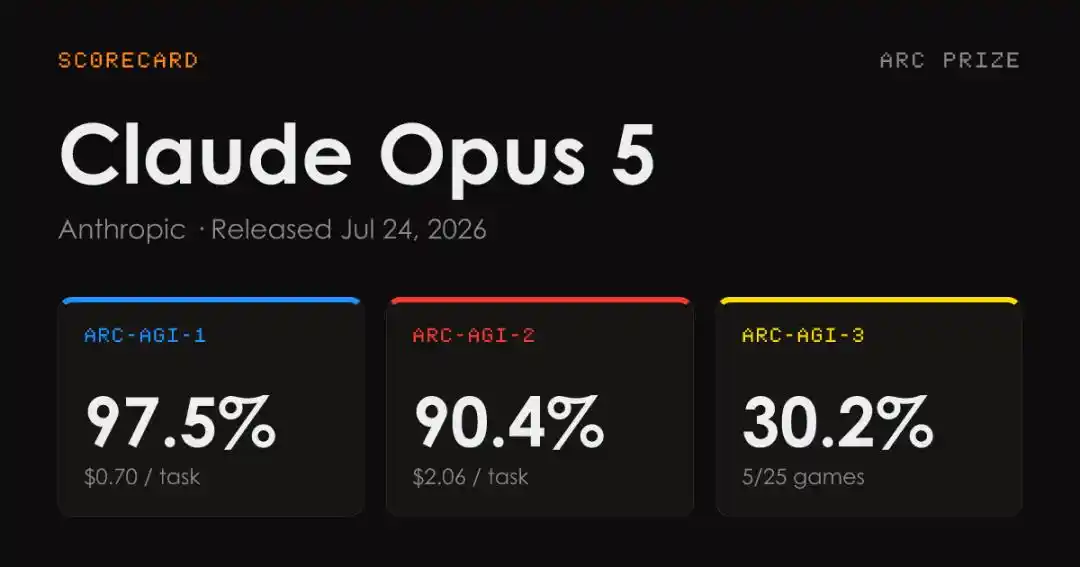
AVO used Claude Opus 5 in this run. The report says that if the model takes the benchmark on its own, it scores 30.16%, which is still the top result on the officially certified leaderboard.
ARC Prize previously analyzed gameplay records from the prior generation and grouped common failures into three buckets: partial understanding without a grasp of the whole task, forcing unfamiliar mechanics into patterns from familiar games, and passing a level without actually learning the underlying mechanism.
The third category was presented as the most damaging. In the example cited, Opus cleared the first level of ka59 in 37 steps, but its understanding of the click mechanic was wrong from the start. It carried that wrong theory into the second level and got stuck there.
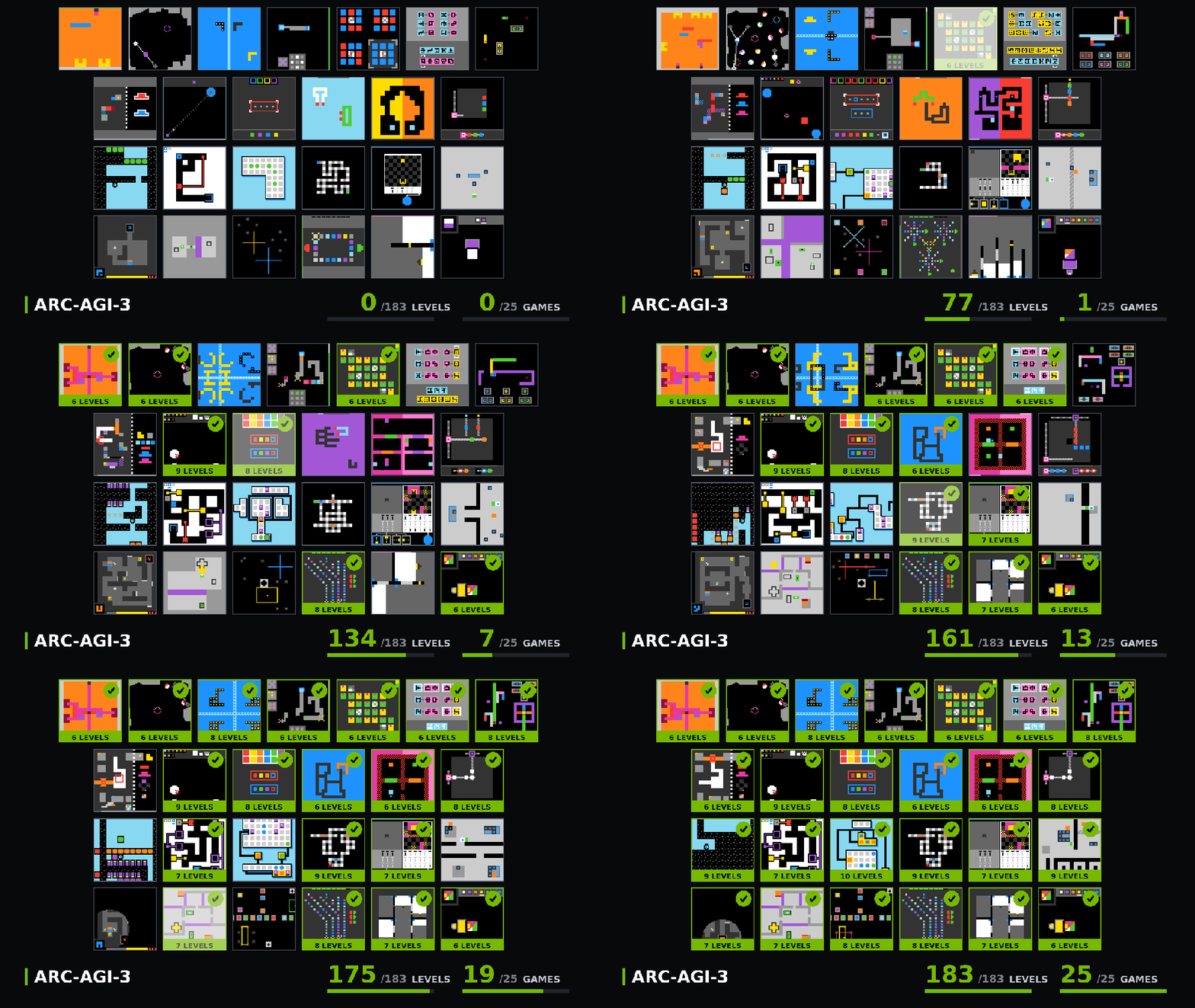
Nvidia’s approach was not to modify the model itself. It added an outer system layer instead. With that setup, the same Claude Opus 5 moved from roughly 30 points to a perfect result.
Two parts did the heavy lifting outside the model
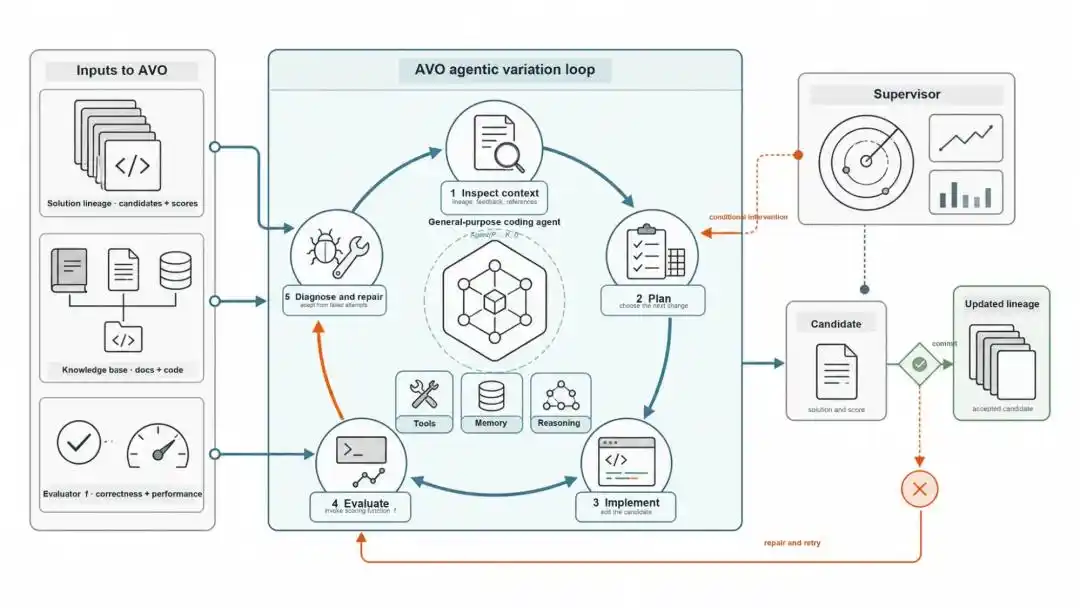
The report compares AVO with recent harness-style systems such as DeepSeek Harness and Codex Harness. What these systems manage sits outside the model: what context to provide, what tools to expose, how to store state, how to feed back results, what to do when progress stalls, and how to continue after the context window fills up.
In AVO’s case, two mechanisms were identified as central.
Persistent memory
Long-horizon work breaks down when the context window fills. Once that happens, the model can lose track of what it already tried, which paths failed, and what came back from tools such as the profiler. A new round can start by repeating the same dead ends.
AVO stores those intermediate states: earlier implementation versions, evaluation results from each run, compiler and analyzer outputs, and the reasoning accumulated along the way. After a context reset, the agent continues from the current state rather than rebuilding the search from scratch.
Supervisor
The main agent handles the work itself, deciding what to inspect, what to change, what to test, and what to submit. The supervisor does not do the task directly. It watches the full search trace and intervenes when progress stalls or when the main agent starts looping through unproductive actions, pushing it toward another strategy.
One detail stands out. AVO ran ARC-AGI-3 in a pure text modality. Every frame was fed to the model as a precise 64×64 text grid. No image was passed in, and no image token was used. In a benchmark built around pixel-heavy game screens, the model never directly saw the visual frame.
That setup produced the final result: 6,624 steps, all 183 levels cleared, and a perfect RHAE. Nvidia’s conclusion from the run is that long-horizon capability does not come from the model alone. It emerges from the full system. Memory determines what survives into the next round. Tools determine what actions the agent can take. Feedback tells it whether it is on the wrong track. And when a hypothesis fails, the ability to recover and continue matters for whether the task can keep moving at all.
AVO was built for GPU operator optimization, not games
The report says AVO was not originally designed to play games. Its main use case is GPU operator optimization.
On March 25, 2026, Nvidia uploaded a paper to arXiv titled AVO: Agentic Mutation Operators for Autonomous Evolutionary Search. The paper is available at https://arxiv.org/abs/2603.24517. Two terms anchor the work: evolutionary search and mutation operators.
In the description provided, evolutionary search starts with a batch of candidate code, modifies it, runs it, keeps the fastest version, and repeats the cycle generation after generation. The part responsible for the modification step is the mutation operator. Historically that logic was hard-coded by humans. Later, even when LLMs were used, the pattern often remained a one-shot code generation pass.
AVO replaces the mutation operator with an autonomous agent. That lets it read the CUDA programming guide and PTX architecture documents, run tests, inspect profiler output, diagnose correctness failures, and decide what to change in the next version.
Nvidia deployed the system on B200 to optimize attention kernels, described in the report as one of the most heavily tuned operators inside Transformers. The system then ran on its own for seven days, explored more than 500 optimization directions, and submitted 40 valid kernel versions.
The resulting multi-head attention kernel was reported to be up to 3.5% faster than Nvidia’s closed-source cuDNN and up to 10.5% faster than FlashAttention-4, an open-source implementation.
Nvidia then moved the same optimization process to GQA, which the report described as a mainstream setup in large models today. In that run, AVO worked autonomously for about 30 minutes, and the new kernel came out 7.0% faster than cuDNN and 9.3% faster than FlashAttention-4.
Handwritten CUDA kernels have long been one of the highest-skill tasks in this ecosystem. AVO’s first overtake happened there. The 25 ARC-AGI-3 game environments used that same core system.
The same loop was transferred into a pixel game benchmark
Kernel tuning and game solving look unrelated, but Nvidia’s framing is that both are driven by the same loop. The agent forms a hypothesis from incomplete evidence, tests it, observes the result, stores the useful state, and revises its understanding of the problem. If the hypothesis breaks, it backs out and starts another round.
In Nvidia’s words as relayed by the report, what transfers is not domain knowledge but the mechanism that sustains long-horizon autonomous progress.
A research roster with several prominent Chinese contributors
The AVO paper lists 23 authors. The report says the roster includes several well-known figures from the past decade of open-source deep learning infrastructure.
One co-first author, Bing Xu, is a Distinguished Engineer at Nvidia and a creator of MXNet. Earlier in his career, he was also the fourth author on the original 2014 GAN paper, where the senior author was Yoshua Bengio at the University of Montreal.
Tianqi Chen, known for TVM and XGBoost, is also on the list. The report also points to Luis Ceze through the TVM line. Ceze and Chen co-founded OctoAI, which Nvidia acquired in September 2024. Ceze later joined Nvidia to continue work on machine learning compilers.
Other names highlighted in the report include FlashInfer author Zihao Ye and CUDA compiler veteran Vinod Grover.
The team is led by Humphrey Shi, Nvidia’s vice president of high-performance AI and a professor at Georgia Tech. Another co-first author, Zhifan Ye, is a PhD student at Georgia Tech.
The blog post itself carries five bylines, four of them Chinese: Humphrey Shi, Terry Chen, Zhifan Ye, and Yeyin Zhu. The fifth is Jean-Francois Puget, described in the report as a two-time Kaggle Grandmaster at Nvidia.
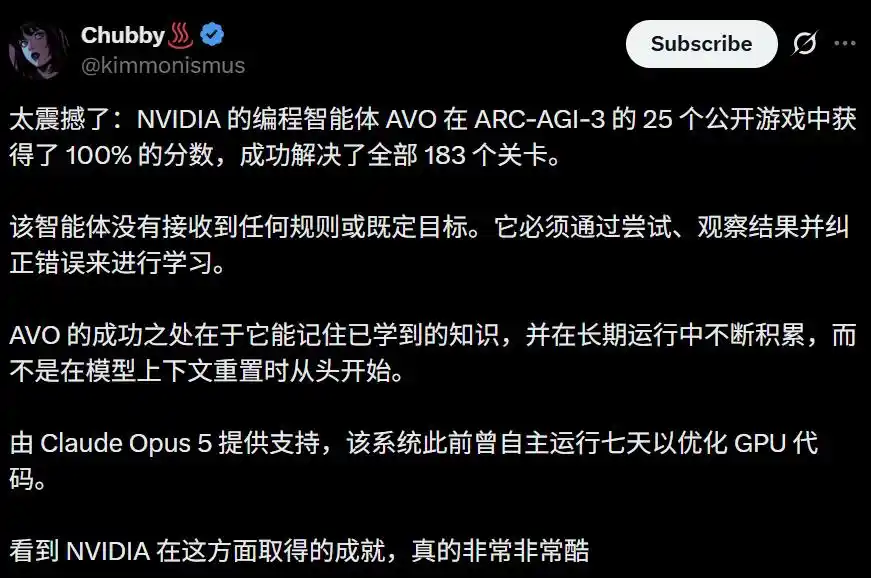
The report also cites an earlier self-description by Bing Xu on X. He said that when he and Terry Chen started working on agentic programming at Nvidia a year and a half ago, neither of them knew GPU programming. Precisely because of that, they aimed from day one at a fully automatic system that would not rely on human intervention, calling the approach “blind programming.” A year and a half later, that hands-off system outperformed kernels that human experts had optimized for months.
Nvidia’s interest is the system layer around the model
The report argues that Nvidia spent a year and a half building a system that does not require manual intervention because this outer layer can sit on top of different models.
AVO has already been run across models. On the same tasks, GPT-5.6 Sol completed the work faster, while Opus 5 used fewer steps.
Nvidia does not depend on model sales as its main business. The report says the company’s Nemotron 4 effort, advanced in August this year, targets the trillion-parameter scale and is expected to finish training in the fall, with the model to be given away free while revenue is collected through GPUs and the software stack behind them.
On the compute side, long-horizon autonomous agents are also the type of workload Nvidia wants. The report cites Jensen Huang’s view at this year’s GTC that the inflection point for inference has arrived. Over the past two years, compute demand rose by about 10,000x while usage rose by about 100x, with inference consuming the gap in between.
By that logic, the choice of model vendor matters less. If agent workloads keep getting longer and heavier, the final bill still lands on the GPU.
Perfect scores are becoming more common, but AVO’s transfer result still stands out
The report notes that a score of 100 on ARC-AGI-3 is losing some of its rarity. In March, nobody could even score 1 point. Tycho reached a perfect score first in late July. VISTA did it again on Aug. 5. AVO is now the third perfect result in six weeks, and all three systems were powered by Claude Opus 5.
That does not erase what AVO accomplished here. An architecture built to squeeze the last few percentage points out of FlashAttention on B200 was moved into a pixel-game benchmark with minimal changes and still worked. The task interface and evaluation method changed. The core loop did not.
As Nvidia wrote at the end of its blog post, the model matters, but the model is not the whole agent.
Reference: https://developer.nvidia.com/blog/nvidia-avo-reaches-100-on-arc-agi-3-demonstrating-a-frontier-level-general-purpose-architecture-for-long-horizon-autonomous-agents/
Source article credited the WeChat account “新智元,” with ASI启示录 as writer and 摩西 as editor.