
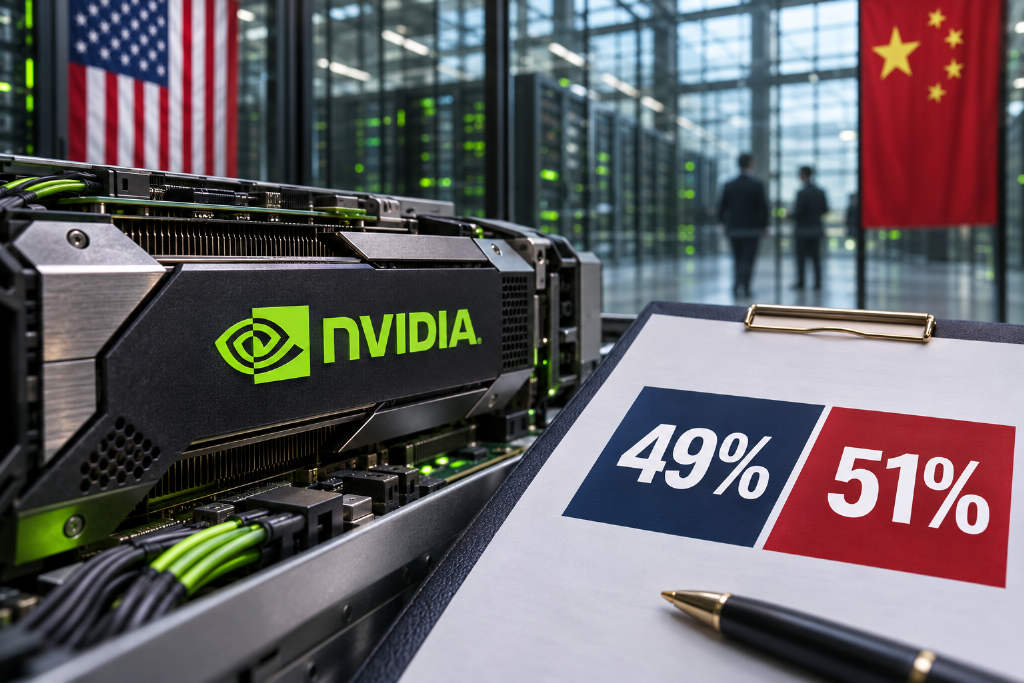
Nvidia has asked cloud and data center customers to ensure that, in future contracts, at least 51% of their services are sold to non-Chinese companies, according to a Nov. 3 report by the Financial Times, which cited five people familiar with the matter. That would leave Chinese customers with a maximum share of 49%. The report said this limit did not previously exist.
The requirement applies only to new contracts, the report said, and existing agreements are not affected. Nvidia reportedly communicated the instruction verbally through its sales teams and regional teams, without written documentation. In comments to AFP, Nvidia neither confirmed nor denied the report.
Chinese firms can still rent Nvidia-powered compute, but with a cap in new deals
Based on the information in the report, Chinese companies are still able to rent cloud services powered by Nvidia hardware. The change is that, under new contracts, their share would be capped at 49%, while existing contracts remain untouched. Reuters added that many Chinese companies rely on overseas cloud computing capacity for AI work, including model training.
The reported restriction concerns who Nvidia’s customers resell computing services to. It does not govern whether Nvidia directly sells chips into China. AFP reported that when asked about the story, Chinese Foreign Ministry spokesperson Mao Ning said she was not aware of the report and expressed hope that all parties would provide companies from all countries with a fair, transparent and non-discriminatory environment.
Company action comes before formal U.S. rules are in place
The report said Chinese companies have shifted to renting overseas compute, a route that is not currently illegal. Bloomberg reported in August that enforcement officials at the Commerce Department’s Bureau of Industry and Security had started mapping how Chinese AI companies obtain Nvidia hardware abroad. According to that report, officials compiled two lists: countries where chips were smuggled into China, and countries where Chinese companies remotely accessed the chips.
In July, White House Office of Science and Technology Policy Director Kratsios wrote on X that Moonshot had used servers in Thailand equipped with Nvidia chips to distill U.S. models for training Kimi K3. The report described distillation as using another model’s outputs to train one’s own model.
The Information reported in late August that the Commerce Department was drafting rules aimed at servers in third countries including Thailand and Singapore, and that a draft could be sent to industry for consultation as early as September.
Congressional bill passed the House but has not cleared the Senate
Legislative action has also stalled short of completion. The Remote Access Security Act, H.R. 2683, passed the House on Jan. 12 by a vote of 369 to 22 and was sent the next day to the Senate Banking Committee. It has not passed the Senate.
As described in the report, the bill defines remote access as a foreign person using items subject to U.S. jurisdiction through the internet or cloud services from outside the location where the chips are physically installed. That would allow the Commerce Department to regulate such access in a way similar to export controls.
Nvidia had already tightened screening for Asian customers
The Financial Times also reported in July that Nvidia had cut by more than half the number of Asian customers authorized to buy AI chips and created a whitelist subject to stricter compliance review. Those affected were said to be mainly newer cloud providers focused on renting out AI computing capacity. The report added that the Commerce Department was involved in oversight and provided political backing.
Key enforcement details remain unclear
Whether the 49% limit can be enforced effectively remains uncertain based on public reporting. One reason is that the requirement was reportedly delivered verbally, without written terms. Public accounts also leave several points unanswered: how a “Chinese company” is defined, whether the 51% threshold is measured by revenue or by compute capacity, what happens if the rule is breached, and which countries are covered.
The definition issue could be especially important. Bloomberg reported in August that Alibaba used Nvidia chips in Malaysia through Singapore-based operator Megaspeed, with a Singapore shell company in between that was controlled by a Cayman Islands entity and ultimately owned by Alibaba. If “Chinese company” is determined only by place of registration, public reporting does not answer how such layered ownership structures would be classified.
In its response to AFP, Nvidia did not address those implementation questions directly. Instead, it said data centers and cloud services built on U.S. chips form the foundation for U.S. model and application developers competing globally. The company also said long-standing U.S. policy encourages every cloud provider to use American infrastructure and to win as much business as possible in markets around the world.



