

Odaily’s editorial roundtable is described as an internal and informal column. Editors use it to record quick reactions to industry news, data, hot events and overlooked details; to lay out investment ideas and opportunity hypotheses that are still being tested; to share observations gained through conversations with industry participants; and to recommend materials that have genuinely improved their understanding, whether those materials come from inside or outside the newsroom. The column states that its content is based on the real investment and observation experiences of Odaily editors, does not accept commercial advertising, and does not constitute investment advice. Its stated purpose is to broaden perspectives and add sources of information rather than create consensus. Odaily also invites readers to join its Telegram community and official X account for discussion, questioning and casual debate.

Higher trading frequency, BTC dip buying and a concern around HYPE
The first editor introduced the note with the phrase “still learning.” This editor said recent trading had become somewhat more frequent than in the previous period. On the crypto side, the editor bought a small amount during the recent decline, mainly BTC, but the entry area was relatively high, around 6.2 to 6.6, so the position had produced almost no profit. In U.S. equities, the editor added a small amount of HOOD, noting that the logic had already been discussed in an article two days earlier. The editor also said they had been playing the World Cup in prediction markets, while combining small, high-frequency copy trading with larger, lower-frequency active orders. The high-frequency copy trading was linked to testing a new tool that, for now, felt useful; the editor said they would try it for a few more days before recommending it.

The same editor then turned to HYPE. While acknowledging that HYPE had performed well recently, the editor said they increasingly felt that “the more expensive HYPE gets, the worse it is for Hyperliquid.” The reasoning was tied to Hyperliquid’s earlier and more imaginative narrative: using HIP-3 to build a multi-asset trading ecosystem with many kinds of custom markets. In the editor’s view, the current situation is different. Within HIP-3 projects, trade.xyz has become dominant, while Felix and Ventuals have closed one after another. The high HYPE price has become an obstacle to expanding the HIP-3 blueprint, because building a custom market on HIP-3 requires staking 500,000 HYPE, which is worth more than $35 million at current prices. Earlier market imagination centered on “Hyperliquid plus countless custom markets.” The editor said the present picture looks more like “Hyperliquid plus trade.xyz.” If the upper-layer market structure becomes fixed around only trade.xyz, the editor argued that both user reach and future imagination would fall short of what the market had previously expected.
Missing SK Hynix and reviewing the psychology of missed trades
A second editor introduced the section by saying they had just “sold SK Hynix too early.” The message focused less on a specific token and more on trading psychology. The editor wrote that markets are never short of opportunities, but calm capital and a calm state of mind are always scarce. Capital markets remain in permanent motion; missing one opportunity does not end the market. A short-term explosive move that was missed, a sector wave that was missed, or a bottoming market that was missed are all only small parts of the many opportunities that appear over time. In this editor’s view, investing does not require catching every move. It requires acting only on opportunities that fit within one’s own understanding and risk control. Becoming attached to an opportunity that has already passed, and being wrapped up in anxiety because of it, was described as one of the largest traps in investing.
The editor also reviewed past trading history and found a recurring pattern. When looking back after the fact, high-quality opportunities appear to be everywhere. Looking back at last year, last month or even just several weeks ago, it is easy to identify which assets had been at low levels, which sectors were about to accelerate, and which moves would have deserved heavy positioning. In hindsight, profitable opportunities appear to have been readily available all over the market. But the editor called this “rearview-mirror thinking”: seeing the market clearly after the event while feeling confused in the moment. For the editor, the phenomenon supports a simple truth: history contained countless opportunities, and the present also contains opportunities. Past opportunities did not disappear; at the time, the trader’s understanding was insufficient or their mindset was too restless, so they could not identify the opportunity or did not dare to act. By the same logic, the current market still contains opportunities across different levels and different degrees of risk.
SpaceX’s Anysphere deal, stock consideration and SPCX flows
Another contribution focused on SpaceX. On June 16, SpaceX announced that it had acquired Anysphere, the parent company of the AI coding tool Cursor, for $60 billion. The editor described the deal as an exchange in which each side gets what it needs. Elon Musk needs Cursor’s developer data to train his own AI model, Grok. Anysphere needs the large computing power behind SpaceX to train its own AI model, Composer, and compete against the model of its former partner Anthropic. Beyond the strategic meaning for the two sides, the editor highlighted a detail that they felt was easy to overlook: the effect of the acquisition on SpaceX’s share price. According to the note, Musk did not actually spend cash, because the entire Cursor acquisition was paid for with SpaceX Class A common stock.
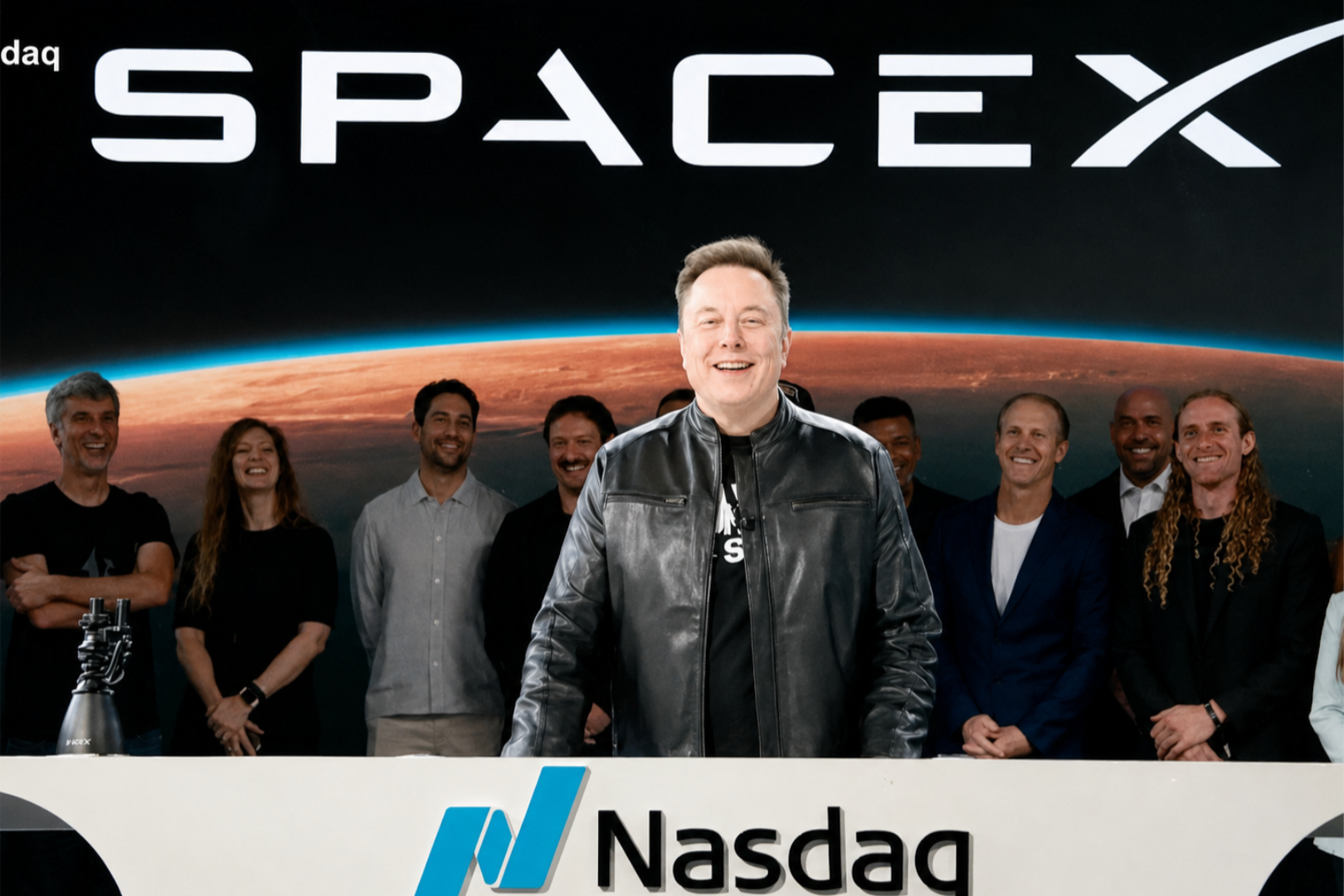
The editor cited SEC filings. SpaceX carried out the merger with Anysphere through its wholly owned subsidiary X67 Inc. X67 Inc. will merge into Anysphere, and Cursor will survive as a wholly owned subsidiary of SpaceX. At the closing of the merger, all Anysphere common and preferred shares will be converted into SpaceX Class A common stock. The exchange ratio will be calculated based on the volume-weighted average price over the seven consecutive trading days before closing. The editor argued that Musk was getting the better side of the structure because paying with SpaceX shares allows him to use the company’s high current valuation and complete the acquisition while giving up a relatively small amount of equity. In the editor’s wording, the real acquisition cost is much lower, and a large part of what is being paid is “bubble.”

The editor then moved to the timing. As of June 16, when the two sides signed the merger agreement, only three trading days had passed since SpaceX listed. Therefore, the earliest equity delivery between the parties would occur next week. The editor asked whether, in order to complete the acquisition more cheaply and with less equity, the “Musk interest group” would actively stabilize SpaceX’s trading volume and market value at a high level. The editor also added an important limitation: there is no strong causal relationship between the two, and the point was only an analytical guess about a factor affecting SPCX’s price. The current SPCX price, in the editor’s view, is mainly being pushed up by market sentiment. According to Vanda Track data from recent days, SpaceX remains the stock most sought after by retail funds and has topped the U.S. single-stock retail net inflow ranking for multiple consecutive days. The editor wrote that retail passion will fade, and “belief” is not without a price. At that point, institutions would need to take the baton and become the main force stabilizing SPCX’s price.
BTC levels, SpaceX IPO, Japan and Korea equities, HYPE buybacks and ETH
Another editor provided more direct market notes. BTC had rebounded slightly, and the situation between the United States and Iran had eased. The editor said they were still bullish, while also saying that the 68,000 to 69,000 area would be a place to consider opening a small short position for testing. On SpaceX, the editor wrote that the IPO had ended, but the stock did not hold a $2.2 trillion market value at the close that day, leading to a loss of 10 U. Even so, the editor said they still looked for a level above 250 after inclusion in the Nasdaq in July.

The same editor said Japanese and Korean stock markets were still moving higher, and the trend of the strong staying strong remained clear. The next landmark event listed by the editor was either a Federal Reserve rate hike or an Anthropic/OpenAI IPO. In the editor’s personal view, Anthropic has a chance to become another historically large IPO after SpaceX, with valuation even jumping into the $2 trillion to $3 trillion range. The editor also mentioned a post shared by a group member, which argued that the AI industry is a heavy-asset industry in the same way that real estate is. The editor said the argument made sense, and that positioning in “picks and shovels” as a defensive investment approach was a good line of thinking.
The final editor reviewed HYPE trading and ETH. In terms of trading, the editor bought HYPE long last week when it fell to around $56, then gradually sold after it moved above $70. The sale was not because the editor had become bearish, but because they believed a major short-term breakout would be difficult. Over the long term, the editor said the $50 to $60 zone would become an important support area, and they planned to continue buying there. Two reasons were given. First, in the current wave of traditional assets moving on-chain for trading, Hyperliquid has captured the largest benefit in the editor’s view. Fees have continued to surge, HYPE buybacks have increased sharply, and the average monthly buyback over the past six months has exceeded $60 million. The editor added that 97% to 99% of Hyperliquid platform trading fee revenue is used directly to buy back HYPE in the open market, and said that no other exchange currently appears to be doing this, making it the largest growth flywheel. Second, after the HYPE spot ETF listed, cumulative net inflows reached $180 million, with average daily net inflows of $7.5 million. The editor said the preference of traditional capital for HYPE was clear, and that this treatment had not appeared after other crypto ETFs listed.

On ETH, the editor described the current market setup as strange. Pure crypto investors are deeply disappointed in ETH because its price performance over the past several years has been weak, causing a loss of opportunity cost. Traditional investors, especially Wall Street figures represented by Tom Lee, are instead continuing to add ETH with real capital and view it as an undervalued “Amazon.” The editor wrote that neither side can convince the other, so the issue can only be left to time. Their personal view is that ETH has fallen to a “cabbage price,” and that buying now gives a lower entry cost than Bitmine.