
A research note from Castle Labs, cited in a MarsBit market analysis, argues that the on-chain options sector is entering a new rebuilding phase after years of repeated failures. Once seen as one of DeFi’s most difficult categories to commercialize, the segment is now benefiting from better infrastructure, stronger institutional interest, and a more mature user base. According to the report, 30-day on-chain options notional volume has reached about $1.44 billion, while premium volume has also hit record highs this year.
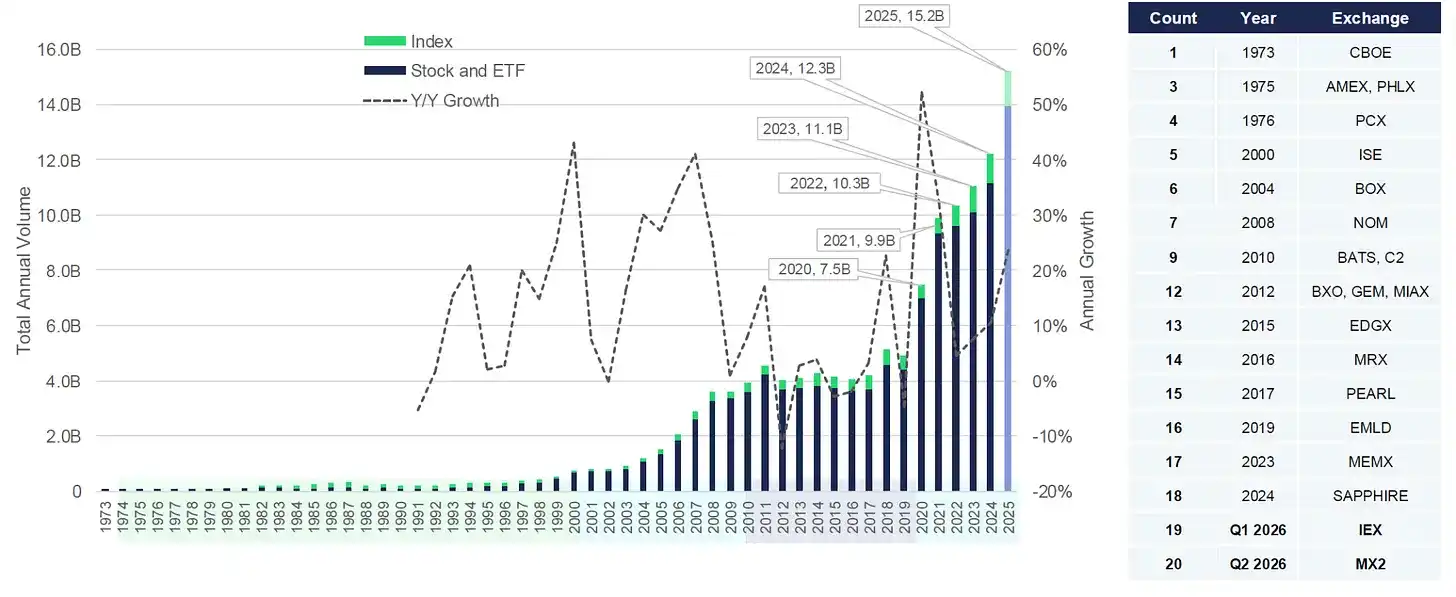
The report places this resurgence in the context of the broader derivatives market. It notes that global exchange-listed options volume in 2024 was more than four times futures volume. In the US, listed options set a sixth consecutive annual record in 2025, with around 15.2 billion contracts traded, equivalent to about $36 billion in daily premium turnover. Meanwhile, 0DTE options have become a dominant force in traditional markets: on SPX alone, peak daily notional exceeded $1 trillion, with average daily volume at 2.3 million contracts and accounting for 59% of that product’s total 2025 activity.
The same report also highlights a regional split in global options participation. India’s National Stock Exchange accounted for roughly 84% of global equity options contracts in 2024, but in value terms US buyers still paid around four times as much total premium as their Indian counterparts. The implication is that Indian retail traders are active in huge numbers of very small contracts, while US participants trade fewer contracts but at larger size and higher price points. Castle Labs argues that crypto options are beginning to draw from this broader trend, though institutional demand remains the main driver for now.
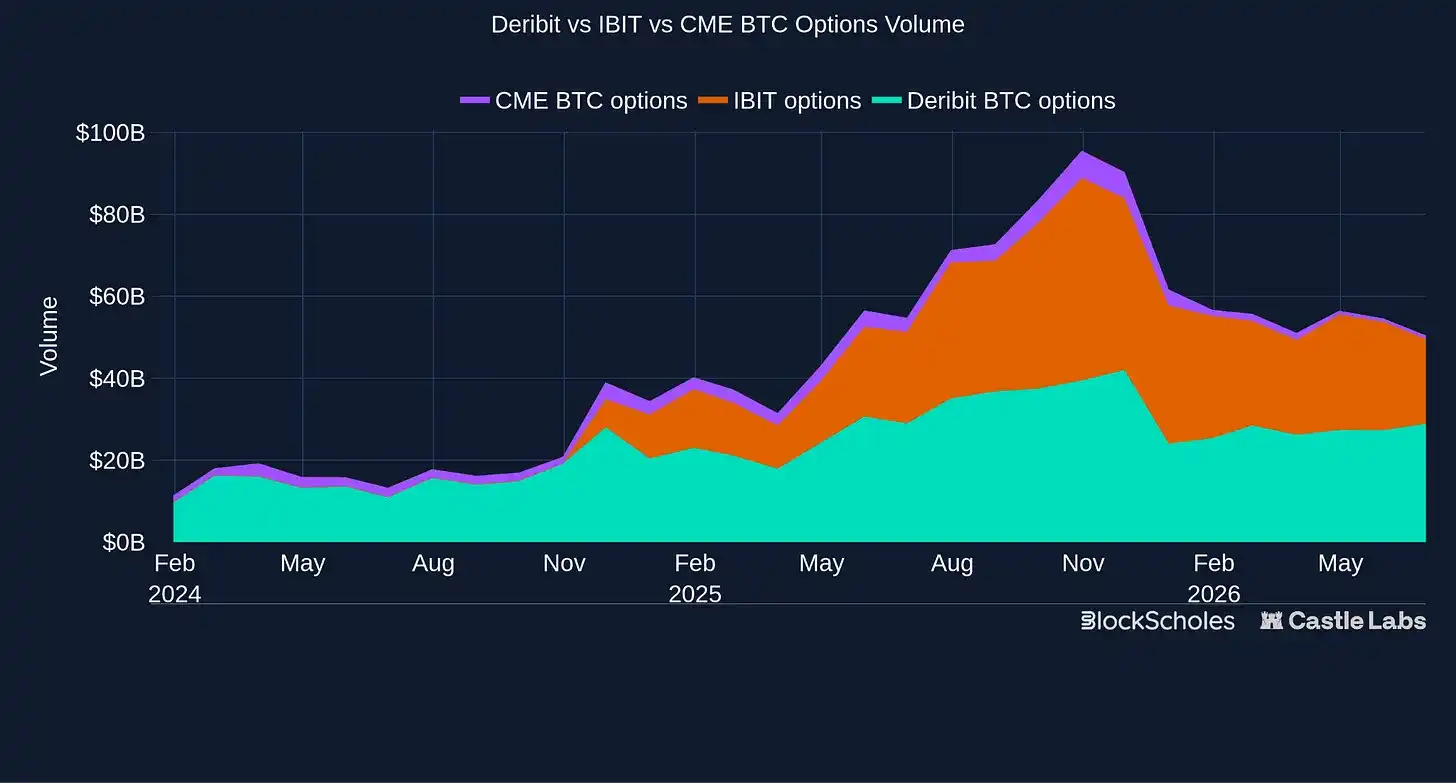
That institutional pull is increasingly visible. CME, the largest regulated derivatives exchange in the US, now offers 24/7 crypto options trading, a major departure from traditional exchange conventions and a sign that crypto’s around-the-clock market structure is reshaping legacy finance. The report also points to the rise of spot ETF-linked derivatives: in April, open interest in BlackRock’s IBIT options rose from $26.9 billion to $27.6 billion and surpassed BTC open interest on Deribit, despite Deribit having launched more than a decade earlier.
Why the first generation of on-chain options failed
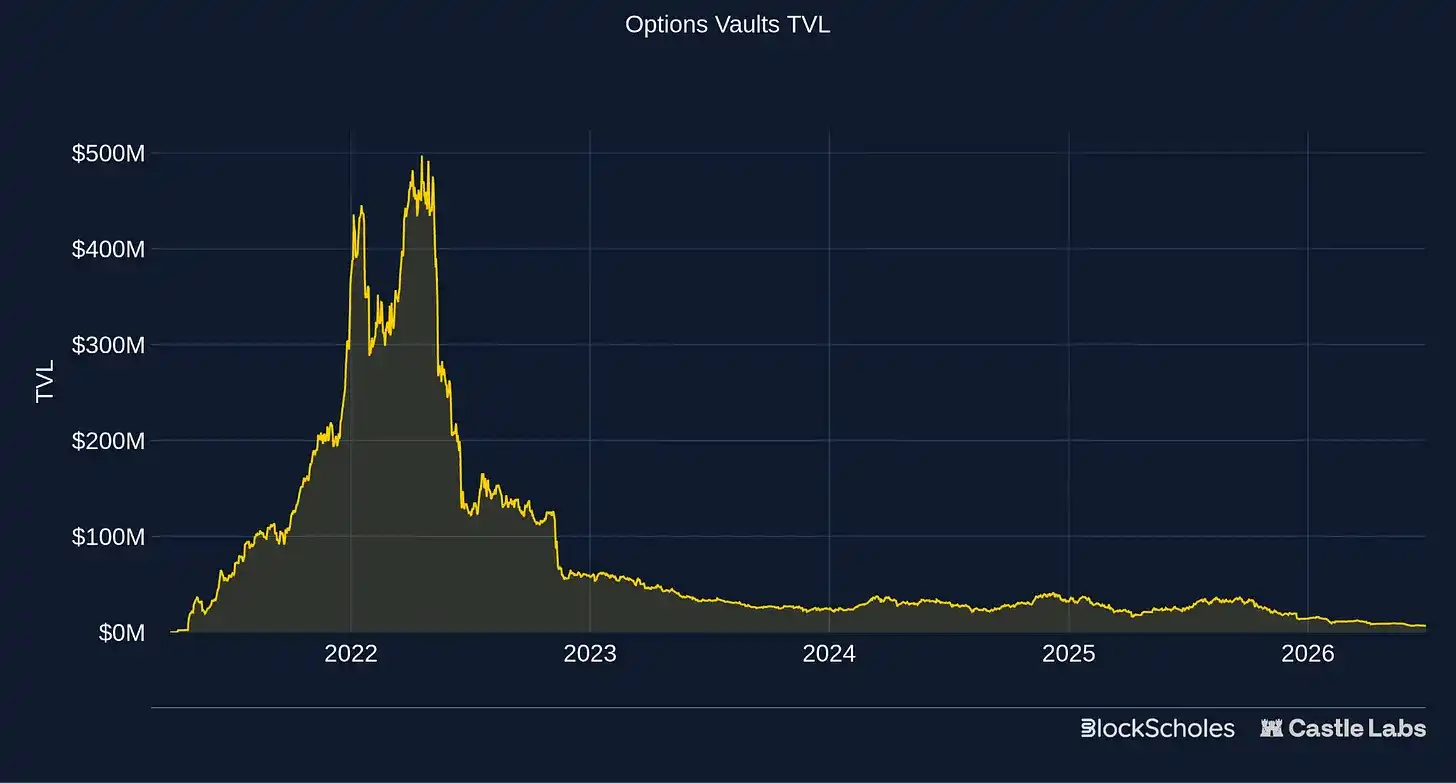
Castle Labs argues that on-chain options did not fail because of a lack of effort. On the contrary, nearly every cycle produced new experiments. Opyn tokenized vanilla options on Ethereum in 2019, but ran into weak liquidity, high collateral requirements, and expensive mainnet execution. Hegic tried a pool-based design in 2020 that simplified the buyer experience, but the LP side absorbed risk that was difficult to hedge. Ribbon, Friktion, and Dopex then popularized structured vaults in 2021, turning options into passive yield products, but those strategies repeatedly sold volatility into shallow and cyclical demand until premiums no longer compensated for the embedded risk.
Other teams pushed further into market design. Lyra, Premia, Pods, and Siren experimented with AMM-based options venues that attempted to provide continuous liquidity across expiries and strike prices. In practice, pricing and hedging were hard to sustain, LPs inherited complicated volatility and inventory exposure, and organic user flow remained thin. Opyn’s later launch of Squeeth in 2022 expanded the design space with perpetual convex exposure tied to ETH squared, but the product remained expensive to carry, difficult to explain, and costly to use on Ethereum at launch.
The report’s central conclusion is that these failures were structural rather than incidental. Market makers were not sufficiently engaged, leaving venues with weak two-sided liquidity. Capital efficiency was poor, making it difficult to form a credible volatility surface. And the user experience sat in an awkward middle ground: too complex for most retail traders, yet still lacking the architecture and precision needed by institutions. As a result, on-chain options never achieved the kind of product-market fit that spot, lending, or perpetual futures found much earlier.
What changed in the latest cycle
Castle Labs says the setup is different today because several bottlenecks have eased at once. Rollups and broader Ethereum scaling have cut gas costs for multi-step on-chain activity and improved execution and settlement. At the same time, AMM-first designs are giving way to CLOB and RFQ infrastructure, which is more natural for professional market makers and volatility traders. Instead of forcing passive LPs to warehouse complex risk, these models allow firms to quote specific strikes and expiries, update pricing dynamically, and manage inventory and hedging more effectively.
Product design has also become narrower and more deliberate. Instead of trying to reproduce a full-service options exchange for every type of user, newer protocols are focusing on specific use cases and user cohorts. Prediction markets have played an important role here: by turning conditional payoff structures into binary, intuitive outcomes, they have made option-like payoffs easier for retail users to understand. In parallel, institutional demand for crypto options has continued to expand through Deribit and, more recently, through CME and ETF-related products such as IBIT options.
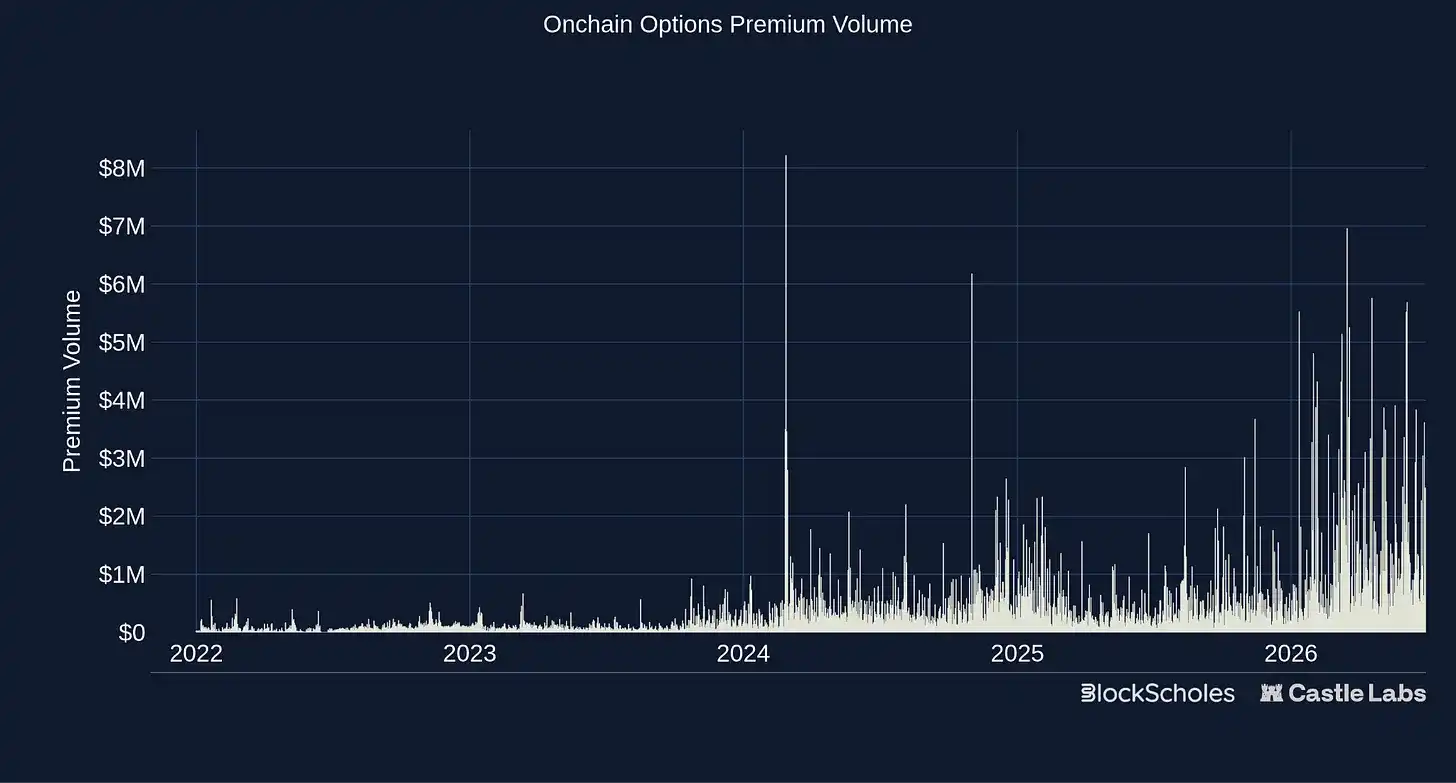
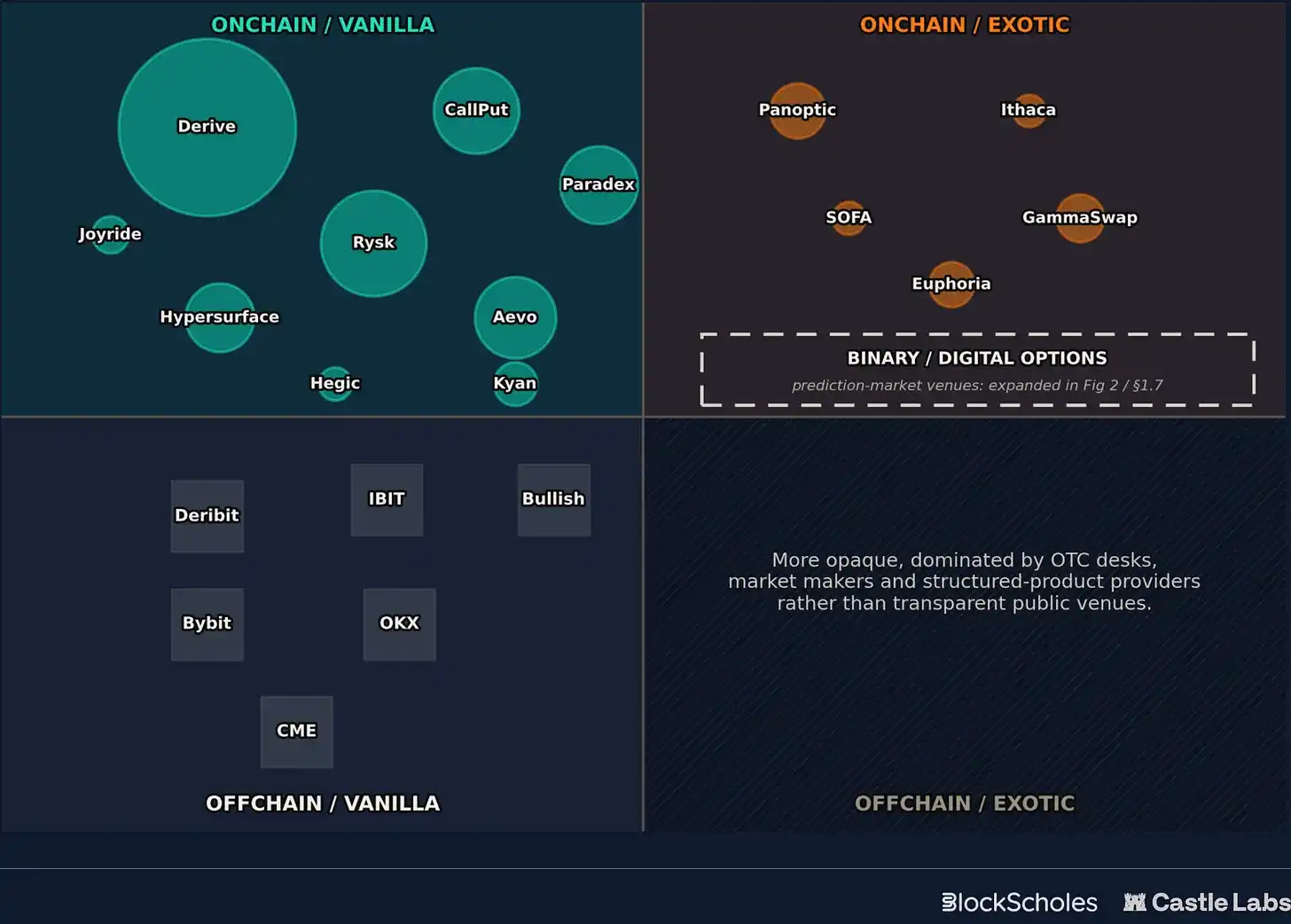
This has produced a market map that looks very different from the first DeFi options wave. Castle Labs frames the ecosystem along two axes: settlement, ranging from on-chain to off-chain; and payoff structure, ranging from vanilla to exotic. Off-chain vanilla options still dominate, led by Deribit, CME, IBIT-related products, and large centralized exchanges such as Binance and OKX. But on-chain activity is now fragmenting into multiple subcategories, including vanilla trading venues, yield-oriented short-volatility products, perpetual options, AMM-native options, and ultra-short-term touch-style contracts.
Derive leads the rebuilt on-chain vanilla market
Among on-chain vanilla venues, the report presents Derive as the clearest example of the new architecture. Derive evolved from Lyra’s AMM-based design into a CLOB-based platform running on its own OP Stack Layer 2. It offers cross-margined options and futures through a professional order book interface and does not attempt to hide the complexity of options trading from its core users. Instead, it is explicitly aimed at market makers, professional volatility traders, and institutional participants who want a venue that resembles a traditional options exchange but preserves on-chain settlement and non-custodial asset ownership.
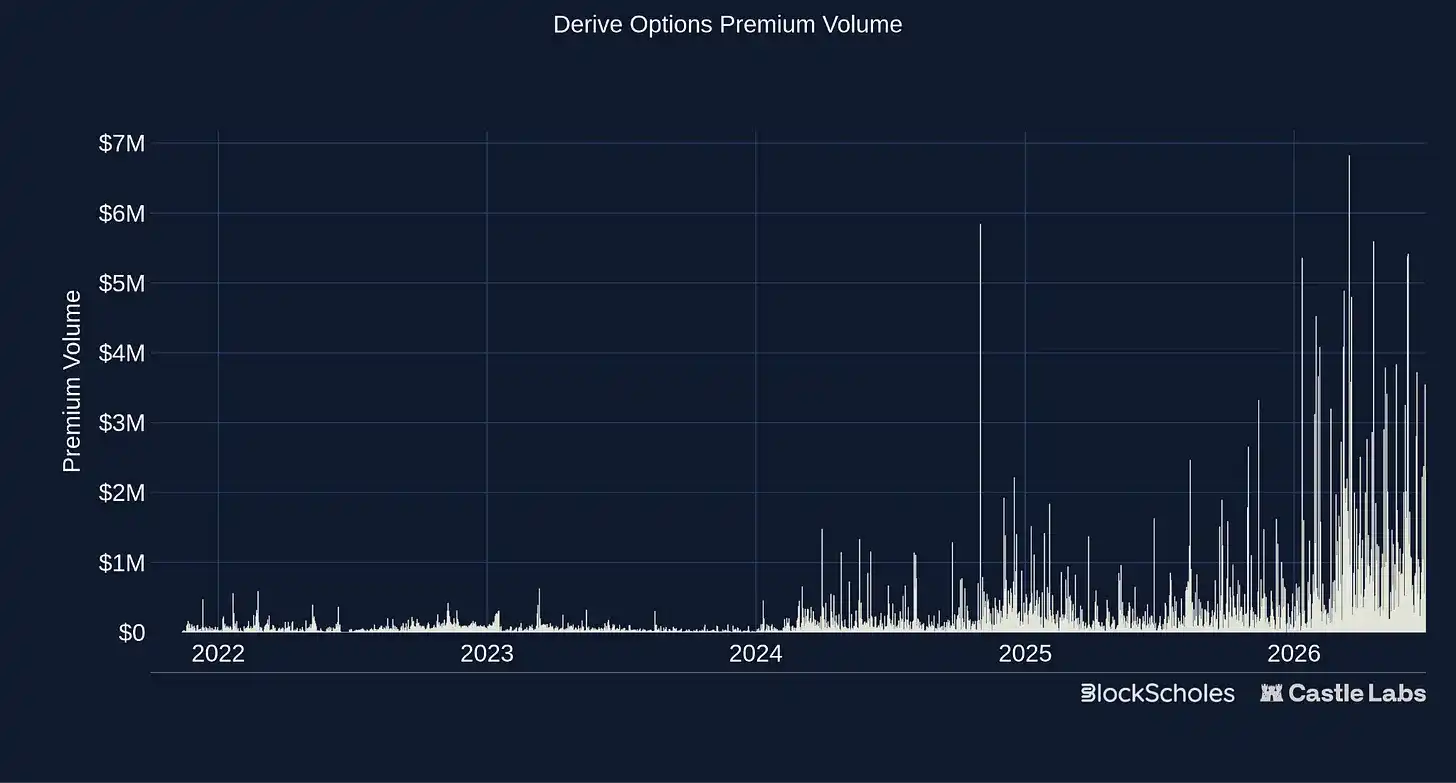
Execution on Derive uses an off-chain matching engine for speed, while settlement happens on-chain on its L2. That combination allows participants to trade with latency closer to a centralized venue like Deribit while maintaining on-chain collateral control. The platform also offers vault products that use the exchange infrastructure to run pre-defined options strategies for depositors. In the past 30 days, Derive generated $1.142 billion in notional volume and $44.3 million in premium volume, equal to 79.2% and 87.2% of the on-chain options category respectively. The report notes, however, that liquidity is still supported by incentives including market maker rewards, OP incentives, DRV rewards, and rebate programs.
Even with those incentives, Castle Labs treats Derive as evidence that the category has matured. Rather than pushing complexity onto passive LP pools, it now resembles a purpose-built, high-performance options venue running on an application-specific chain. In the report’s view, that is a major break from earlier DeFi options experiments.
Rysk’s yield-first model targets a different user base
Rysk is highlighted as a contrasting strategy. Rather than building around general-purpose options trading, the platform focuses on covered calls and cash-secured puts, effectively turning options into prepaid yield products. Users choose the price level at which they are willing to sell or buy an asset, while market makers quote those requests through an RFQ system and manage the hedging elsewhere. That packaging strips away much of the complexity that discouraged earlier users and reframes options as a simple way to earn premium against an existing asset view.
The report says this approach has attracted a broad but coherent user base. Treasuries, DAOs, and funds can use the platform to monetize existing positions while expressing where they would be comfortable buying more or selling some exposure. The analysis cites Hyperion, a Nasdaq-listed HYPE treasury company, as an institutional user running curated vault strategies on Rysk’s infrastructure. Because Hyperion’s stated goal is to accumulate HYPE, cash-secured put strategies become a natural fit: they place bids below the market while collecting yield in the process.
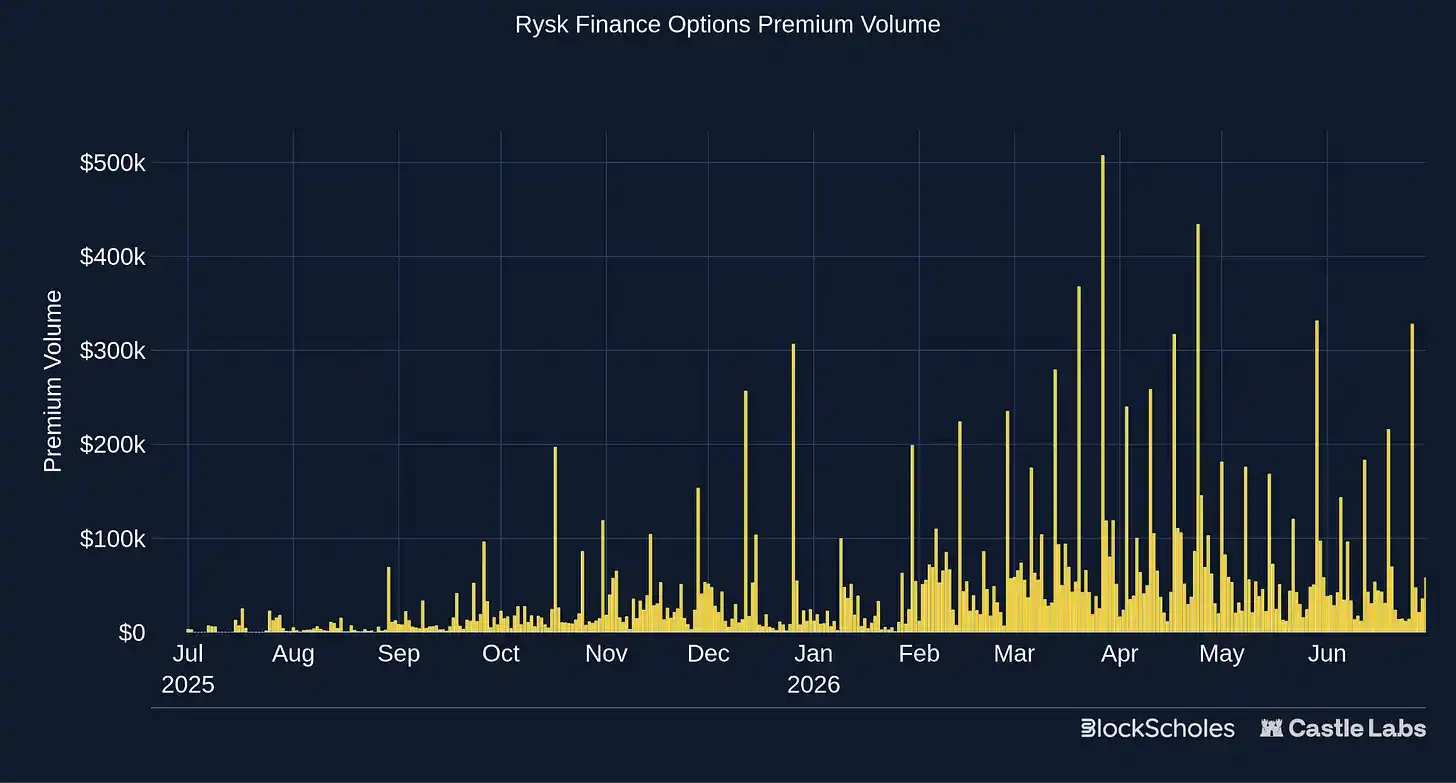
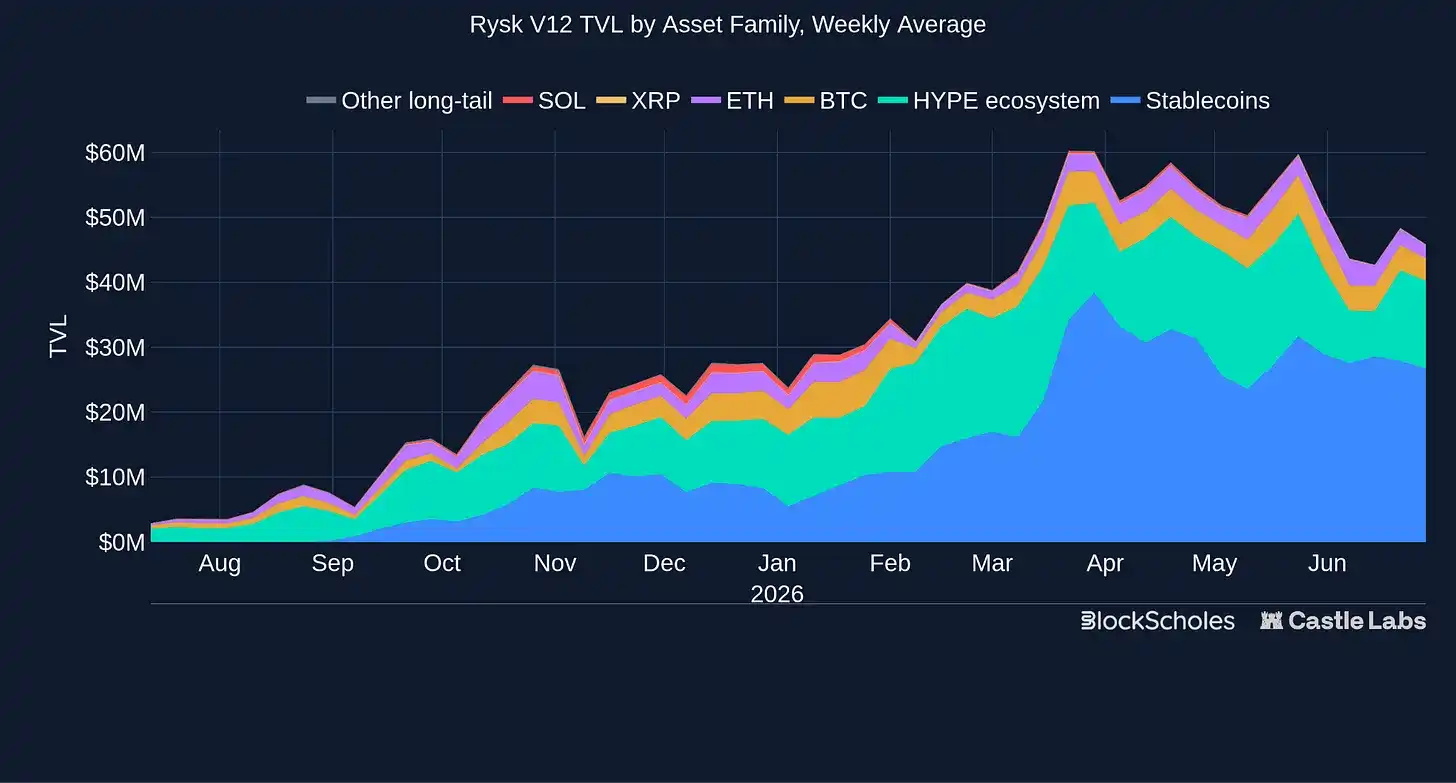
Over the past 30 days, Rysk generated $136.3 million in notional volume and $1.94 million in premium volume, accounting for 9.5% of total category notional. Monthly notional grew from $50 million in January to $182 million in May, after also staying above $175 million in both March and April. Unlike Derive, TVL matters more to Rysk because the product is built around collateralized option selling. To earn premium, users must deposit the full collateral, whereas a platform like Derive can attract directional traders who buy cheap options with low premium outlay in search of large convex payoffs.
Castle Labs argues that this is a meaningful product-market fit in its own right. As yield across the crypto industry compresses, short-volatility income products can compete more directly with lending, staking, and basis trades. Rysk’s growth, in the report’s telling, reflects that shift.
Aevo broadened into a multi-product derivatives venue
Aevo represents a third path. The platform evolved out of Ribbon Finance, one of DeFi’s earliest major options vault teams, but later pivoted into a broader derivatives exchange. It now offers options alongside futures, pre-launch markets, OTC functionality, and automated strategies, all on a custom Layer 2. Like Derive, it uses off-chain matching through a central limit order book while settling on-chain, seeking to replicate the speed and familiarity of centralized exchange trading without requiring users to relinquish custody of funds.
The report notes that Aevo was especially active in options during 2024, but reported TVL and visible options activity have since fallen from earlier highs, even as premium turnover has recently started to improve again. Over the past 30 days, Aevo generated $45.1 million in notional volume and $2.52 million in premium volume, equal to 3.1% of on-chain options notional. Monthly notional rose from $20 million in January to $50 million in May, but real-time options open interest was only around $3.6 million, well below Derive and below Rysk’s estimated proxy for open notional exposure.
Castle Labs suggests that incentives may be supporting part of the recent pickup. Aevo distributes 1 million AEVO in weekly trading rewards, with 30% allocated to options. That likely helps explain some of the rebound in visible options volume. Still, the report’s broader assessment is that Aevo’s strategic focus has shifted toward a more general derivatives exchange, with pre-launch tokens, futures, and trading activity now commanding more attention than options alone.
Smaller venues are diversifying the tail of the market
Below the top three, the market becomes smaller and more fragmented. Paradex, built by the Paradigm.co team, offers futures, options, and Vault Traded Funds, and recently paused perpetual options to focus on expiring options opened in April. To gain share, it has reintroduced zero-fee trading across spot, futures, and options. Hypersurface resembles Rysk in its use of covered calls and cash-secured puts as yield products on HyperEVM. CallPut differentiates itself by extending beyond crypto and offering stock-linked options exposure on names including SPCX, TSLA, NVDA, and COIN.
Kyan evolved from Premia into a broader order book-based derivatives venue with RFQ support, portfolio margin, and multi-leg combinations. Ithaca provides a wider set of options, strategies, and structured products, and recently integrated AI agents for options strategy management. SOFA.org wraps option-like outcomes into branded products such as Earn and Surge rather than asking users to trade options directly. The report says this lower end of the market has become more diverse, with newer entrants such as Kyan, Paradex, and CallPut gaining share in premium volume over recent months.
Even so, Castle Labs cautions that infrastructure alone is not enough. Better order books, RFQ systems, and margin models do not by themselves create reasons for users to choose options over perpetual futures for directional exposure, or over prediction markets for event trading. Demand appears strongest when options are tied to the concrete needs of asset holders. The report cites the HYPE example as proof that targeted products can work: holders want yield, entry and exit management, and a way to monetize exposure without simply selling everything outright.
Exotic and short-term option primitives remain experimental
Beyond vanilla options, the report surveys a set of exotic or ultra-short-duration structures that expand the design space. These include perpetual options, AMM-native options, and touch-style contracts that settle on whether price reaches a zone within a short time window. The analysis acknowledges that these designs are often intellectually interesting and distinctly DeFi-native, but says most remain commercially unproven because they solve for payoff novelty before solving for user demand.
Perpetual options remove the expiry variable and instead give traders ongoing convex exposure funded over time, somewhat analogous to perpetual futures with a volatility tilt. Squeeth remains the historical reference point, and Paradex has also tested perpetual options in the past. But Castle Labs argues that removing expiry does not remove complexity. Users still need to understand convexity, now alongside ongoing funding or premium costs, and they must decide when that exposure is no longer worth carrying. One of standard options’ clearest advantages—knowing the premium and payoff structure upfront—becomes weaker in a perpetual format.
AMM-native options take a different angle. Panoptic uses Uniswap V3-style liquidity ranges to create perpetual options. Instead of paying a fixed premium for a fixed expiry, buyers pay streaming premium over time while the liquidity range acts as the basis for strike and exposure. Panoptic V2 has launched with perpetual options trading for ETH and SPCX. It also offers vault products such as Unicorn Vault, which aims to remain delta-neutral and scalp gamma, and PLP Vault, which combines Uniswap fees, Panoptic premiums, and lending fees on deposited ETH liquidity.
GammaSwap approached the problem from another direction in V1 by allowing users to borrow AMM liquidity and create perpetual option-like exposure, enabling impermanent loss hedging or volatility speculation without relying on oracles. The report notes, however, that products in this category are among the most complex DeFi-native designs in the market. In Panoptic’s case, reducing expiry fragmentation introduces a new set of moving parts including streaming premium, liquidity width, and concentrated AMM range mechanics. GammaSwap has since pivoted more fully toward order book-based binary markets in an attempt to solve its own capital efficiency and complexity problems.
Touch-style contracts and prediction markets may be the simpler gateway
The report says ultra-short-term touch options may be the farthest removed from standard calls and puts. Instead of choosing a strike and expiry in a classical format, users select a simple condition over a short horizon: will price enter this zone, settle above this level, or finish in the money within the next few minutes? Euphoria’s Tap Trading is presented as a recent on-chain example. Users select a grid square representing a five-second price band, and market makers pre-quote the payout based on spot distance, time to expiry, and volatility. If price touches the chosen region before expiry, the trade wins; if not, it expires at zero.
Castle Labs says this design competes less with conventional options exchanges and more with perpetual futures, prediction markets, and mobile-first wagering products. Its appeal lies in simplicity. Users can understand the trade quickly and gain convex exposure without managing funding rates, liquidations, Greeks, or classic time decay. That same simplicity is part of why the report sees prediction markets as an important educational bridge into on-chain options more broadly.
In one of its more direct conclusions, the report argues that financial prediction markets—such as BTC up-or-down contracts—are structurally equivalent to binary options, a well-known and heavily studied instrument in traditional finance. Each contract pays a fixed amount if the condition is met at expiry, and $0 otherwise. Retail users may not recognize the connection, but Castle Labs believes the recent popularity of prediction markets is effectively the first major proof that non-linear payoff products can achieve broad on-chain traction when their interface is intuitive enough.
The final takeaway is that on-chain options are no longer just trying to become an on-chain Deribit clone. Infrastructure has improved, and market structure has matured, but future growth will likely depend on building targeted products around specific user problems. In Castle Labs’ view, the protocols with the best chance of lasting success will be the ones that give traders and holders a clear reason to choose options over perpetuals or prediction markets, rather than simply offering another venue with better plumbing.