
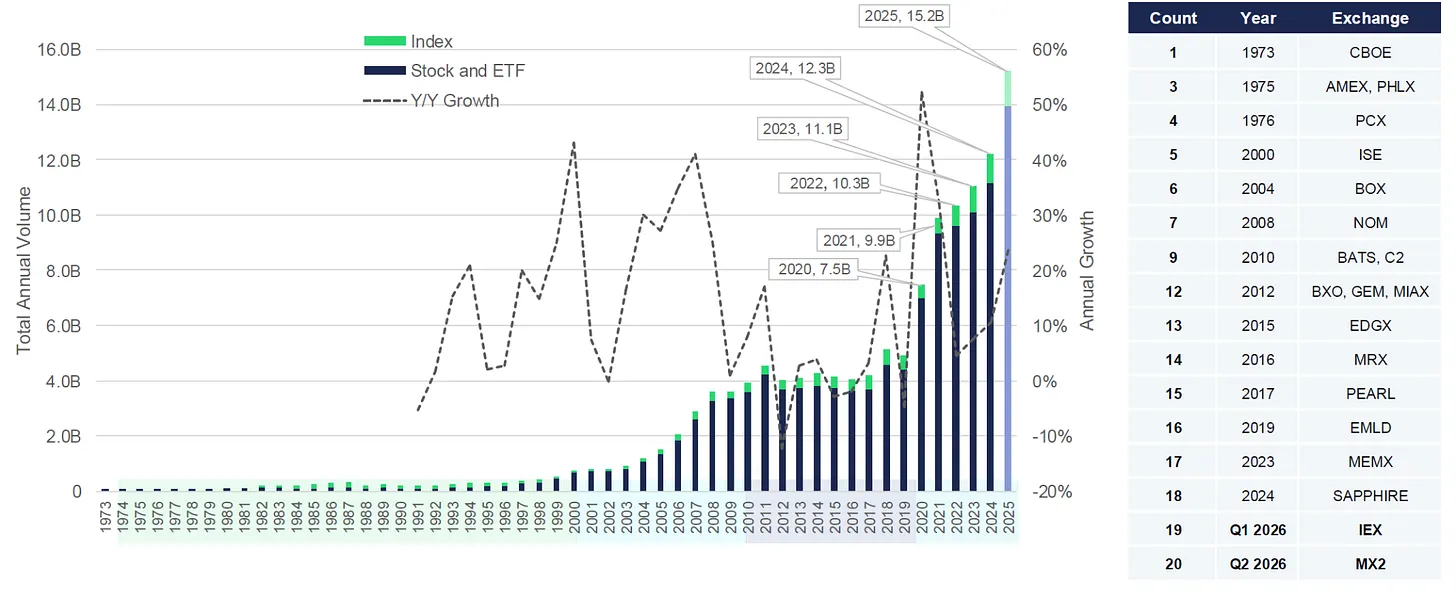
On-chain options were once viewed as one of the most natural derivatives for crypto markets, yet they became one of DeFi’s most visible failures. In research highlighted by TechFlowPost, Castle Labs argues that the sector is now rebuilding after multiple abandoned attempts by protocols including Opyn, Hegic, Ribbon, Friktion, Dopex, Lyra, Premia, Pods and Siren. The report says the original wave ran into the same structural barriers again and again: shallow liquidity, weak capital efficiency, difficult pricing, and a user experience that was too complex for retail traders while still lacking the institutional-grade architecture professional firms needed. Those constraints did not kill demand for options as a product; they mainly showed that the market infrastructure arrived too early.
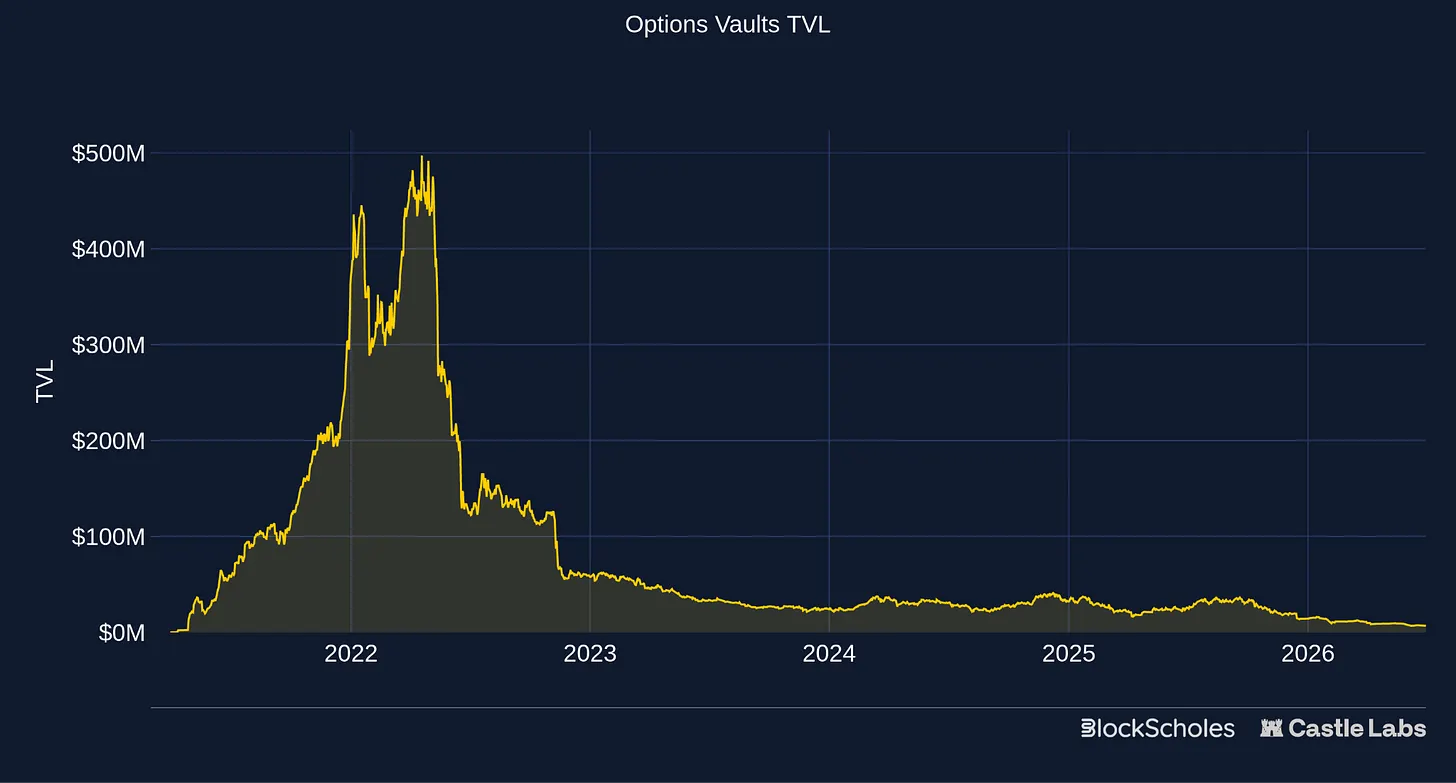
The backdrop outside crypto makes the renewed interest easier to understand. Options have become the dominant force in listed derivatives globally. The report notes that in 2024, options contract volume was more than four times futures volume, and in 2025 U.S. listed options posted a sixth consecutive record year with roughly 15.2 billion contracts traded, equivalent to about $36 billion in daily premium turnover. Ultra-short-dated contracts are a major part of that story. In SPX alone, 0DTE options at their peak surpassed $1 trillion in daily notional value, with average daily volume of 2.3 million contracts and a 59% share of the product’s 2025 annual activity.
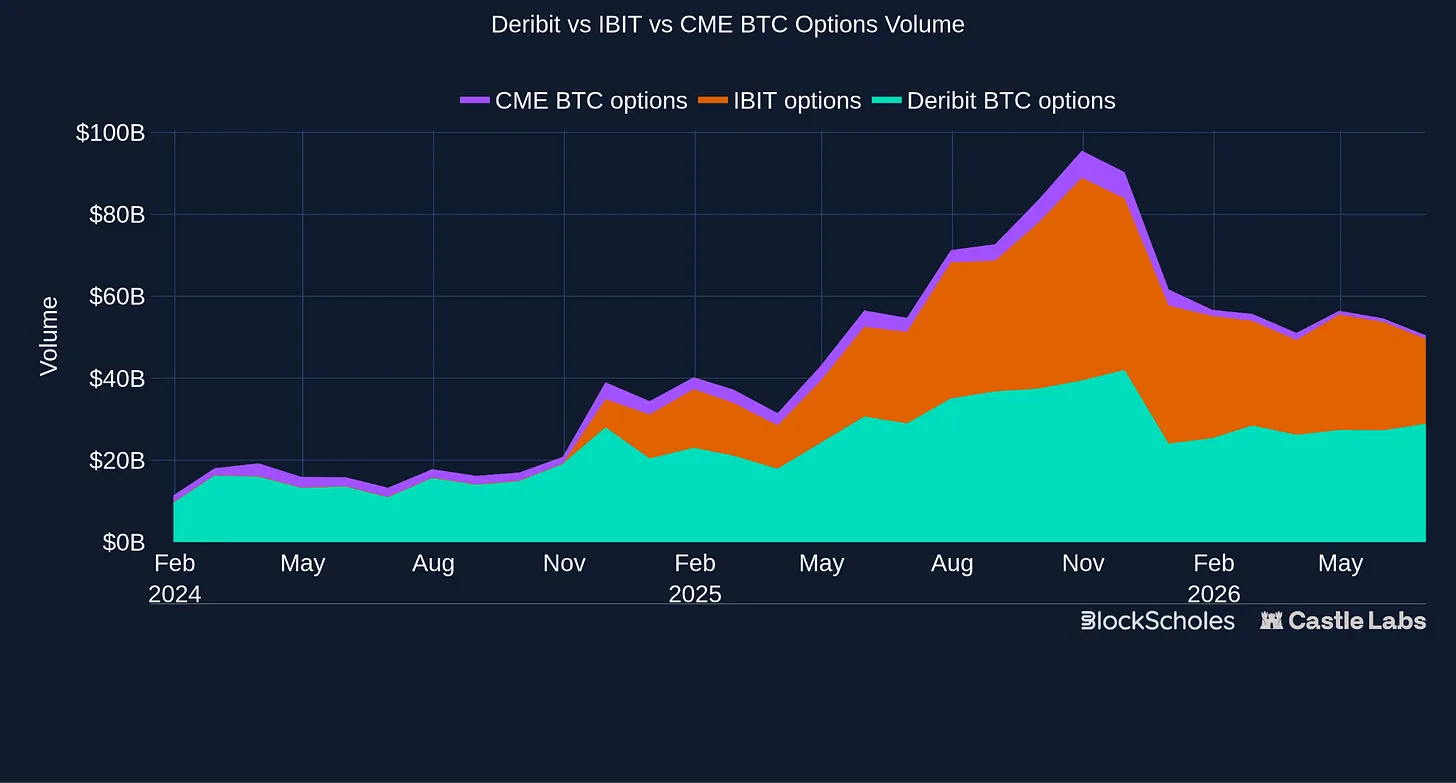
Geographic participation also differs sharply depending on how activity is measured. India’s National Stock Exchange accounted for about 84% of global stock options contract volume in 2024, yet U.S. option buyers still paid roughly four times as much premium in total value terms. That suggests Indian retail traders are active in huge numbers of very small contracts, while U.S. participants trade fewer but larger and more expensive positions. Crypto is beginning to absorb some of the same options demand, especially from institutions. CME now offers 24/7 crypto options, an unusual concession by a regulated traditional exchange to the round-the-clock nature of digital asset markets. In April, open interest in BlackRock’s IBIT options reportedly rose from $26.9 billion to $27.6 billion, overtaking BTC options on Deribit.
Why the first DeFi options wave failed
The early on-chain ecosystem covered nearly every design path the market could imagine. Opyn tokenized vanilla options on Ethereum in 2019. Hegic introduced a peer-to-pool model in 2020 to simplify buying flows. Ribbon, Friktion and Dopex launched vault-based products in 2021, turning options into structured “deposit-and-earn” strategies. Lyra, Premia, Pods and Siren experimented with AMM-based options markets, trying to maintain liquidity across strike prices and expiries. In 2022, Opyn introduced Squeeth, a perpetual instrument designed to track squared ETH exposure and offer convexity without managing dated contracts.
Despite the breadth of experimentation, the same issues kept surfacing. Market maker participation was limited, so two-sided liquidity remained thin and hard-to-hedge risk often ended up with passive LPs. Capital requirements were high, pricing was unreliable, and volatility surfaces were difficult to maintain on-chain. Ethereum mainnet costs added further friction, making sophisticated strategies expensive to execute and roll. The result was an awkward middle ground: products were too complicated for most retail users, while institutions still found the architecture too immature for serious deployment.
Castle Labs’ core argument is that on-chain options were not underexplored; rather, they were attempted before the surrounding stack was ready. Many protocols effectively tried to become an on-chain version of Deribit without the performance, risk management, or professional liquidity base needed to support that ambition. The market did not reject options themselves so much as the way they were first implemented in DeFi.
What changed: rollups, order books, RFQ and clearer user segmentation
The current revival is built on a very different infrastructure layer. Rollups and Ethereum scaling have reduced gas costs enough to make more complex trading and settlement flows economically viable. Just as important, CLOB and RFQ models are replacing AMM-heavy designs in much of the sector. That shift allows professional market makers to quote specific strikes and expiries, update prices in real time, and manage risk in a way that looks much closer to established off-chain options markets.
The product side has also become more specialized. Rather than trying to serve every possible user, newer platforms are targeting narrower needs. Some are clearly built for professional volatility traders, with cross margin, portfolio margin and exchange-style order books. Others package options into more intuitive yield products for token holders who already have views on the prices at which they would be willing to buy more or sell some exposure. The report also highlights prediction markets as a major educational force. By normalizing binary, conditional payoffs for retail users, prediction markets have effectively prepared a broader audience for options-like products even if those users do not think of them in derivatives terms.
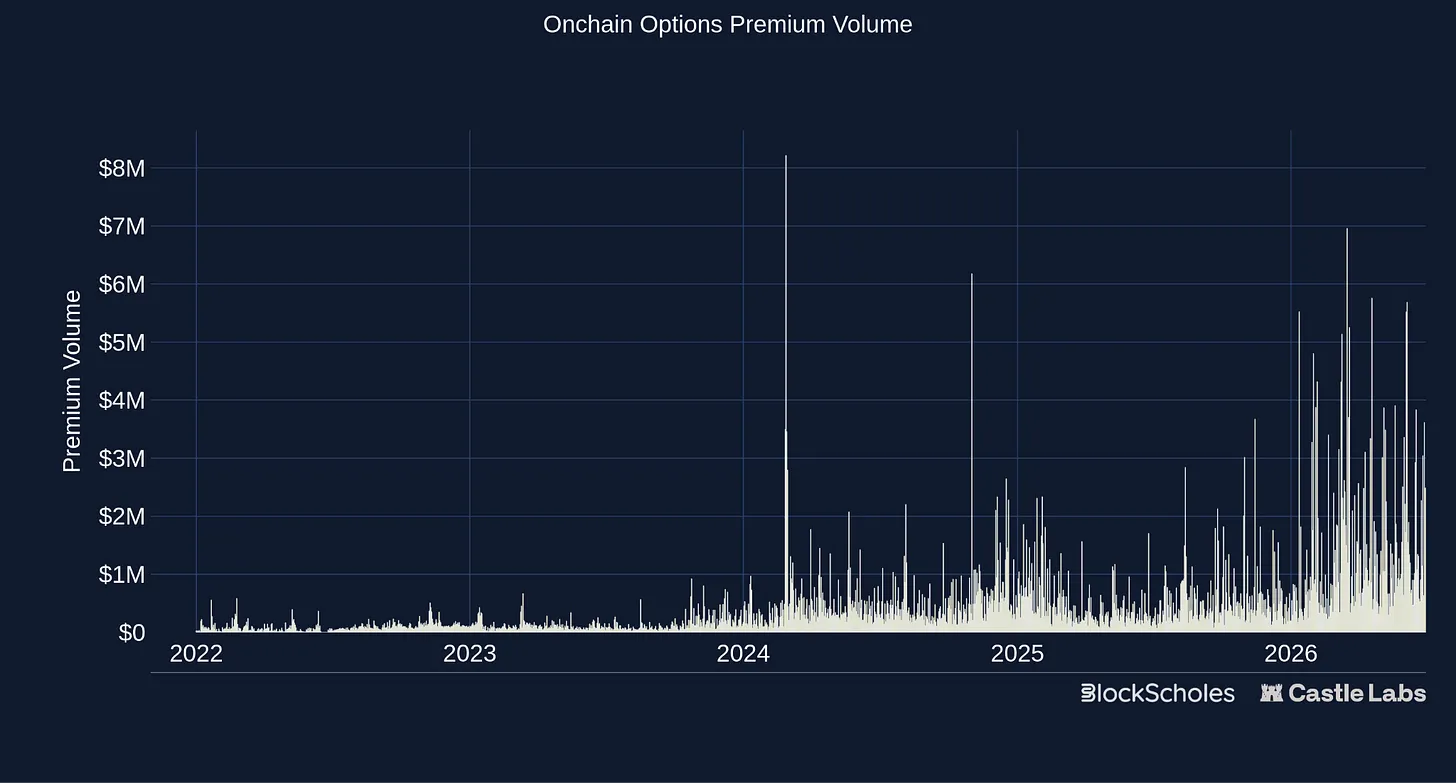
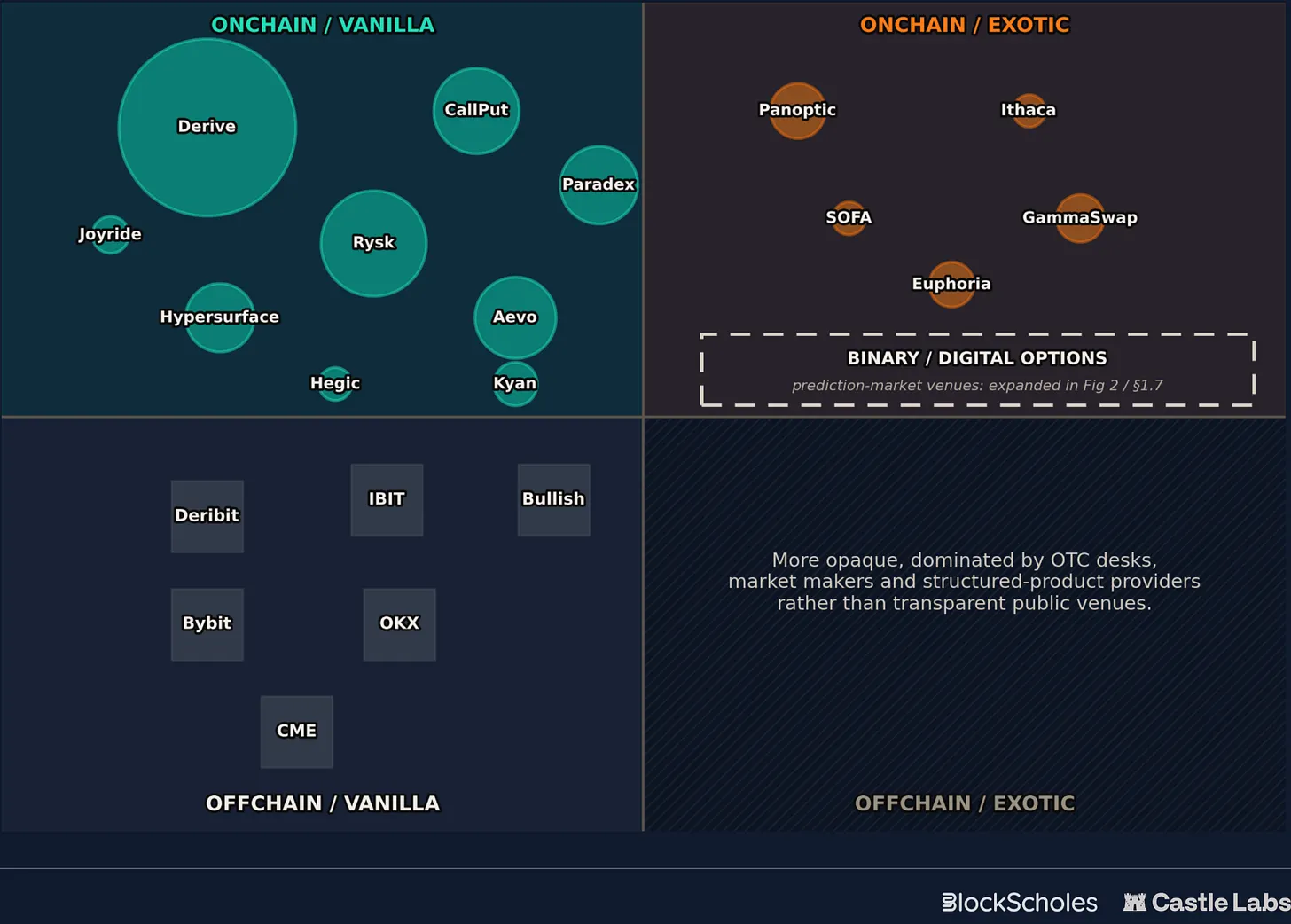
Those improvements are now visible in the data. The report estimates that on-chain options have reached roughly $1.44 billion in 30-day notional volume, while premium volume has hit a new yearly high. Just as importantly, the category no longer revolves around a single idea of building “an on-chain Deribit.” Today’s landscape includes on-chain vanilla venues, perpetual options concepts, AMM-native options, very short-term touch-style structures, and binary-style markets that overlap with prediction products.
Derive leads the rebuilt vanilla options market
Derive is presented as the clearest example of the architectural transition now underway. The platform evolved from Lyra, an earlier AMM-based options protocol, into a CLOB-based venue running on its own OP Stack Layer 2. It offers options and futures with cross margin through a professional exchange interface aimed at market makers, institutions and experienced volatility traders. Rather than trying to conceal complexity, Derive embraces a structure that resembles a traditional listed options venue, with multiple assets, expiries and strikes that can be combined into custom payoff structures.
Execution uses an off-chain matching engine for speed while settlement occurs on-chain on its Layer 2, a design intended to give institutions and sophisticated traders an experience closer to centralized exchanges while preserving non-custodial ownership of funds. Derive also offers vault products, but unlike older DeFi vault experiments, these strategies are built on top of a more mature trading venue that can execute options positions directly rather than relying on crude passive LP mechanics.
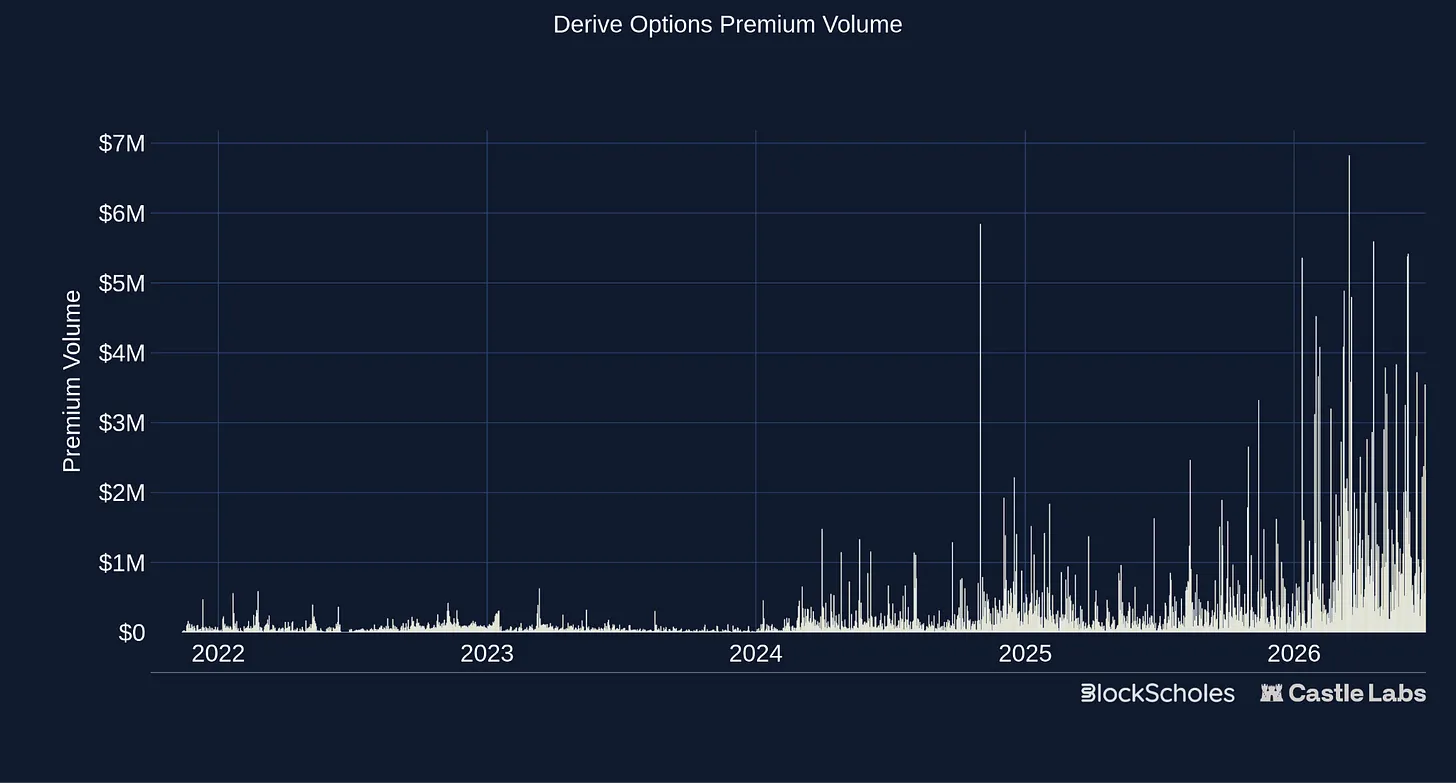
By the report’s numbers, Derive is currently the dominant on-chain options venue. Over the last 30 days it generated $1.142 billion in notional volume and $44.3 million in premium volume, representing 79.2% and 87.2% of the category respectively. The study does note that Derive supports activity with a range of incentives, including market maker rewards, OP incentives, DRV rewards and rebate programs. Even with that caveat, the platform is portrayed as evidence that a professionally structured options exchange can now operate on a high-performance application chain in a way that was not realistic during the first DeFi options cycle.
Rysk reframes options as yield rather than trading
Rysk takes a very different route. Instead of building around professional volatility trading, it centers its offering on covered calls and cash-secured puts, effectively turning options into pre-defined yield products. Users choose the price levels at which they would be willing to sell or buy an asset, and the platform routes demand through an RFQ system where market makers quote specific requests and manage the risk elsewhere. The complexity of options remains in the backend, while the frontend experience is closer to a guided yield interface.
The report argues that this is where Rysk has found product-market fit. Treasury managers, DAOs and funds often already have target buy and sell levels for long-held assets, even if they do not want to trade actively on a short horizon. Selling options around those views lets them collect premium while they wait. Castle Labs points to Hyperion, a Nasdaq-listed HYPE treasury company, as an example of an institutional user deploying curated vault strategies on Rysk’s infrastructure. Because its mandate is to accumulate HYPE, a cash-secured put structure naturally aligns with placing lower bids while earning yield on idle collateral.
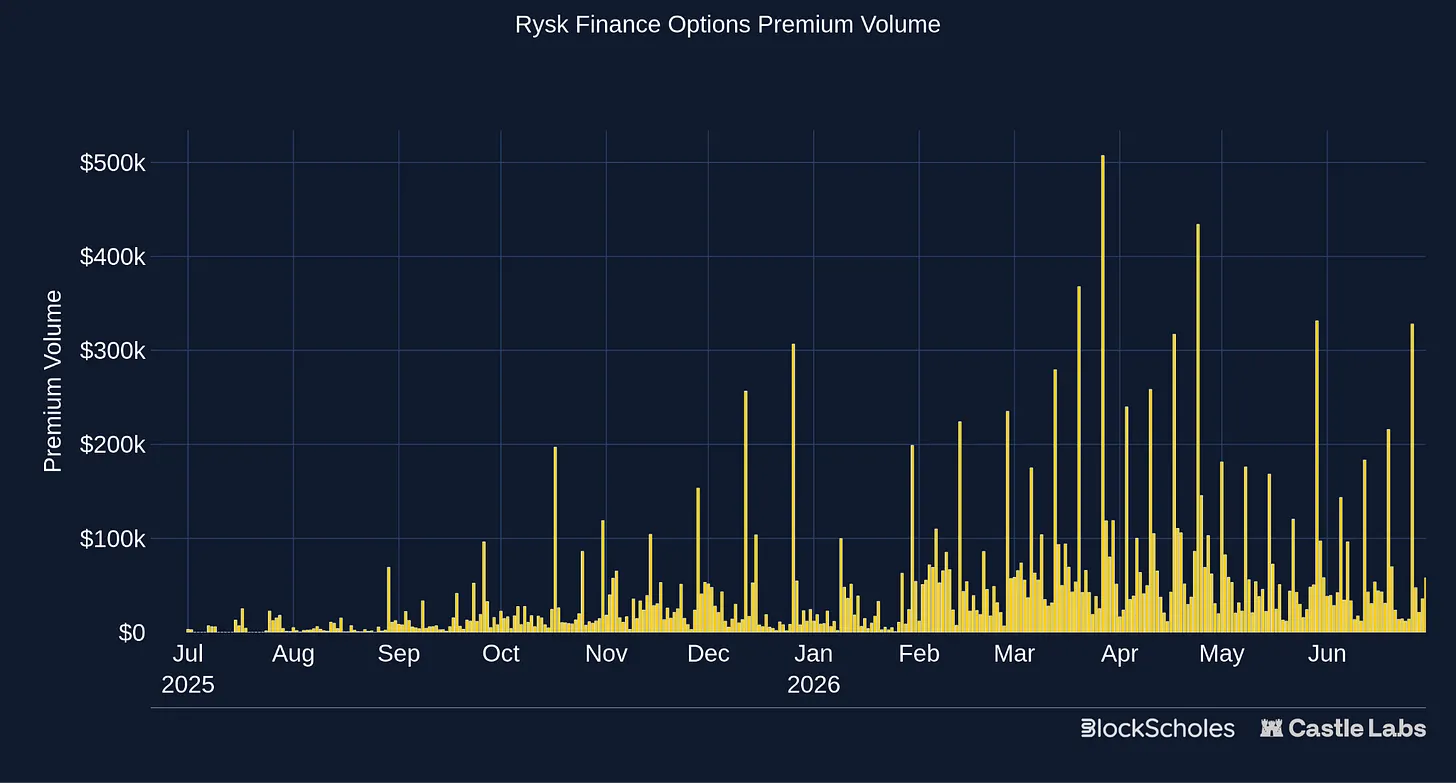
Rysk generated $136.3 million in 30-day notional volume and $1.94 million in premiums, accounting for about 9.5% of category notional volume. Monthly notional volume reportedly rose from $50 million in January to $182 million in May, while March and April both stayed above $175 million. Unlike Derive, TVL matters more directly for Rysk because its strategies depend on fully collateralized option-selling structures. The report frames this as a meaningful distinction: users on Derive can buy relatively cheap optionality with limited premium outlay, whereas Rysk’s model depends on committed capital that backs a yield-generating strategy.
Aevo remains in the market, but options are no longer the whole story
Aevo followed its own evolution from an options-first identity toward a broader derivatives exchange. It emerged from Ribbon Finance, one of the earliest major DeFi options vault teams, and now operates a custom Layer 2 venue offering options, perpetuals, pre-launch markets, OTC products and automated strategies. Like Derive, it uses off-chain order matching and on-chain settlement in an effort to combine centralized-exchange speed with self-custodied funds held in smart contracts.
Aevo launched in 2023 and was among the most active venues for options during 2024. Since then, according to the report, its TVL and visible options activity have fallen from earlier peaks, although premium volume has recently started to recover. Over the last 30 days, Aevo generated $45.1 million in notional volume and $2.52 million in premium volume, equal to about 3.1% of on-chain options notional activity. Monthly notional value rose from $20 million in January to $50 million in May, but live options open interest was only around $3.6 million, far below Derive and also below Rysk’s implied open interest proxy.
The report suggests that incentives may be supporting part of the recent rebound. Aevo distributes 1 million AEVO per week in trading rewards, with 30% earmarked for options. That may help explain rising options activity, but it also underscores a broader point: Aevo now looks more like a general derivatives venue where attention is concentrated on perpetuals, pre-launch markets and trading activity overall. Options remain present, but they no longer appear to be the platform’s single defining business line.
Other venues are diversifying the lower end of the market
Below the top three, the market is smaller and more fragmented, but still increasingly varied. Paradex, built by the Paradigm.co team, offers perpetuals, options and various VTF products. It previously supported perpetual options, but more recently paused that function and shifted focus to expiring options opened in April, while also reintroducing zero-fee trading across spot, futures and options to attract share. Hypersurface resembles Rysk in its use of covered calls and cash-secured puts as yield products on HyperEVM.
CallPut distinguishes itself by expanding beyond crypto into equities, listing stocks such as SPCX, TSLA, NVDA and COIN through a request-based execution model and protocol-managed liquidity. Kyan evolved out of Premia into a broader derivatives platform with order-book trading, RFQ support, portfolio margin and multi-leg combination trading. Ithaca offers a broad menu of options, strategies and structured products, recently adding AI agents to help manage options strategies. SOFA.org packages options-like outcomes into branded structured products such as Earn and Surge instead of asking users to trade listed options directly.
The report’s broader conclusion is that better infrastructure alone does not create demand. Order books, RFQ systems, cross margin and portfolio margin are enabling layers, not demand generators by themselves. Users still need a clear reason to choose options over perpetuals for directional exposure, or to prefer options over prediction markets for event-driven trading. Demand appears strongest when options are tightly aligned with a specific asset-holder problem, as in the HYPE example tied to Rysk. For the category to expand materially from here, teams likely need to ship products that solve a user problem better than perpetuals or prediction markets can.
Exotic and short-term structures are expanding the design space
Beyond vanilla options, the report surveys a group of more experimental “on-chain exotic” or short-term primitives. These products move beyond listed calls, puts and simple spreads. Some remove fixed expiries, others derive options-like exposure from AMM liquidity, and some settle based on whether price touches a region within a very short time window. In principle, these designs showcase the flexibility of on-chain finance. In practice, most remain commercially unproven and often appear to solve an elegant payoff-design problem before proving they solve a user-demand problem.
Perpetual options are one such example. By eliminating expiry, they aim to offer continuous convexity in a way that feels analogous to perpetual futures. Squeeth remains the best-known historical example, while Paradex also experimented with the format before narrowing its current live options offering to expiring contracts. The report argues that removing expiry does not actually remove complexity. Users still need to understand convexity, but now they must also monitor ongoing funding or premium flows and decide when carrying the position is no longer worth the cost. That weakens one of standard options’ main advantages: knowing the premium and payoff structure in advance.
AMM-native options represent a more distinctly DeFi-native branch. Panoptic uses Uniswap V3-style liquidity ranges to create perpetual options exposure. Instead of paying a fixed upfront premium for a dated contract, buyers pay streaming premiums over time, while the liquidity range itself acts as the basis for strike-like exposure. Panoptic V2 recently launched with perpetual options trading on ETH and SPCX. On the liquidity side, depositors can enter products such as the Unicorn vault, which aims to remain delta neutral while scalping gamma, or the PLP Vault, which earns Uniswap fees, Panoptic premiums and borrowing fees from deposited ETH liquidity.
GammaSwap explored a related but distinct concept in V1, allowing users to borrow AMM liquidity and create perpetual options-like exposure. That design was intended to support impermanent-loss hedging or token volatility speculation without relying on oracles. But the report emphasizes just how complex these products are in practice. Panoptic removes expiry fragmentation, yet introduces streaming premiums, liquidity-width parameters and concentrated-liquidity mechanics that require users to be comfortable with Uniswap V3 and LP dynamics. GammaSwap has since pivoted more fully, moving toward order-book-based binary markets focused on crypto, with the goal of simplifying convex trading and removing liquidation risk. In those products, users either finish correct and receive a fixed payoff, or they finish wrong and lose the stake.
Touch products and prediction markets blur the boundary with options
At the shortest end of the spectrum, touch-style structures may be the farthest from conventional listed options. Instead of selecting a strike and expiry in the standard sense, users choose a simple condition over a brief time window: will price enter a zone, finish above a level, or settle in the money within the next few moments? Euphoria’s Tap Trading is presented as a current on-chain example. Users select a grid square representing a price range over a five-second window. Professional market makers quote the payout in advance based on distance from spot, time to expiry and volatility. If the selected zone is touched before expiry, the trade wins; otherwise it expires worthless.
That direction increasingly overlaps with binary market structures and with the broader rise of prediction products. The appeal is not sophistication but simplicity. Users get quick feedback, convex exposure and a clear payoff without managing funding rates, liquidation thresholds, Greeks or time decay in the way traditional options require. In that sense, the real competitors for these products are often perpetuals, prediction markets and even mobile-style betting interfaces rather than listed options exchanges.
The report closes by making that connection explicit. Financial prediction markets, including simple “BTC up or down” contracts, are structurally equivalent to binary options: they pay a fixed amount if a condition is met at expiry and $0 otherwise. The recent popularity of prediction markets among retail users may therefore represent the first large-scale on-chain adoption of nonlinear payoff products, even if many participants do not think of themselves as options traders. That user education could prove important for the future of the broader on-chain options ecosystem.
Overall, Castle Labs does not argue that on-chain options are already fully mature. Instead, it suggests the sector has finally moved beyond its first era of repeated, infrastructure-constrained experiments. A more coherent division of labor is emerging: professional flow is gravitating toward venues such as Derive, yield-oriented demand is finding products such as Rysk, multi-product exchanges like Aevo continue to keep options available, and more aggressive experimentation is happening in exotics and binary-style markets. After a long list of failures, on-chain options have not disappeared. They are being rebuilt in forms that look more compatible with real user demand.