
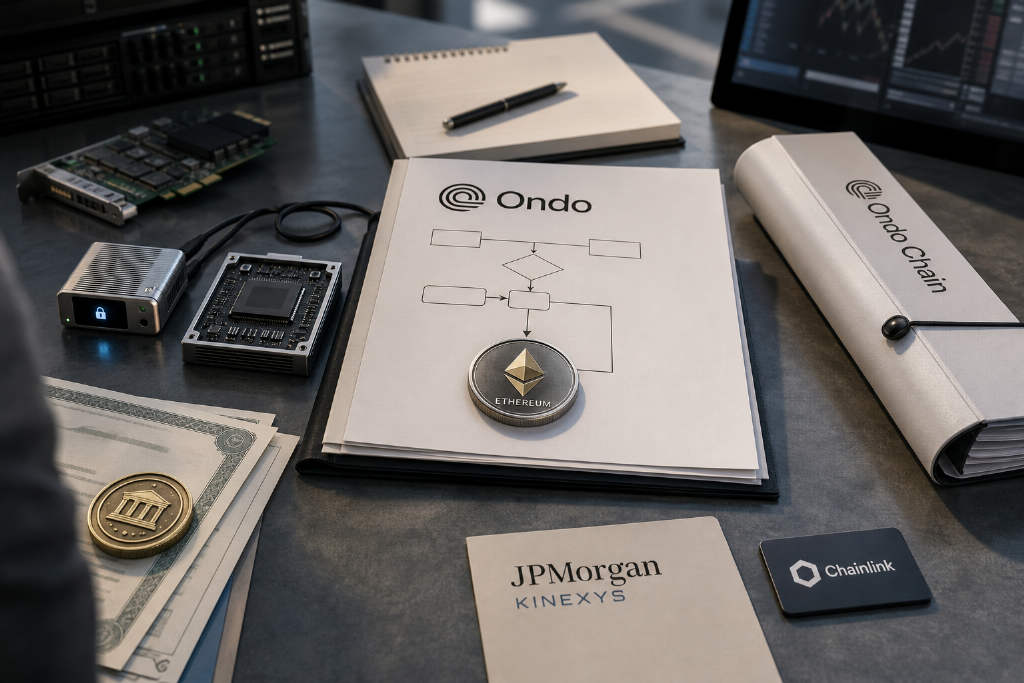
Ondo Finance has decided it will not run a standalone blockchain alongside its newer trading stack. Chief executive Ian De Bode confirmed that the company is dropping the blockchain project and keeping Ethereum as the settlement layer, while moving execution and verification out of the chain-based design.

That marks a sharp turn from the roadmap Ondo had been pursuing for roughly 17 months. The company had already built a working testnet and a tokenized Treasury settlement system, and JPMorgan’s Kinexys had used Chainlink on that testnet to settle tokenized Treasuries.
From Ondo Chain to Ethereum settlement
On July 27, Ondo Finance published a blog post introducing Ondo Network. The new design looked very different from what the company had announced 17 months earlier.
The earlier plan centered on Ondo Chain, a Layer 1 network built for tokenized real-world assets. It featured permissioned validator nodes, passive income staking, and native bridging. Franklin Templeton, WisdomTree, and Wellington were listed among its backers. Kinexys, the JPMorgan unit, had also tested settlement of tokenized Treasuries on the network with Chainlink.
That architecture is no longer the one Ondo plans to carry forward. The company is now keeping settlement on Ethereum while shifting execution and verification into an off-chain system.
Execution moves into trusted execution environments
Under the new setup, code runs inside hardware enclaves, also known as trusted execution environments, or TEEs. These are sealed modules on server chips where code can execute without the server operator being able to read or alter it.
Each enclave generates a hardware fingerprint for the code it is running. Change a single byte and the fingerprint changes too, causing verification to fail.
Verification depends on a group of independent validators. Before an enclave starts, they compare its fingerprint against approved code. They also hold fragmented key shares, so no single operator, including Ondo, possesses a complete key. The full key can only be reassembled inside an enclave whose code has already been verified.
Settlement remains on Ethereum. Asset transfers still happen on a public blockchain, as before.
Ondo’s view: blockchains bundle too many functions together
According to the article, Ondo sees blockchains as bundling four separate functions into one system: consensus, replication, transparency, and final-state settlement.
In that view, consensus and replication slow systems down, while transparency exposes all information. Those trade-offs are not useful for order matching, so Ondo has moved execution off-chain and left settlement on-chain.
The company’s position is summed up in a quote included in the piece: 「匹配引擎需要一个确定性的序列器,而复制操作会给每个订单增加延迟。」

ASX’s CHESS overhaul as a warning case
The article compares Ondo’s decision with the Australian Securities Exchange’s attempt to replace its CHESS clearing and settlement system. ASX spent more than seven years trying to replace it with a distributed ledger system from Digital Asset and bought an 8.5% stake in that company in 2016.
Launch targets kept slipping and were only finalized after 2021. By the end of 2022, an Accenture audit found that just 63% of the software development had been completed, with no credible delivery timeline in place. The audit stated: 「分布式系统会引入更高的延迟。」
After the project collapsed, ASX wrote down as much as A$255 million. The Australian Securities and Investments Commission sued the exchange over misleading market updates, and brokers that had connected to a system that was never deployed lost tens of millions of Australian dollars as well.
Traditional markets already separate matching from settlement
The article notes that the New York Stock Exchange and Nasdaq use private matching engines run by a single company. They do not replicate order books across hundreds of computers, and traders do not want their live orders visible to the entire market.
Trades are then sent to DTCC for settlement. DTCC is slower, but it is a shared industry utility. According to the piece, a DTCC subsidiary processed $47 trillion in securities transactions in 2025.
The article says no blockchain today can handle that kind of volume. It adds that DTCC is still moving toward tokenization because settlement only happens on business days. DTCC formally went live with trading on July 15 and plans to scale up in October, with the tokenized layer sitting on top of its existing post-trade machinery.
The test is not speed alone
The article argues that speed is not a reliable test for whether a blockchain is needed. A better test is whether anyone other than the platform operator needs write access to the ledger.
Ondo runs a trading venue that matches perpetual futures tied to Nvidia, crude oil, and the S&P 500. These products track prices and settle in cash, so no one actually receives the underlying shares. The tokenized part is the collateral. Users post tokenized Treasuries as margin.
That means Ondo controls the order book and no outside party needs write access to its margin engine. Putting the system on a blockchain would mean running multiple database copies, exposing the order book, and managing a validator set.
The article says the platform reached $6 billion in notional volume in three weeks without using any blockchain technology, averaging more than $300 million a day.
By that standard, the article concludes that Ondo failed the test for needing a blockchain. In this case, the chain does not add enough to justify the cost.
Base, Robinhood, and Ondo are solving different problems
The piece contrasts Ondo with Base. Coinbase sells blockspace on Base for other builders, so the network’s activity reflects what outside users and developers are doing.

In the second quarter of 2026, more than 90% of agent stablecoin volume ran on Base, according to the article. It adds that 97% of on-chain agent transactions used the x402 protocol, which processed 160 million payments over the past year. Stablecoin volume on Base rose 7x year over year and reached $19 trillion so far in 2026, almost none of it generated by Coinbase itself.
In that framework, moving Base execution into an off-chain private environment would wipe out the very product Coinbase is selling.
Robinhood sits in a different position. The Chain launched on July 1 as an Arbitrum Orbit integration product, and stock tokens are now circulating in more than 120 countries and regions. But however users hold them, those stock tokens are debt instruments issued by Robinhood Assets Jersey Limited rather than shares.
The article says that puts Robinhood on the wrong side of guidance the US Securities and Exchange Commission issued in January 2026, which drew a line in favor of issuer-backed tokenized stocks rather than third-party synthetic versions. Self-custody can protect holders if Robinhood loses the tokens, but not if Robinhood itself fails.
Even so, Robinhood still gets distribution from the chain. The article says Uniswap launched its token issuance venue pools.trade on Robinhood Chain on Aug. 5, placing outside apps next to Robinhood’s 23 million users.
dYdX, Hyperliquid, and the uneven record of app chains
The article says the past three years have produced a long run of companies building their own chains, with mixed results.
dYdX is presented as the largest real-world test of the app-chain thesis. At the end of 2023, the protocol left StarkEx and launched its own Cosmos chain, moving order matching directly onto a decentralized validator set. Architecturally, the article says, that looked like a win. Commercially, the outcome looked very different.
At the start of 2023, dYdX accounted for 73% of decentralized perpetual futures volume. By 2026, that share had fallen below 3%. Monthly volume now stands around $25 billion to $30 billion, versus $180 billion to $208 billion for Hyperliquid. dYdX has total value locked of roughly $100 million to $150 million, far below Hyperliquid’s $6.2 billion.
Hyperliquid is then framed as the strongest case for owning a blockchain. Its matching engine, HyperCore, runs consensus directly. It uses 27 validators, up from 5 at launch, and it does not use slashing. The project does not open-source the code; it only releases the final binary. Users can run it but cannot inspect how it works. Joining the active validator set requires more than 1 million HYPE.
The article sets up a comparison between two models: 27 validators running publicly unreadable code and processing $200 billion a month, versus a secure enclave running audited code checked by attestors. Both depend on a tightly managed operator circle and cryptography. One is called a blockchain. The other is called off-chain.
Unichain and the concentration across L1 and L2
Unichain, the article says, exists to capture Uniswap’s volume and send sequencer fees to UNI holders.

But while Uniswap processes roughly $15 billion a week on existing networks, Unichain holds only $532 million of Uniswap’s $5.76 billion in total value locked. The fee switch already consumes $90 million of UNI annually without the need to launch a dedicated chain.
The broader picture in the article is also concentrated. Across secondary collateral, three players hold 91% of total value locked, and only 20 have any TVL at all. Ethereum itself holds 65% of primary collateral on the L1 side, while Base accounts for 53% of secondary collateral on L2.
Chain shutdowns and token pricing incentives
The article lists several recent shutdowns as evidence that blockchain projects are being closed at a faster pace. Swell ended Swellchain in June, Mint Blockchain shut down in April, and Polygon turned off its zkEVM sequencer on July 1. RootData records show that by early 2026, about 100 crypto projects had died, with networks making up a large share.
Why keep launching products anyway? The article’s answer is that applications had been priced on revenue, while chains were priced on potential.
When Ondo first announced a blockchain with staking rewards, the ONDO token jumped 11%. Once the network went live, little changed. The article says ONDO provides no yield and that growth in protocol trading volume does not create direct token demand. Management had said utility would come later through proof-of-stake and slashing.
Secure enclaves still carry physical-world risk
The article does not treat TEEs as a clean solution. It points to a series of attacks against secure chip hardware over the past year.
Hackers used $50 tools to break memory protections and $1,000 devices to steal Intel’s main security key. In October last year, researchers disclosed the TEE.fail attack. By attaching a $1,000 board to a computer’s RAM, they were able to eavesdrop on plaintext data moving between memory and the processor, breaking the assumption that no one could peer inside the enclave.
The researchers then stole Intel signing keys, which are used to certify that code is running inside a genuine secure environment. Using those stolen keys, they created a fake secure certificate on BuilderNet, an Ethereum system that organizes pending crypto transactions. That let them secretly view private transaction instructions while the system’s automated checks still reported that everything was safe.
These attacks require physical access to machines. So Ondo’s strongest protections ultimately become physical protections: who installs the hardware, where it is stored, and who transports it. The article suggests that this is not necessarily worse than trusting 27 validators without slashing, but it is still real-world risk, and it should be priced that way.
What Ondo plans next
According to the article, Ondo plans to open attestation to collateral operators while splitting code verification, key custody, and server hosting across different entities. Final state will still be posted on-chain so external observers can challenge bad trades. Proof-of-stake and slashing are expected to be added later.
The result is a narrower architecture than the one Ondo first proposed. Instead of running a full standalone blockchain for tokenized asset trading, the company is now leaving settlement on Ethereum and pushing execution off-chain.