
OpenAI said on Aug. 24 that a joint test with Amazon Web Services found GPT-5.6 Terra lowered the cost of completing a successful task by about 82% in Kiro on Terminal-Bench 2.1. Kiro is AWS’s software development agent platform spanning IDE, CLI, and web.
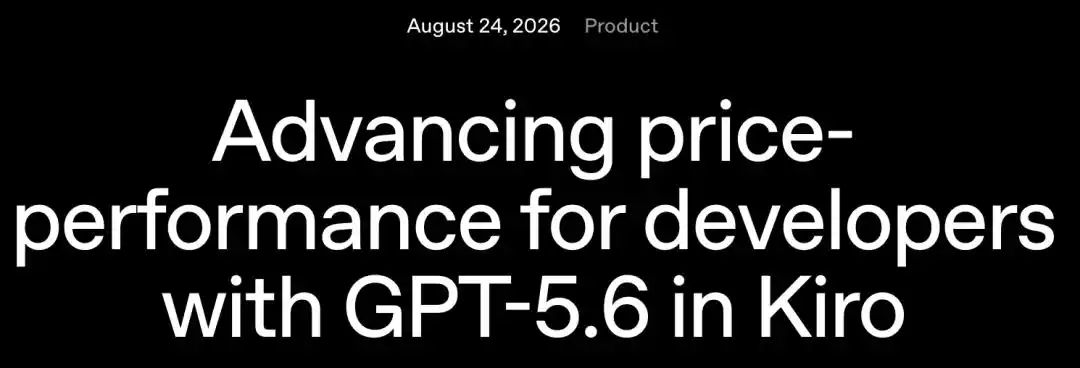
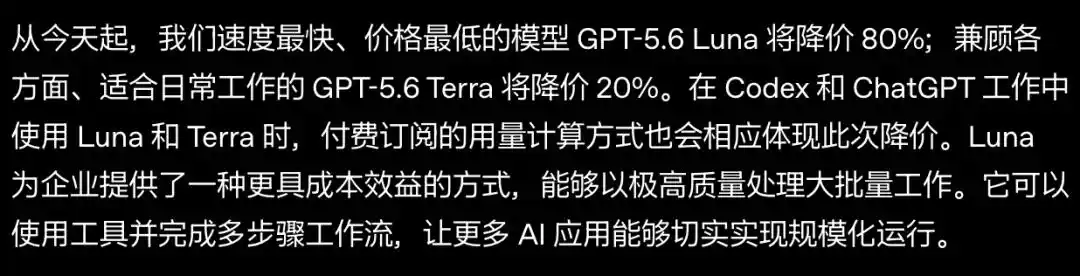
That 82% drop was not the same as an 82% list-price reduction. According to the article, Terra’s most recent official pricing change came on July 30, when OpenAI cut the model’s price by 20%. The gap between a 20% price cut and an 82% reduction in per-task spending is the center of the report.
How GPT-5.6 entered Kiro
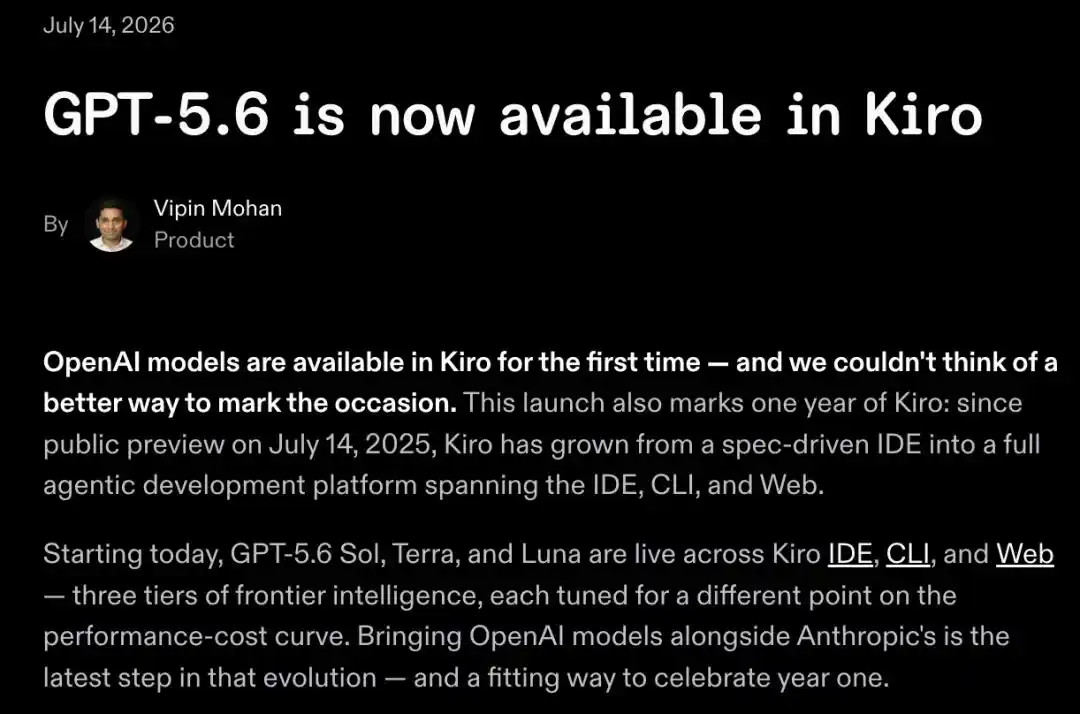
The rollout began in July. On July 13, AWS announced that GPT-5.6 Sol, Terra, and Luna were available in Amazon Bedrock. One day later, Kiro said in a blog post that all three models had gone live across its IDE, CLI, and web products.
This marked the first time OpenAI models had been added to Kiro, coinciding with the first anniversary of Kiro’s public preview. After more than a month of use inside the platform, OpenAI returned with the result of a joint tuning effort covering both the Kiro environment and the OpenAI models: Terra’s cost per successful task fell by about 82%.
The savings came from cutting wasted work
The article argues that the extra savings did not come from another hidden price cut. They came from reducing waste inside the workflow itself.
It lists several likely sources: fewer tokens generated by the model, fewer back-and-forth tool calls, fewer retries after failure, and less wandering down unproductive paths. In other words, the bigger reduction was not mainly about making each call cheaper. It was about cutting the number of billed calls that did not move the task toward completion.
That distinction matters in real development work. If an AI agent fails once, chooses the wrong path, or spends several turns drifting before correcting course, the bill still accumulates. The article frames this as the money lost on detours.
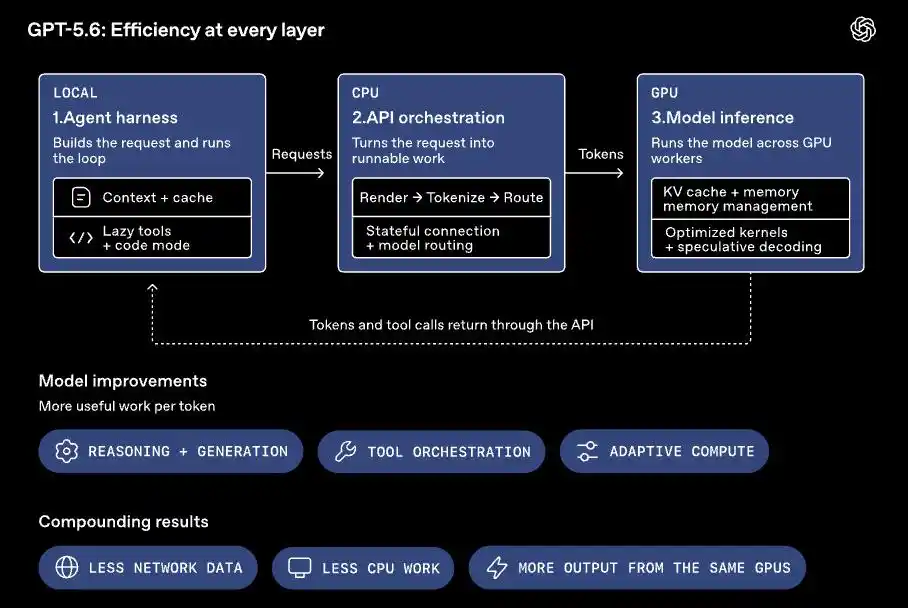
OpenAI’s own blog makes a similar point, saying efficiency comes from three layers: the agent framework that initiates requests and organizes context, the orchestration system that routes and coordinates those requests, and the model running on the GPU.
Model division of labor can also change costs
The report also points to a workflow in which Sol handles planning and problem framing first, then Luna takes over the clearly defined implementation work, writes tests, and runs evaluations.
Under that setup, one pipeline can assign different stages to different model tiers. The total bill then depends not only on a model’s posted price, but also on how the task is broken down and routed.
Terminal-Bench 2.1 measures an agent-plus-model system
The article stresses that Terminal-Bench 2.1 is not a plain model quiz. The benchmark places a model in a terminal environment and gives it a loosely defined objective. The system then has to plan a path, call tools, write scripts, handle errors, and iterate. What gets measured is the combined performance of the agent and the model.
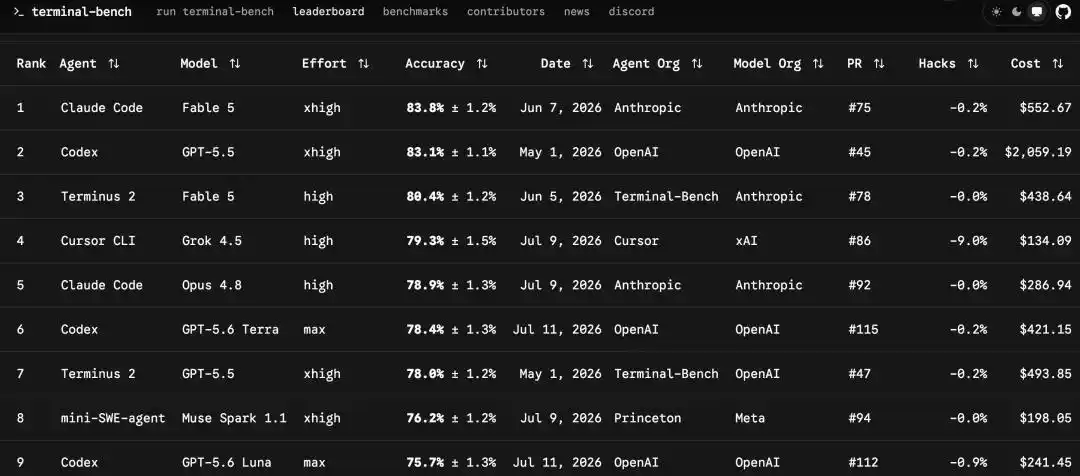
It highlights four lines from the public leaderboard:
- Claude Code with Fable 5: 83.8%, $552.67;
- Codex with GPT-5.5: 83.1%, $2059.19;
- Codex with GPT-5.6 Terra: 78.4%, $421.15;
- Codex with GPT-5.6 Luna: 75.7%, $241.45.
The first two entries were separated by only 0.7 percentage points in score, yet their cost differed by nearly 4x. The article uses that spread to make a broader point: the same underlying model can produce very different economics depending on the framework around it, the way context is assembled, and the strategy used for tool calls.
Kiro’s spec-driven flow is part of the cost story
By Kiro’s own numbers, Terra scored 77.4 on the Coding Agent Index, slightly above Claude Fable 5 at 77.2. The report says the appeal is not just the score itself, but the price attached to that score.
Kiro’s spec-driven approach is presented as the mechanism behind that. Instead of having the model jump straight into code, the workflow first turns a vague user request into a requirements document, a technical design, and an actionable task list. Only then is the task handed to the model.
That means the model is no longer starting from an ambiguous prompt. It is starting from a clearer job description. For people familiar with agent systems, the article says, this is exactly where some of the most expensive waste tends to happen: drift, rework, and full do-overs often burn more tokens than the actual implementation.
Kiro also keeps two review gates in the process. Before code changes are applied, it pauses for a human check. After the task is finished, it automatically runs tests to verify the result. Each avoided round of rework lowers the final bill.
OpenAI’s models are in Kiro, but not for everyone
The article says that a year ago Kiro was still primarily a spec-driven IDE where Anthropic dominated the model selector. A year later, AWS has added three OpenAI model tiers to its own development agent platform.
Sol, Terra, and Luna now appear alongside Claude in the same dropdown menu. Even so, access is not fully open. The rollout is described as gradual and experimental, limited to Pro, Pro+, Pro Max, and Power users in two regions only: Northern Virginia in the United States and Frankfurt in Europe. Cross-region inference is supported.
Another detail the report flags is hidden chain-of-thought. In Kiro, users do not see the models’ reasoning steps, only the final output. The official position, according to the article, is that this is expected behavior and does not affect output quality.
Kiro adjusted its own multipliers after OpenAI’s July price cut
When GPT-5.6 first went live in Kiro on July 14, the same task was billed at multipliers of 2.4x for Sol, 1.2x for Terra, and 0.6x for Luna.
After OpenAI’s July 30 price cut, Kiro updated its pricing the next day. Luna dropped from 0.6x to 0.1x, Terra moved from 1.2x to 1.0x, and Sol stayed unchanged.
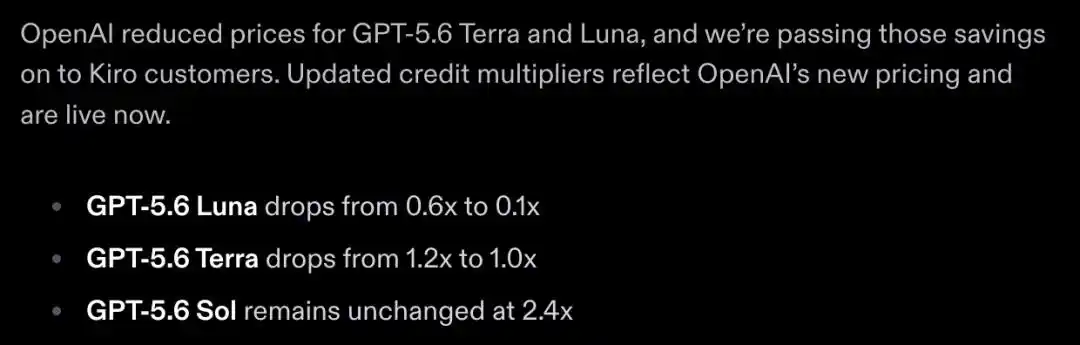
The article reads that as a clear signal from AWS: a development platform will not stay tied to a single model provider. Inside one model selector, frontier systems from OpenAI and Anthropic are now competing on both capability and the cost of getting a job done.
For developers, the practical question shifts with that change. The key comparison is no longer just the price per million tokens. It is the full cost of finishing the task.
References
OpenAI Devs on X: https://x.com/OpenAIDevs/status/2091966982015103068
OpenAI blog: https://openai.com/index/gpt-5-6-in-kiro/