

OpenAI has shut down Atlas as a standalone browser, but the browsing layer itself has reappeared inside the ChatGPT desktop app.

Tibo Sottiaux, a core OpenAI executive, said in a recent X post that ChatGPT desktop is now his primary browser and that his productivity has "never been higher." The comment offers the clearest explanation yet for why OpenAI pulled Atlas: in Sottiaux’s framing, ChatGPT itself has grown into a better browser, with capabilities absorbed from Atlas along the way.
Those capabilities now sit alongside Codex under Sottiaux’s product scope. Atlas tried to add AI to a browser. OpenAI’s newer approach flips that around and puts browser functions inside an AI workflow. Over roughly 10 months, the company appears to have arrived at a simple product conclusion: AI does not need to redefine the browser from scratch if it can open pages, read websites, click buttons and complete tasks on a user’s behalf.
How ChatGPT desktop changed course in two months
Sottiaux’s posts over the past two months sketch a compact timeline for how the desktop product evolved.
On July 10, ChatGPT Work launched. Sottiaux said Work had been rolled out to 100% of Pro users and that anyone who wanted full access to apps, browser tools and local files should install the new desktop app. He closed that post with a line about "amplifying your ambition" and said GPT-5.6 Sol was "unlike anything you’ve seen before."
The redesign quickly ran into user resistance. By merging the Codex app into the desktop experience, OpenAI buried some familiar functions too deeply, and negative feedback followed. Just eight days later, on July 17, Sottiaux posted an apology, saying the first version "didn’t fully get it right" and listing three fixes: restore conversation history and projects to the sidebar, enable cross-device sync between Chat and Work, and add dual-mode switching on desktop.
Even while making those changes, he maintained that the Codex mode best suited for getting work done was still "the original one."

Then came a sharper product break. On Aug. 9, OpenAI formally shut down Atlas. The company did not automatically migrate bookmarks. Instead, users were told to export them as an HTML file and then import them into Chrome. That handoff signaled a larger structural change: OpenAI was no longer preserving Atlas as a standalone shell and was instead extracting its browser functions for use inside a new desktop framework.
After that, iteration continued. The desktop app reached Linux in mid-August, and Sottiaux said users could "cancel that MacBook order." On Sept. 3, he said ChatGPT had officially become his primary browser.
Read as a sequence, the logic is clear. OpenAI kept Codex as the core execution layer, dropped the standalone browser form factor and pulled web browsing directly into the AI workflow.
Atlas ended, but browsing did not
Atlas lasted less than a year from launch to shutdown. In about 10 months, it moved from a high-profile product to a discontinued form factor.
When Atlas launched in October 2025, it still looked heavily like a traditional browser. The browser window was the main surface, while ChatGPT and agent mode sat in the sidebar.
At the time, the pitch was that AI would redefine how people use the internet. But Atlas gradually lost weight inside OpenAI’s product stack. It launched only on macOS, and the previously discussed Windows and mobile versions never arrived.
On July 9, 2026, OpenAI formally announced that Atlas would be discontinued, gave users roughly 30 days to migrate and fully shut the product down on Aug. 9.
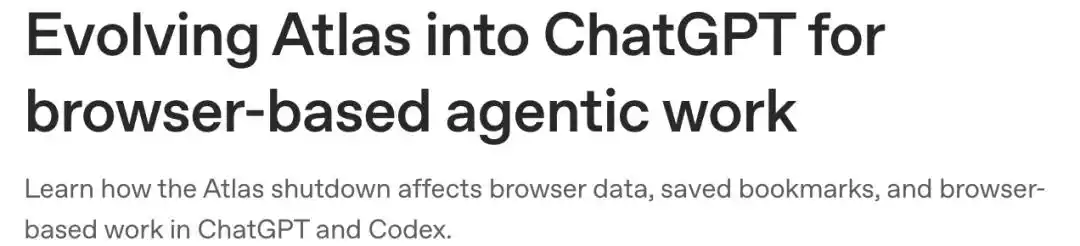
That same day, OpenAI released a new ChatGPT desktop app that combined Chat, Work and Codex and added a built-in browser. The company’s help documentation was explicit: "browser-based agent capabilities" were being moved into ChatGPT and Codex.
In other words, OpenAI abandoned the standalone browser as a product form, not web browsing itself. Multi-tab support, downloads, page navigation and account sign-ins, all capabilities refined during the Atlas period, were carried over into ChatGPT desktop.
What died with Atlas was a shell that had already aged quickly. Its core browser execution layer survived and was inherited by ChatGPT.
From browser as destination to browser as execution layer
Sottiaux’s claim that productivity has "never been higher" points to a deeper shift in how the browser is being used.
Traditional browsers are organized around webpages and tabs. Users open a browser to go somewhere, then call on AI once they get there. ChatGPT desktop reverses that order. The basic unit is no longer the page. It is the task.
A user starts by giving ChatGPT a job, such as comparing quotes from three suppliers and turning them into a table. The browser appears only when the task needs it. Pages become an intermediate surface. Tabs are opened by AI, links are clicked by AI and downloads are initiated by AI. If a site requires login, the system stops and waits for the user to sign in before continuing.
That leaves the user with two main actions: hand over the task and approve steps when asked.
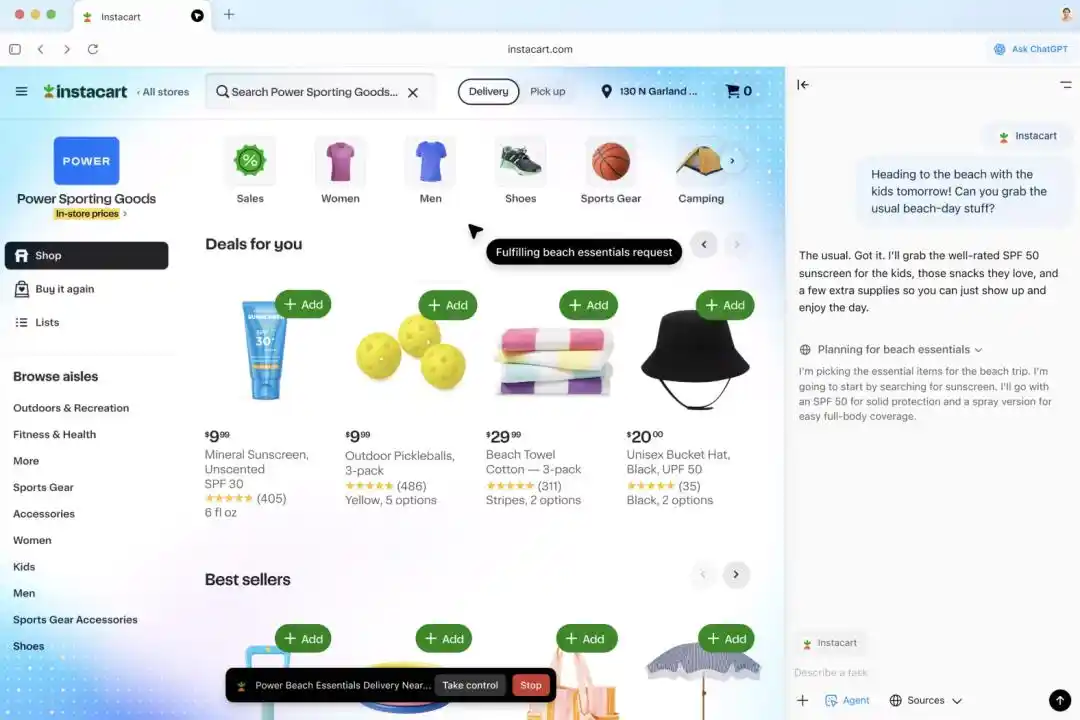
Seen that way, "primary browser" does not simply mean a better browser window. It means the user no longer needs to browse many pages directly because ChatGPT is invoking browser functions in the background to do the work.
Add desktop Computer Use, which can click across apps and move files, plus scheduled tasks that check websites and send summaries every day, and the browser starts to look less like the main interface and more like an execution surface inside the ChatGPT stack.
OpenAI did not rebuild the browser. It turned toward Chrome
After Atlas exited, the product direction taken by OpenAI, Anthropic and Google points to a shared conclusion: no one appears eager to build a new standalone browser from the ground up.
OpenAI now looks more focused on extending AI through existing browser systems. The built-in browser inside ChatGPT desktop runs in its own browsing state and does not interfere with a user’s Chrome setup. At the same time, OpenAI’s documentation leaves a second route open. If a task requires an existing Chrome configuration, a saved login session or browser extensions, users are told to switch to the Codex Chrome extension. In more complex cases, ChatGPT may even prompt them to return to Chrome.
That gives OpenAI two tracks at once:
- one that places browser functions inside the agent while keeping the runtime relatively isolated;
- and another that places the agent inside Chrome, drawing on years of accumulated logins, extensions and usage patterns.
That split gets at the real defensive asset in the browser market. Chrome is not only protecting the address bar. It is also protecting passwords, bookmarks, extensions and the digital identity layer users have built across the web over many years.
Atlas made that visible on its way out. Bookmarks could be exported, but login state could not be taken along. Without explicit user authorization, AI cannot simply assume control of those identity assets.
Anthropic’s recent move follows a similar line. Claude in Chrome, which was opened broadly on Aug. 26, did not try to become a standalone browser. It arrived as a Chrome extension and used the user’s existing digital identity to do the work.
The first casualty of the AI browser race was the AI browser itself
Across OpenAI and Anthropic, the underlying logic now looks strikingly similar. The priority is no longer to establish an independent browser. The focus has shifted to competing around Chrome while trying to control the task entry point and, where permitted, the identity layer attached to it.
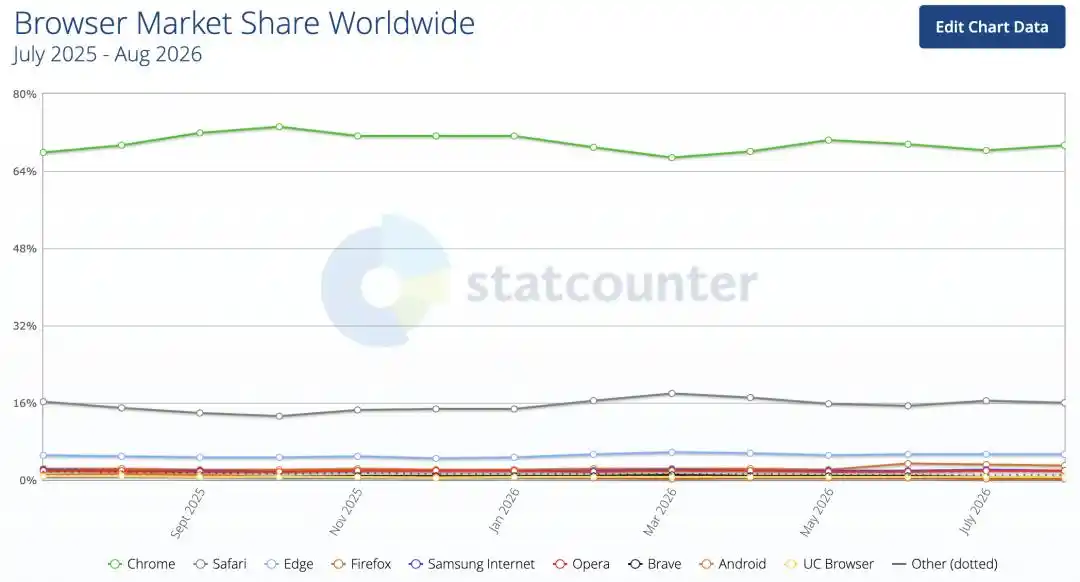
In that sense, the first thing to lose ground in the AI browser race was the standalone AI browser form itself. With Arc no longer being updated, Sidekick shut down and Atlas taken offline, AI browsers did not secure standalone labels in StatCounter’s browser share rankings. They were grouped into the dotted "Other" category, which the source says remained below 3%.
The article cites StatCounter data showing that from July 2025 to August 2026, Chrome held more than two-thirds of the global browser market throughout the period, while AI browsers such as Atlas and Comet did not appear as independent entries.
That outcome suggests even top AI labs have struggled to break habits users have built over many years. People may want AI, but they do not necessarily want a new browser. OpenAI appears to have taken 10 months to accept that trade-off.
The next contest on the desktop may not center on who controls the browser address bar. It may center on who becomes the first place users turn when they want AI to execute a task.