
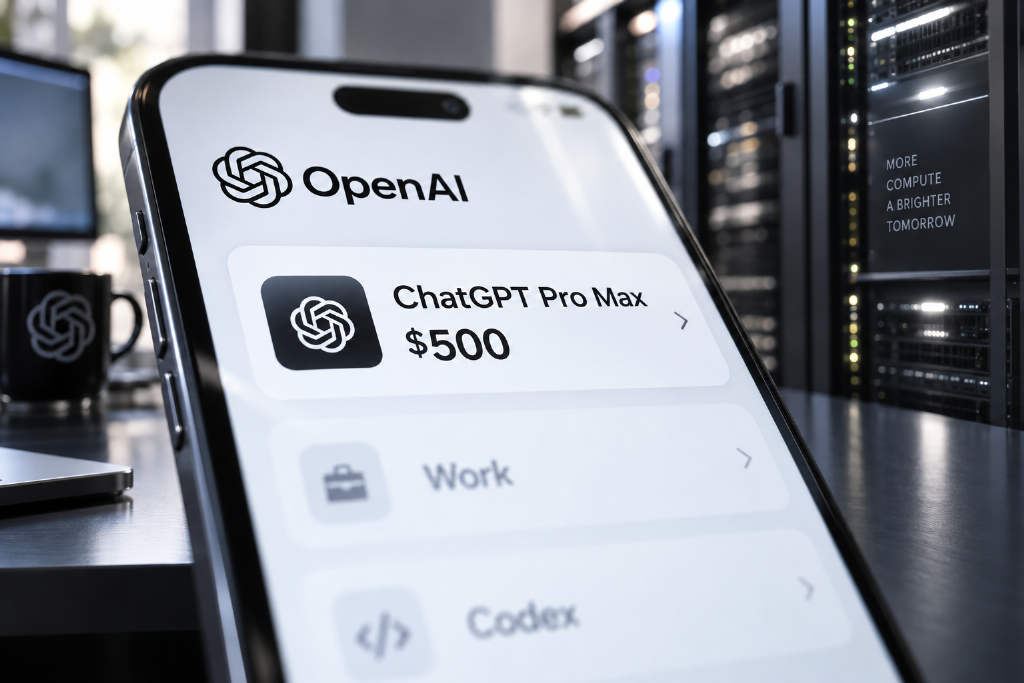
OpenAI may be preparing a new ChatGPT subscription tier priced at $500 per month, with speed — not intelligence — showing up as the main selling point.
The possible plan, called ChatGPT Pro Max, surfaced weeks after OpenAI stopped accepting new subscribers for its $200-a-month ChatGPT Pro 20x tier on Sept. 10 because of compute constraints. That contrast stands out on its own: a company that just froze access to one high-end plan now appears, through code and interface clues, to be readying an even more expensive one.
Researchers found the Pro Max label in code and subscription screens
The leaked pricing would put Pro Max at 25 times the cost of the $20 Plus plan and 2.5 times the price of the $200 tier that was recently closed to new signups.
OpenAI had already signaled that the $200 plan was placing meaningful strain on its systems. Thibault Sottiaux, who leads Codex and ChatGPT, said the suspension was meant to preserve the current Astra model experience and represented the smallest step that would keep access available for the greatest number of users.
On Sept. 24, independent researcher Tibor Blaho, whose X account is @btibor91, said he found an unreleased Pro Max plan in ChatGPT frontend settings. The entry listed a monthly price of $500 and described the tier as offering the fastest Work and Codex.
TestingCatalog, an AI product tracking site, later reported seeing the same plan in the ChatGPT subscription interface. A separate AI leak account, Chetaslua, also posted interface screenshots. The three findings were independent of one another but pointed to the same internal label.
On Sept. 25 UTC, OpenAI merged pull request #47971 into its official Codex repository. The PR title said it added support for the Pro Max plan and updated how Pro plan names are displayed. In the code, the system began recognizing the plan identifier "promax" and remapped names so that "prolite" appears as "Pro," "pro" appears as "Pro (More)," and "promax" appears as "Pro (Max)."
Other leaked benefits tied to Pro Max include access to the strongest frontier models, the largest memory capacity, 100 GB of file storage, and early access to new features. Even so, the only difference explicitly singled out against the current Pro tier was speed for Work and Codex.
OpenAI has not confirmed that the plan exists.
Why speed may now justify a premium
To understand the logic behind a Pro Max tier, it helps to look at the two tools highlighted in the leak. Work is OpenAI’s agent product for multi-step research and writing tasks. Codex is its agent for extended autonomous coding and debugging. In both cases, more complex jobs usually mean longer wait times.
That makes latency a product feature rather than just a technical detail.
In January 2026, OpenAI signed an inference compute agreement with chip company Cerebras worth about $10 billion and covering 750 megawatts, or MW. The arrangement later expanded into a three-year compute procurement deal worth more than $20 billion through 2028, and OpenAI secured warrants that could let it buy up to 10% equity.
Cerebras is best known for wafer-scale chips. Instead of cutting a silicon wafer into many smaller chips, the company builds the whole wafer as one chip. The design includes 44 GB of SRAM, allowing model weights to sit on-chip rather than being moved back and forth across memory. Less movement means faster execution.
That speed has already been demonstrated publicly more than once. In February 2026, GPT-5.3-Codex-Spark running on Cerebras hardware delivered more than 1,000 tokens per second, roughly 15 times faster than standard Codex. That model was retired about seven months after launch.
Then on Aug. 13, 2026, OpenAI introduced an Ultrafast mode preview that ran flagship model GPT-5.6 Sol on Cerebras chips. Output reached as high as 750 tokens per second, around 14 times the standard mode. OpenAI said broader access would come as capacity increased, which implied that this level of speed was still scarce.
Chetaslua claimed that Cerebras is the inference provider behind Pro Max, but neither OpenAI nor Cerebras has confirmed that point.
A broader pattern of segmentation is taking shape
Placed alongside OpenAI’s recent moves, the rumored Pro Max tier fits into a wider pricing structure.
On Sept. 24, ChatGPT ads officially launched in Taiwan, with advertisers able to start at NT$8,000 and initial access going first to e-commerce and travel categories. A day earlier, on Sept. 23, OpenAI rolled out GPT-6 Sol and GPT-6 Luna with API pricing cut by 50% versus GPT-5.6. And above those changes sits the newly surfaced $500 Pro Max tier.
So within a short span, OpenAI lowered model pricing, added ads to the free layer, and may now be pushing the ceiling for individual subscriptions to $500 a month. If launched, it would be the most expensive mainstream personal subscription among major AI providers.
A previously exposed internal OpenAI financial forecast projected cumulative free cash flow of negative $278 billion by 2030. In that setting, expanding revenue sources and splitting paid users into more tiers looks less like an option and more like a requirement.
OpenAI’s annual developer event, DevDay, is scheduled for Sept. 29. New subscription plans are often introduced at events like that, so formal answers on Pro Max may not be far off.