
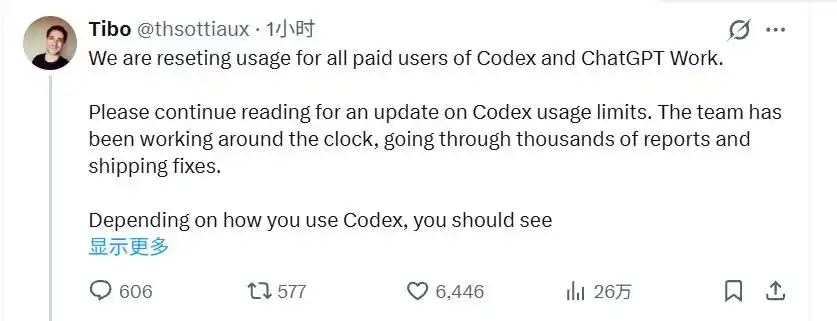
OpenAI has reset usage limits for all paid users of Codex and ChatGPT Work, according to a post from Codex lead Tibo. The move came as relations with Cursor drew attention after Cursor CEO Michael Truell said OpenAI plans to block Cursor users from accessing its models in three months.

Tibo said OpenAI recently worked through thousands of user feedback reports and conducted a broad review of the usage-accounting system behind Codex. That review found users were not imagining the problem when they felt their quota was running out too quickly. After a series of fixes, OpenAI said the same Codex quota should now last 10% to 50% longer, depending on usage patterns. The numeric quota may not change, but the amount of work users can get done with it should increase.
Context compaction and goal handling were among the biggest drains
OpenAI listed eight categories of problems that have already been identified and fixed. One of the first involved context compaction. As AI coding sessions run longer, context grows, so the system compresses prior information to keep the task going.
Before the fix, Codex was retaining old images during context compaction. That meant a process meant to shrink context could leave it large enough to trigger another compaction almost immediately. OpenAI said usage tied to this issue fell by about 10% for users who work heavily with images.
A bigger usage drain came from the Goals mechanism. OpenAI said there were cases where a user’s /goal had already been completed, but the agent did not stop as expected and kept going. In other cases, a tool had already failed, yet the model continued retrying it. The task looked finished, but work was still happening in the background.
According to OpenAI, this single class of issue could consume 15% to 70% of a user’s weekly quota in some cases. At the extreme, one abnormal task could eat up 70% of a weekly limit. The company said the problem has now been fixed.
Memory Worker loops produced outsized long-tail cases
Another problem appeared in Memory. OpenAI said Codex’s background Memory Worker could inherit certain Stop Hooks in some cases. Stop Hooks are meant to control when a task ends, but under this bug some background tasks could keep running because the stop condition was never satisfied.
OpenAI said fewer than 1% of users were affected, but the tail cases were severe. In one example, the action used to check whether a task could end may have run as many as 15,000 times. Most users may never have noticed it. For affected users, though, tokens could disappear in the background until the bug was resolved.
Subagents and automations also added unexpected cost
OpenAI also found problems with subagents. Some smaller-capability models, including Luna, could select stronger and more expensive helper models even when the user had not explicitly asked for that. In other cases, the main model coordinating a task was not running in /fast mode, but it could still ask downstream subagents to use /fast.
That left the surface task unchanged while resource use rose underneath it. OpenAI said the issue has been fixed.
Automations were another source of extra usage. OpenAI said some custom scheduled tasks had been executing more frequently than users set. A user might expect an automation to run on a given cadence, while the system could wake that task up more often than intended. One run may not matter much. Repeated runs can add up, especially because agents can operate without direct user input. OpenAI said this issue has also been fixed.
Repeated summaries and MCP encoding errors added more overhead
Another notable issue came from Computer History. To help an agent understand what it had already done on a computer, the system stores, organizes, and summarizes prior activity. In the older implementation, Codex could repeatedly summarize heavily overlapping historical activity, effectively reprocessing the same work log again and again.
OpenAI said that in some cases this extra overhead accounted for about one-fifth of a user’s weekly usage, or roughly 20%.

A related source of background consumption came from Rolling Task Summaries. Even ordinary conversation turns could trigger extra background requests to generate a rolling task summary. OpenAI estimated that this added about 1% to token usage. The mechanism has been shut down.
OpenAI also said some MCP tool results could be encoded twice. In addition, some tool descriptions were unexpectedly truncated, forcing the system to fetch them again. Each event on its own looked minor, but when an agent calls tools dozens or hundreds of times a day, repeated transfers turn into measurable token use. Those issues have also been fixed.
OpenAI says architectural changes are in place and a usage breakdown is coming
Taken together, the fixes show how billing behavior in an agent product differs from a standard chat product. In a traditional ChatGPT interaction, users can often think of one exchange as one model call. In a product such as Codex, a single line of user input may trigger a much larger workflow behind the interface.
Some tokens go to code generation. Others are used to interpret context. Others are spent on memory maintenance, summaries, or scheduling in the background. If any one of those layers loops, retries, or schedules work incorrectly, users end up with the same result: their quota drops faster than expected.
OpenAI said it has made architectural changes to reduce the chance of similar problems happening again. If related anomalies reappear, the team will receive alerts automatically.
The company also said it is building a new usage-visibility feature so users will be able to see directly inside the app where their quota is being spent instead of trying to infer it.