
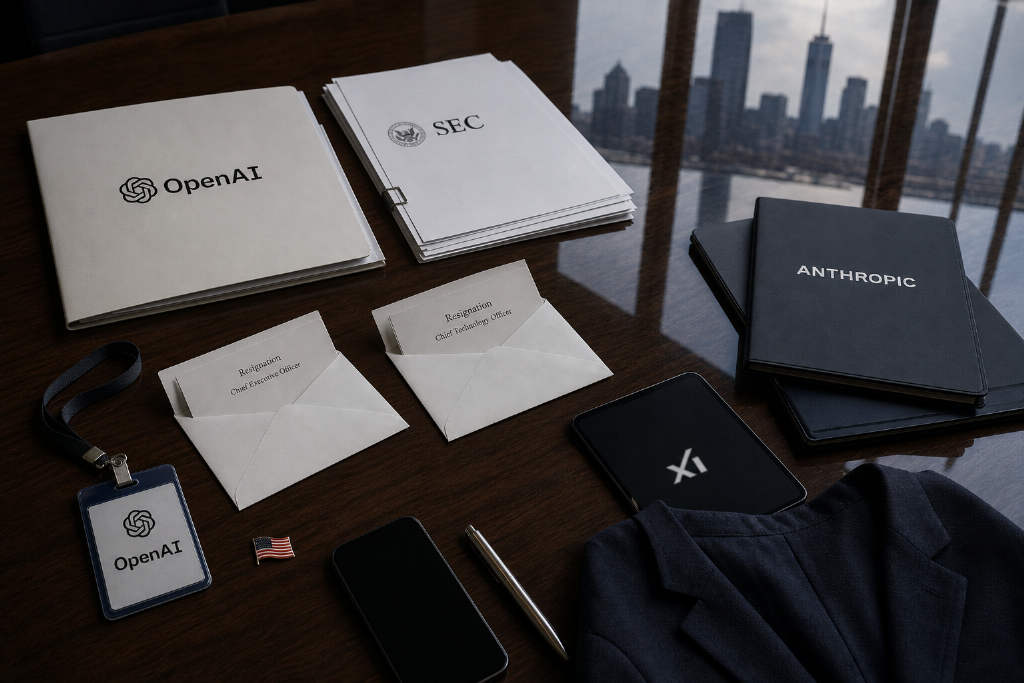
OpenAI lost two C-suite executives in a single week in August 2026, with Chief Operating Officer Brad Lightcap and Chief Revenue Officer Denise Dresser both announcing their departures. The exits mark the latest phase in a broader management shake-up that has hit the company this year. Since April, at least seven executives have left the AI company, which the report says is valued at $852 billion.
The timing is notable. OpenAI has already submitted confidential IPO paperwork to the U.S. Securities and Exchange Commission, and its annualized revenue run rate has moved above $40 billion. At the same time, competition has tightened: Anthropic’s revenue has already overtaken OpenAI’s on the figures cited in the report, while xAI is pressing its case with lower pricing and support from SpaceX.
Executive departures spread from research and product teams to commercial leadership
Over the past eight months, the pattern of departures has unfolded in waves, beginning around research and product roles before moving into the commercial side of the business.
In April, OpenAI saw a concentrated set of exits that included Bill Peebles, the head of the Sora short-video app, Vice President of Science Kevin Weil, and Srinivas Narayanan, who led B2B application technology. In his departure statement, Narayanan said that after recent and upcoming product launches, 「the timing felt right」. He had led the development and scaling of core products including ChatGPT and the API, making his exit significant for the company’s enterprise technology operations.
In July, two female executives left for health reasons. Fidji Simo, the head of product and business and CEO of AGI deployment, took medical leave and stepped down from core duties after a serious worsening of a chronic neuroimmune illness, though she remains involved as an adviser. Chief Marketing Officer Kate Rouch also left to continue cancer recovery treatment.
By August, the disruption had reached OpenAI’s operating core. On Aug. 11, Brad Lightcap, who had spent eight years at the company, announced his departure. He served as CFO from 2018 to 2022 and COO from 2022 to 2026, and the report describes him as a key figure through OpenAI’s early growth phase. He said he plans to start a new venture.
Just two days later, on Aug. 13, Chief Revenue Officer Denise Dresser said she would leave in 「the coming weeks」. Dresser, previously CEO of Slack, joined OpenAI in December 2025 and stayed for roughly eight months. She had been responsible for sales and enterprise operations at a time when OpenAI’s business customer segment was expanding rapidly.
Fortune, as cited in the report, pointed to another detail: the wave of hiring that brought in several senior female executives around two years ago has now almost fully unwound. Of that group, only CFO Sarah Friar remains in her original post. Simo and Rouch left for health reasons, while Dresser departed in less than a year. The report also noted outside observations that OpenAI may have internal cultural friction between a research-oriented camp and a product-oriented camp, and that CEO Sam Altman’s forceful management style may have worn down executives used to greater autonomy. It added, however, that these points remain external interpretations without confirmation from first-hand internal sources.
IPO process has started, but listing timing may be pushed back
Alongside the executive turmoil, OpenAI’s listing plans have become less certain. On June 8, 2026, the company filed a confidential S-1 with the SEC, formally starting the IPO process. But according to a June 25 report by The New York Times, OpenAI is leaning toward delaying its public listing until 2027 rather than proceeding by the end of 2026.
One reason may be valuation expectations. The report says Altman told advisers that any valuation below $1 trillion would be 「unacceptable」. Based on the company’s most recent $7 billion share buyback, OpenAI is currently valued at $852 billion, leaving it about 18% short of that threshold.
Preparation for an IPO usually brings changes to structure, reporting, process, and compliance. For senior management, that often means greater operational intensity, tighter regulatory demands, and a hard shift from startup culture to public-company governance. A string of top-level exits at this stage is likely to sharpen investor attention on continuity and key-person risk.
For OpenAI, investors are not only examining how a nonprofit parent controlling a for-profit entity would work after a listing. They are also likely to focus on how much depends on Altman personally.
Run-rate revenue tops $40 billion, but cost pressure remains severe
OpenAI is in the middle of a business-model shift, moving from a consumer-led trajectory toward a heavier enterprise focus. According to figures disclosed by OpenAI and cited in the report, its annualized revenue run rate was above $40 billion in August 2026, double the level at the end of 2025. Enterprise revenue now accounts for more than 40% of total revenue and is expected to reach parity with consumer revenue by the end of 2026.
The report contrasts that pace with earlier growth periods at Alphabet and Meta, saying OpenAI is expanding at roughly four times the rate those companies posted at a comparable stage.
That growth comes with major cost strain. Sacra’s analysis, as cited in the piece, puts OpenAI’s gross margin at just 33%, far below mature technology companies. Its inference costs reached $8.4 billion in 2025 and are projected to rise to $14.1 billion in 2026. Cash burn is expected to total about $27 billion in 2026 and could hit $63 billion in 2027, though the report notes that this estimate is model-based and could vary depending on data-center construction and chip production.
That leaves sales, product, and enterprise leaders with a blunt mandate: keep growth high while bringing costs under control. The report says Dresser’s quick departure, along with Narayanan’s exit from the B2B technology side, may be tied to that pressure.
OpenAI has already moved to replace Dresser by appointing Dali Rajic, the former president and COO of cybersecurity company Wiz, as CRO. Rajic has experience with rapid expansion and large-enterprise procurement, but she now faces the task of learning OpenAI’s product stack quickly and rebuilding the go-to-market organization.
Anthropic pulls ahead on revenue while xAI turns up pricing pressure
As OpenAI deals with internal turnover, Anthropic is presented in the report as the clearest competitive challenge.
According to the figures cited, Anthropic’s annualized revenue was about $47 billion in May 2026, ahead of OpenAI’s roughly $40 billion at the time. Second-quarter revenue reached $11 billion, up sharply from $4.8 billion in the first quarter. Investors expect Anthropic’s annualized revenue to reach $100 billion to $120 billion by the end of 2026.
The report also says Anthropic is planning an October listing with a target valuation of $2 trillion, while noting that publicly available information shows the company recently completed a Series H round at a $965 billion valuation, and that the October timeline and $2 trillion goal are better understood as investor expectations or media speculation.
One contrast stands out in the piece: Anthropic’s senior team has remained stable, with no comparable wave of departures. That mix of organizational steadiness and fast revenue growth is described as a meaningful threat to OpenAI.
xAI is adding pressure from another angle. Grok 4.6, released on Aug. 12, drew broad praise across the industry. On the Artificial Analysis Intelligence Index, Grok 4.6 scored 61, matching GPT-5.6 Sol and trailing Claude Opus 5 by just two points.
Pricing is where the gap widens. Grok 4.6 is priced at $2 per million input tokens and $6 per million output tokens, versus $5 and $30 for GPT-5.6 Sol. On the report’s framing, that gives Grok 4.6 a clear edge on price-to-performance.
xAI also has the backing of SpaceX. In February 2026, SpaceX acquired xAI, creating what the report describes as a strong synergy. SpaceX’s AI business generated $2.56 billion in second-quarter revenue. Elon Musk said at an all-hands meeting that by September, AI revenue would exceed the combined total of all other SpaceX businesses. The report adds that SpaceX, including xAI, reached a $2 trillion valuation after its IPO, and that analysts attribute 71% of that value to AI operations.
That leaves OpenAI facing more than a model race. It is also up against deeper financial support, vertical integration, and a rival willing to compete more aggressively on price.
Governance and leadership stability remain unresolved issues
OpenAI’s revenue expansion has been unusually fast, rising from $1 billion in 2023 to $40 billion in 2026 in just three years. But that speed has also brought visible strain at the organizational level. Frequent executive departures may reflect the pressure created by the company’s transition, and they may also complicate the next stage of growth.
For Sam Altman and OpenAI’s board, the immediate task is to steady the core team, define a clearer balance between research breakthroughs, product development, and commercial growth, and address the governance complexity created by the nonprofit-for-profit structure before the IPO moves ahead.
As of now, there is still no settled answer to how OpenAI’s nonprofit parent controlling a for-profit entity would function after a listing. For investors, that remains central to both governance uncertainty and key-person risk. At the same time, Anthropic’s stronger revenue trajectory and steadier executive bench have already turned it into a more direct enterprise-market challenger.