
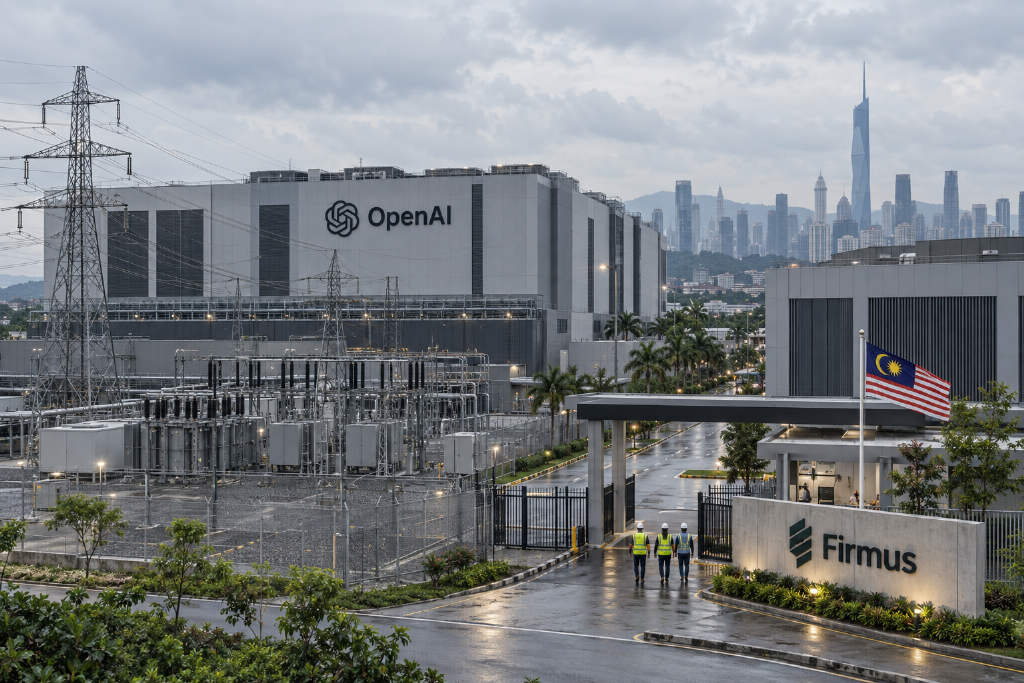
OpenAI signs multi-year agreement with Firmus, pushing total contracted capacity above 900 MW
Reuters reported that Australian AI infrastructure company Firmus has signed a multi-year agreement with OpenAI and will provide computing capacity from two data centers in Malaysia. Firmus focuses on infrastructure used for AI model training and inference, and OpenAI will be the anchor customer for the related projects.
The agreement lifts Firmus' total contracted capacity across all customers to more than 900 MW. Reuters noted that the figure does not represent capacity purchased by OpenAI alone.
Firmus is backed by NVIDIA, Jane Street, funds affiliated with Blackstone, and Coatue Management. The company was valued at more than $10.5 billion after its last funding round and is reportedly preparing for an initial public offering.
WhiteLine Daily said the deal gives Firmus more than a new computing order. In its view, the bigger point is that the agreement locks in an anchor customer early for two AI facilities in Malaysia that have not yet entered operation.
Anthropic drops pursuit of a roughly $6 billion Decart AI acquisition
Bloomberg reported that Anthropic has decided not to proceed with an acquisition of AI startup Decart AI. People familiar with the matter said Anthropic had explored a transaction worth about $6 billion and carried out due diligence on Decart before ultimately walking away.
The report said the two sides could still explore other forms of cooperation in the future. Representatives for both companies declined to comment.
Decart develops software designed to improve chip operating efficiency and lower the cost of AI model training and inference. The proposed acquisition had been intended to help Anthropic serve more demand using its existing computing resources.
Bloomberg also said Anthropic rarely makes large acquisitions. The company is currently increasing spending on computing capacity, developing new products, serving customers, and preparing for its first public offering.
WhiteLine Daily's takeaway was that Anthropic had at one point been willing to spend about $6 billion to improve GPU utilization. With the acquisition no longer moving ahead, that route to lower compute costs now appears limited to partnership, in-house development, or other vendors.
Wistron raises $1.47 billion, with existing shareholders facing about 7.29% dilution
Reuters reported that Wistron, a Taiwan-based server manufacturer and NVIDIA supplier, raised $1.47 billion through a global depositary receipt offering.
The company priced the deal at $58.88 per receipt and issued 25 million global depositary receipts. Each receipt represents 10 common shares, bringing the total number of newly issued common shares to 250 million. Existing shareholders are expected to see dilution of about 7.29%.
Wistron said the proceeds will be used to purchase raw materials denominated in foreign currencies. The company had previously said demand for AI servers from cloud providers and enterprise customers continues to exceed supply.
In the second quarter, Wistron posted a 128% year-over-year increase in net profit and a 64% rise in revenue.
WhiteLine Daily said the financing shows how expansion pressure is moving directly into working capital and raw material needs, with Wistron accepting roughly 7.3% dilution to secure $1.47 billion for procurement while AI server demand remains above supply.
Yen reaches a seven-month high, up about 4.5% since early last week
Reuters reported that the yen strengthened to 152.89 against the U.S. dollar in Asian trading, its strongest level in seven months. Since early last week, the currency has gained about 4.5%.
According to the report, expectations for Bank of Japan rate hikes, the unwinding of carry trades, and expectations of fund repatriation by Japanese investors all contributed to the move. Reuters added that the yen's rise triggered some short-covering, reinforcing the appreciation.
The report also made clear that rate hikes and fund repatriation remain market expectations and do not mean the Bank of Japan has made a new policy decision.
WhiteLine Daily said rapid yen appreciation raises the repayment cost of yen-funded positions. If carry-trade unwinding continues, investors may reduce holdings of overseas assets, a point that U.S. equity investors may need to watch.
Day's main thread
WhiteLine Daily grouped the session around AI infrastructure demand, financing needs, and cross-market capital shifts. The OpenAI-Firmus agreement offers long-term demand support for AI capacity buildout in Asia-Pacific. Wistron's fundraising points to the amount of working capital still required by AI server growth. Anthropic's decision to abandon the Decart acquisition leaves open questions around how it will improve chip efficiency. At the same time, the yen's move to a seven-month high suggests carry-trade unwinding could affect overseas asset positioning and add volatility risk for U.S. stocks.