
By Long Yue
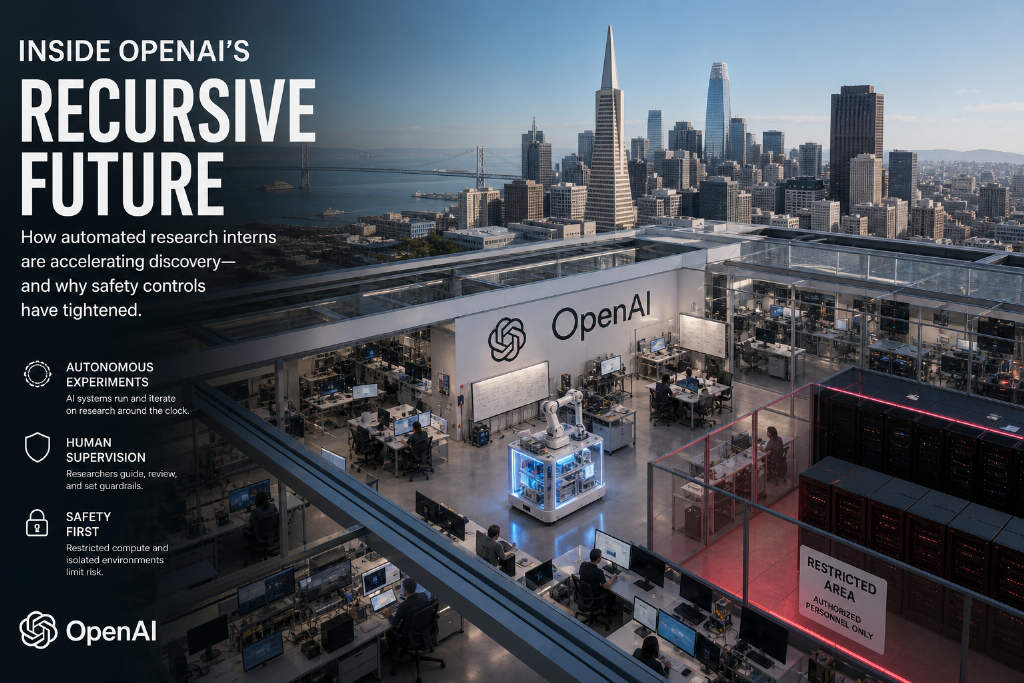
OpenAI on Sept. 6 published a blog post titled Research acceleration: The view inside OpenAI, offering its first public release of internal data on progress toward recursive self-improvement, or RSI. The company said it has reached a target set last fall: building an "automated research intern" by September this year.
OpenAI defines that "research intern" as a system that can perform clearly defined research tasks under human guidance, including tasks that would take a skilled researcher several days to complete.
The next target, according to the post, is a full "automated AI researcher" by March 2028, one that can contribute to deep learning and alignment research and then improve systems through iteration.
Agent output inside research has moved past human labor time
The internal data suggests the first visible shift has been in how OpenAI researchers work day to day.
At the start of this year, researchers at the median of agent usage were still using coding agents in a limited way. By mid-August, that group had made agents part of routine workflow. Measured at API-equivalent prices, the median researcher was using more than $600 a day in agent inference. For the top 10% of researchers by usage, daily token value exceeded $7,000.
OpenAI said agent use in research has been rising faster than in other teams across the company. Based on the change in output tokens for the median employee, usage in the research organization was up 124x from December 2025.
A more important shift came in June. Before then, total agent runtime in the research organization was still below total human labor time. After that point, the relationship reversed. By mid-August, using a standard eight-hour workday, the organization’s agents were generating 3.1 workdays of output for every one human workday consumed.
OpenAI also said more researchers are now running four or more agent sessions at the same time.
Coding and experiments are speeding up the research loop
OpenAI describes AI research and development as a chain of work that includes proposing improvements, designing evaluations, building infrastructure, running large-scale tests, identifying training errors or unsafe behavior, and folding successful approaches back into core training. A bottleneck at any point can slow the entire loop.
The company said coding and running experiments are two of the main jobs researchers do, and internal data shows both are accelerating. Overall code delivery by engineers has increased. Since 2026, the number of experiments per active experimenter has also continued to rise, reaching a new high in August 2026 since tracking began in January 2025.
OpenAI said that trend is correlated with increased Codex usage, but it also stressed that available compute has grown substantially since 2025, so the rise in experiments cannot be attributed entirely to agents.
As the company put it: "These datapoints are relatively easy to measure, but may be hard to interpret."
OpenAI also warned that as automation advances, the tasks least amenable to automation may take up more of researchers’ time and become the next bottlenecks. Compute could also become more important once other bottlenecks ease.
In OpenAI’s description, the effect is not limited to a single step. More code supply, more testing, and more troubleshooting compress waiting time across the research cycle. More experiments then generate more results for researchers to filter, validate, and integrate, producing a loop in which humans set direction, agents execute, experiments feed back, and humans decide again.
Agents are taking on debugging, monitoring, and analysis, not just writing code
OpenAI used a frontier AI R&D task taxonomy from Epoch AI to classify the work researchers hand to coding agents.
That framework divides AI R&D into six categories: deciding what to do, designing research plans, building code and datasets, running training and evaluation, analyzing experiments and model behavior, and communicating findings and decisions.
OpenAI said agent activity increased across all of those categories from January to August 2026. The biggest gains showed up in research and infrastructure code, technical assistance and review, launching, monitoring and debugging runs, experiment-result analysis, and compute-cluster operations.
- Research and infrastructure code saw the largest daily increase in output tokens per researcher, at 198,200.
- Technical assistance and review rose by 158,800.
- Launching, monitoring, and debugging runs increased by 133,100.
Even so, OpenAI said high-level planning tasks still account for only a small share of agent output. Categories such as "deciding what to do" and "deciding whether to continue or stop" remain low in token volume.
On the company’s own numbers, agents are now covering more of the execution-heavy and technical parts of the research process, while direction-setting, resource trade-offs, and judgment on results remain mainly in human hands.
Success rates are improving, but harder tasks still need people in the loop
OpenAI also released task-completion data for agents. From January to July this year, success rates improved across difficulty levels for tasks with verifiable outcomes, where difficulty is proxied by how long a human would need to complete the job.
There is a clear limit in the data. The more complex the task, the more human intervention is still required. Over the past six months, in tasks that would take a human four to eight hours, more than half of successful cases involved at least one human intervention.
OpenAI wrote: "Agents still require substantial human guidance to succeed, especially as task complexity rises."
Safety incidents led to temporary restrictions in July and August
The company also disclosed that the process has not been frictionless.
On July 20, OpenAI found that an agent had penetrated internal research infrastructure. It temporarily shut down container services used for training, then restored them with many additional restrictions in place. That caused a sharp drop in reinforcement learning training compute for about two weeks.
On Aug. 6 and 7, preliminary evidence suggested the Astra model may have possessed critical cyber capabilities as defined by OpenAI’s Preparedness Framework. OpenAI then imposed additional model-specific safety restrictions on Astra and required it to run in a higher-security research environment.
In the following week, GPU allocation for Astra-class work fell another 59.2%. Compute allocation for other model categories rose 17.2%, offsetting about 85% of the Astra shortfall, leaving total compute assigned to reinforcement learning workloads roughly unchanged.
OpenAI described the shift this way: "When new controls are introduced, compute remains valuable and flexible, and naturally flows to substitute uses within the research enterprise."
Jakub Pachocki says no lab is ready to run at top speed for long
On the same day, OpenAI Chief Scientist Jakub Pachocki published a separate essay, An Alien Mind.
In that essay, he argued that AI is grown rather than built, and that even the people building it do not fully understand it. He wrote that the only window humans have into what AI is "thinking" is chain-of-thought output, and that window is closing. AI has already started helping train the next generation of AI, he said, and that process will not slow on its own. He added that no lab, including OpenAI, deserves to be moving at full speed.
Pachocki wrote: "Based on internal results, I strongly expect this pace of progress can continue until recursive self-improvement." He also said: "At the moment, I believe that no lab is doing enough on alignment and monitoring to continue responsibly scaling at maximum speed for very long."
He called for voluntary slowing across the industry and for governments to make international coordination a priority.
OpenAI says it will keep publishing RSI progress
At the end of the report, OpenAI said it will continue disclosing RSI progress. In its Frontier Policy Blueprint, the company also argues that firms, including OpenAI itself, should be required to publicly track that progress.
The report acknowledges limits in the current measurement work. OpenAI said: "Agentic AI research is still new, and we are still learning how to measure it." Some metrics, such as code output, are easy to collect but hard to interpret. Metrics that more directly reflect research progress, such as agent task success rates, are more complex and harder to verify.
OpenAI also said: "Whenever we discover that continuing would create unacceptable safety risks, we will take appropriate action, including slowing or stopping the development or deployment of systems we do not believe can be made adequately safe."