
OpenAI is reshaping its leadership ranks and internal structure as it moves toward an IPO, with a burst of departures landing only two months after the company said it had confidentially submitted a draft S-1 to the U.S. Securities and Exchange Commission.
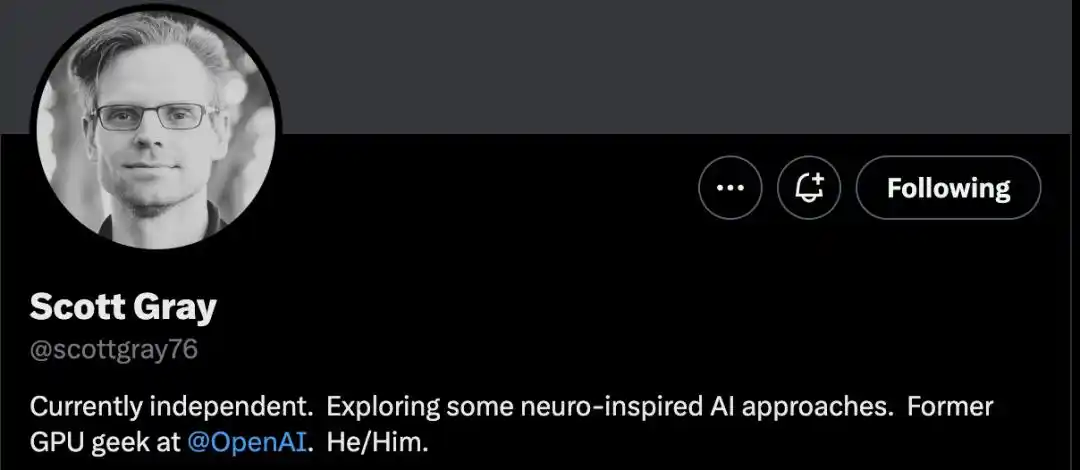
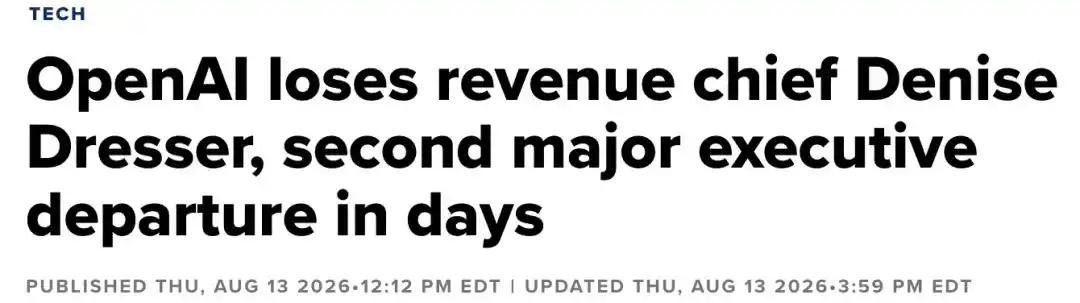
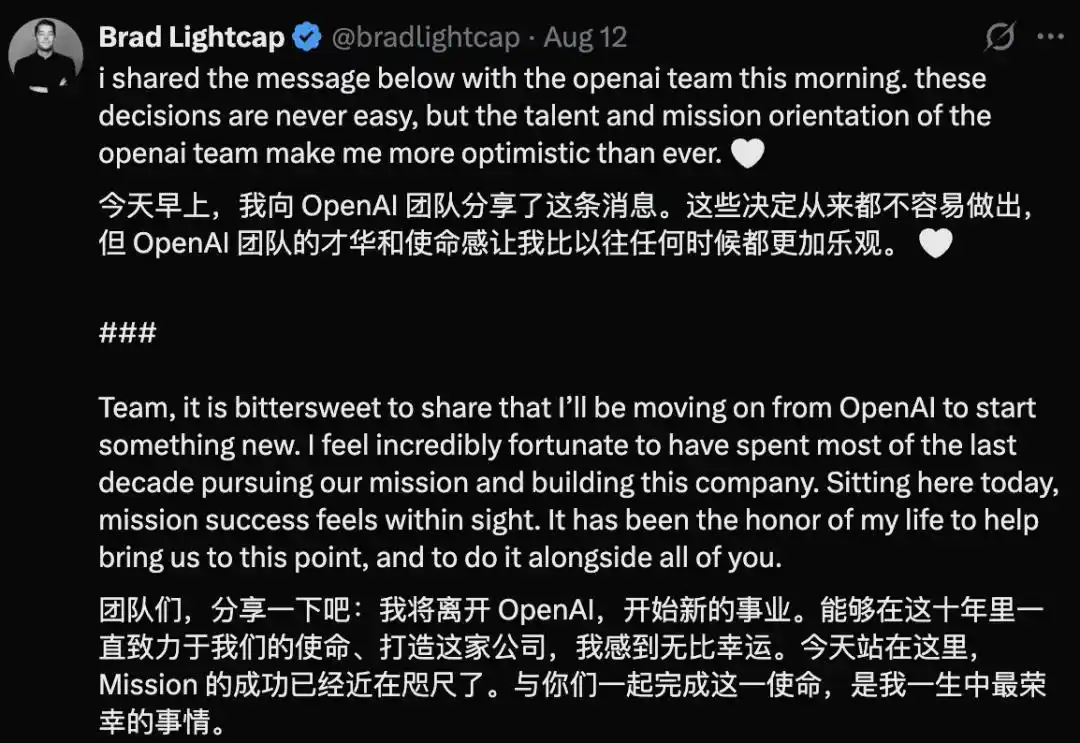
From Aug. 11 to Aug. 13, former Chief Operating Officer Brad Lightcap said he was leaving after eight years at OpenAI, and Chief Revenue Officer Denise Dresser also announced her exit after just eight months in the job. Around the same time, Scott Gray, a decade-long OpenAI veteran known for core GPU and model optimization work, changed his X bio to read: "Currently independent, exploring some neurally inspired AI directions, former GPU geek at OpenAI."
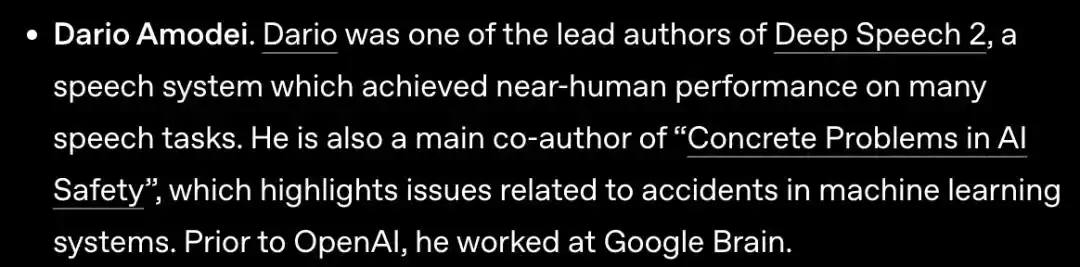
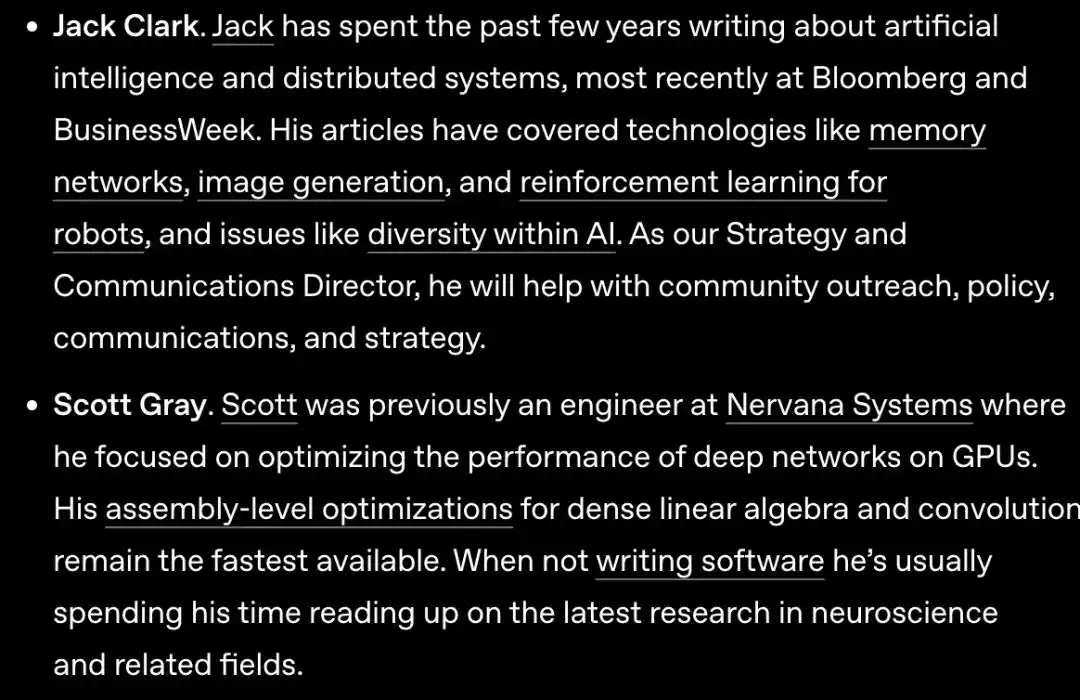
The change drew attention because Gray was part of an earlier generation of hires. In an Aug. 16, 2016 OpenAI hiring announcement, Dario Amodei, Jack Clark and Scott Gray were all listed. Ten years later, Amodei is CEO of Anthropic, Clark leads policy there, and Gray now describes OpenAI as a former employer.
The timing is notable. OpenAI has already confirmed that it confidentially filed a draft S-1, though it has not set a public listing date. The Financial Times, citing people familiar with the matter, reported that an IPO could slip to next year.
Two C-suite exits in three days, and a new CRO arrives
The most visible changes came over the course of a single week.
On Aug. 11, Lightcap wrote on X that he was ending his eight-year run at OpenAI to do something new. He joined in 2018, first as CFO, became COO in 2022, and was moved in April this year to oversee what the company called special projects.
Two days later, Dresser said she was leaving. She had taken the CRO post in December 2025. Before joining OpenAI, she spent more than a decade at Salesforce, most recently as CEO of Slack.
OpenAI named her replacement the same day. Dali Rajic will serve as the company’s new chief revenue officer. Rajic came from Wiz, the cloud security company later acquired by Google, and previously held president and COO roles at Zscaler and AppDynamics.
CNBC, citing a person familiar with the matter, reported that Rajic had been introduced to OpenAI by Thrive founder Josh Kushner.
The sequence left a company valued at $852 billion with two C-level departures in one week and one new CRO appointment. It also changed the tone of OpenAI’s Aug. 14 shareholder meeting, which, according to the source text, turned into a live Q&A session on roadmap questions, executive turnover and IPO timing.
Business Insider counted 12 executive departures in the first eight months of 2026
Business Insider said 12 executives have left OpenAI in the first eight months of 2026. The source text distinguishes between those who have fully departed or ended full-time roles and those whose status changed in another way.
The 10 people listed as already gone or no longer in full-time positions are:
- Chief Revenue Officer Denise Dresser
- Chief Operating Officer Brad Lightcap
- Chief Product Officer Kevin Weil
- Sora lead Bill Peebles
- Enterprise applications CTO Srinivas Narayanan
- Head of enterprise AI sales Barret Zoph
- Ethics lead Chloé Bakalar
- Head of Safety Systems Johannes Heidecke
- Chief Futures Officer Joshua Achiam
- Head of robotics and consumer hardware Caitlin Kalinowski
Two others were in a different category. Former applications CEO Fidji Simo took leave in April for health reasons, then stepped down from a full-time role in July and became a part-time adviser. Former CMO Kate Rouch stepped aside in April to focus on breast cancer treatment. OpenAI had previously said she might return in a more focused role if her health allows.
Scott Gray was not included in that group of 12. The source text describes him not as an executive but as a technical backbone figure who helped make the models run.
After Fidji Simo shifted to an advisory role, attention turned to internal power dynamics
The Financial Times, citing several people familiar with the matter, reported that OpenAI has been through nearly six reorganizations this year. The company’s own framing was that this was a pre-IPO streamlining effort.
Sam Altman had given employees a clear directive, according to the source text: cut peripheral projects and concentrate resources on ChatGPT and on competing with Anthropic for enterprise customers.
OpenAI told the Financial Times that it is moving at an unusual pace and is not afraid to make organizational changes.
Inside the company, though, employees have not all experienced the changes the same way. The source says repeated leadership reshuffles and a string of senior departures have left some workers tired of the nonstop churn.
Fidji Simo’s status has become one of the more delicate parts of the story. She had been seen as Altman’s No. 2. After moving into an advisory role in July, two people close to OpenAI told the Financial Times that she was still communicating with employees almost daily. One person familiar with the situation described her as still operating behind the scenes, while several executives competed for Altman’s attention and internal politics remained pronounced.
OpenAI responded that Simo’s advisory work was proceeding as expected.
That raised a broader question: who is now effectively second in command at OpenAI? The source text says that after the boardroom crisis in late 2023, when Altman was briefly ousted and then reinstated within less than a week, he rebuilt the management structure and pushed the company toward a more professionalized model. In that setting, co-founder Greg Brockman is described as using the latest departures to expand his practical influence.
There were public signs of that. Brockman delivered the statement around Rajic’s appointment, and he appeared alongside Sarah Friar at the Aug. 14 shareholder meeting.
Preparedness team was dismantled, while the broader safety framework remained in place
The more unsettling shift, according to the source text, came in late July. The Financial Times reported, citing several people familiar with the matter, that OpenAI had dismantled the standalone Preparedness team.
That group had been responsible for assessing whether OpenAI models could create severe or catastrophic risks and for studying mitigation measures. After the change, duties related to areas such as biosecurity and cybersecurity were distributed to senior staff inside existing teams.
The source text makes a distinction here: what disappeared was the independent organizational unit carrying out the work, not the entire governance structure around safety. The Preparedness Framework is still operating, covering risk categories including biological threats, cybersecurity and AI self-improvement, with oversight from the Safety Advisory Group. In OpenAI’s own definition, the framework is meant to track and respond to frontier capabilities that could cause novel and severe harm.
The issue is who now executes that work, and where they sit.
In July, Johannes Heidecke, the head of Safety Systems, left the company. He joined OpenAI in 2021, took charge of Safety Systems in 2024, and led a team that evaluated dangerous model capabilities and built safeguards. Before leaving, he said: "The requirements for safety work keep increasing, while the pace at which we train models is getting much faster."
After Heidecke’s departure, the safety team was folded into the organization led by Mia Glaese, OpenAI’s vice president of research and safety. OpenAI said the move would embed safety earlier and more deeply into model development.
That same month, Chief Futures Officer Joshua Achiam also left after nearly nine years at the company. He had previously led the mission alignment team, which was tasked with helping OpenAI uphold its founding pledge to ensure that artificial general intelligence benefits all of humanity. That team had already been disbanded earlier this year, and Achiam later moved into the chief futures role.
Ethics lead Chloé Bakalar also departed in July. She had been at OpenAI for less than a year and worked on model behavior, the relationship between humans and AI, and whether advanced systems should receive moral consideration.
Placed on a longer timeline, the source describes a consistent path. The Superalignment team focused on long-term risk was dissolved in 2024. The mission alignment team was dissolved earlier this year. Then the Preparedness team was dismantled in late July. Across those three teams over a little more than two years, OpenAI moved safety from an independent structure into one component of the broader R&D system.
That leaves the company without an independent team whose sole job is to watch risk regardless of product launch schedules.
$40 billion in annualized revenue helps explain the scale of the reorganization
At the Aug. 14 shareholder meeting, CFO Sarah Friar offered the operating context behind the changes.
According to one attendee’s account in the source text, Friar said that consumer and enterprise revenue had been running at roughly a 60-40 split at the start of the year. Enterprise growth, however, came in far stronger than expected, and the two lines have now crossed. Enterprise has become the larger part of OpenAI’s revenue base.
That happened more than a quarter earlier than what Friar had told CNBC earlier this year, when she said the two segments would not reach parity until the end of 2026.
CNBC verified that OpenAI’s annualized revenue has reached $40 billion, a figure first reported by Bloomberg. Based on presentation materials reviewed by CNBC, July revenue rose 20% month over month, while enterprise customers grew 32%.
The source text adds that OpenAI now gets most of its money from more than 2 million enterprise customers, double the count from a year earlier, rather than primarily from a consumer product with more than 1 billion monthly active users. If that is the revenue mix, then the sales system, organizational chart and reporting lines all need to change with it.
That helps explain why a CRO who had been in the seat for only eight months was replaced by an executive associated in the source text with driving rapid growth at Wiz.
The comparison with Anthropic is also part of the picture. In an official announcement dated May 28, Anthropic said its annualized revenue had surpassed $47 billion earlier that month. It also said it had raised $65 billion in the same round, giving the company a post-money valuation of $965 billion.
The source text cautions against a direct one-to-one comparison between Anthropic’s $47 billion and OpenAI’s $40 billion because the two companies do not recognize partner revenue in the same way. It says that difference alone is not enough to conclude that Anthropic has fully overtaken OpenAI commercially.
Still, Friar said at the shareholder meeting that the era of "tokenmaxxing" is over. Enterprise customers are no longer letting employees run up AI bills without limit; they are watching the cost of each unit of intelligence more closely. Using the latest model as an example, she said efficiency in agentic coding tasks had improved by 54%, alongside earlier rounds of price cuts.
She also said the advertising business had made substantial progress and was approaching a $1 billion annualized run rate. ChatGPT began testing ads in February this year.
At the same time, OpenAI has been spending heavily to retain employees. The Financial Times reported that a tender offer to repurchase close to $7 billion of employee shares had been completed, with several staff members cashing out more than $10 million each.
Scott Gray’s profile change revived questions about technical talent retention
Gray’s case stands apart from the executive reshuffle, but it points to another concern inside OpenAI.
He joined OpenAI from Nervana Systems in 2016. At the time, the company said he worked on GPU performance optimization for deep networks. His assembly-level optimization work in dense linear algebra and convolutions was described as among the fastest implementations available.
Gray later appeared on the author list of the 2020 Scaling Laws paper alongside Dario Amodei. The source text says he worked with Tom Brown, Rewon Child and Alec Radford on an optimized Transformer implementation. That paper later shaped how much of the industry thought about scaling and spending.
After that came GPT-3, OpenAI Five and, in the GPT-4 era, contributions to GPT-4 inference research and inference infrastructure.
During the November 2023 governance crisis, Gray also posted a line that spread widely: "Without its employees, OpenAI is nothing."
The S-1 can spell out revenue and compute, but not every internal trade-off
OpenAI has already submitted its draft S-1. The company has said the timing of a listing remains undecided because some initiatives are easier to carry forward while the company is still private. The Financial Times, citing people familiar with the matter, reported that the IPO may be pushed into next year.
Customers, revenue, compute and data centers will likely feature prominently in the filing. What the document will not settle is who applies the brakes after safety responsibilities have been dispersed, or how many deep technical contributors in Scott Gray’s mold still remain inside the company.