
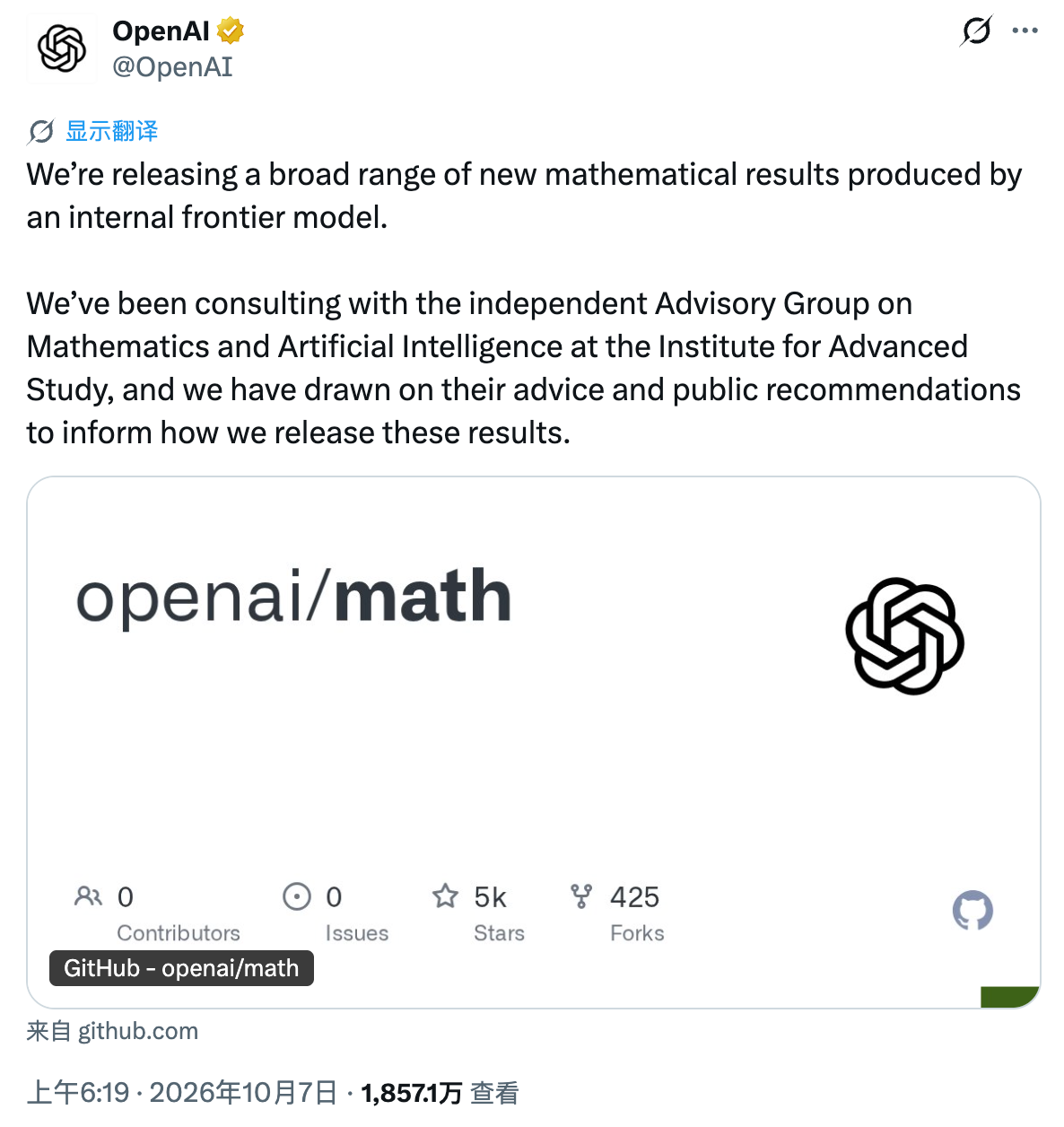
OpenAI’s latest disclosure on mathematical research has set off a new round of debate over the security assumptions behind crypto systems. Early on Oct. 7 Beijing time, OpenAI said its internal frontier model had produced a broad set of mathematical results that were compiled on GitHub into 722 manuscripts and 372 result families. The work spans number theory, geometry, combinatorics and theoretical computer science, and includes areas such as the Milne rationality conjecture and algebraic specialization, the quasi-Riemann hypothesis, and Hilbert’s tenth problem. OpenAI also said the evaluation process involved about 4,000 questions, with each result using compute roughly equivalent to about three hours of ChatGPT Pro thinking.
Later that night, Ethereum Foundation researcher Justin Drake responded with a far more forceful message. He called on the crypto industry to calmly start planning for what he described as “bunker mode,” meaning a gradual transfer of assets into fresh addresses that have never signed a transaction.
Drake’s core argument is straightforward: if AI keeps advancing at this pace in mathematics, the Elliptic Curve Digital Signature Algorithm, or ECDSA, could face a break before quantum computing is actually ready for practical attacks. If that happens, the security of accounts on major blockchains including Bitcoin and Ethereum would come under direct pressure.
Why Drake is focused on ECDSA
For years, crypto has treated account-security planning as a problem tied mainly to the distant “Q-day,” the moment quantum computing can defeat modern public-key cryptography. Drake is warning about a different route. In his view, AI-driven mathematical superintelligence could kill ECDSA earlier, and do so on classical hardware rather than quantum machines.
He argued that this risk can no longer be framed simply as something for decades from now. In the bleakest version of the timeline, he said, the shift could come within months or years. An attacker might not need a quantum computer at all. A large GPU cluster, in that scenario, could be enough to reverse private keys within about a week.
Drake tied that concern to the pace of AI progress in math this year. He pointed to OpenAI’s May disclosure of an AI-generated counterexample to the Erdős unit distance conjecture, followed by progress on long-open problems in August, then a September claim that an internal model had solved the Navier-Stokes Millennium Prize problem. Now, OpenAI has released hundreds more mathematical research results at once.
In Drake’s reading, the field may be approaching an inflection point where “several centuries of mathematical progress” can be crossed in a matter of weeks. If AI can rapidly overturn long-held human judgments about how hard mathematical problems really are, then cryptographic problems now treated as safely difficult may also hide shortcuts that no one has recognized yet.
What “bunker mode” means
Drake sees ECDSA as especially exposed because of its rich mathematical structure. He referred to tools and ideas including the Schoof algorithm, Frobenius and pairings, all of which rely on that structure. By contrast, one of the design goals of cryptographic hash functions is to minimize usable mathematical structure. The more structure a system has, he argued, the more room there may be for undiscovered shortcuts.
That led him to a deliberately extreme but, in his view, worthwhile scenario to prepare for. AI could eventually discover a classical algorithm analogous to Shor’s algorithm, allowing attackers to derive private keys quickly from public information without relying on quantum computers. If that happened, assets protected by ECDSA could be exposed directly.
His “bunker mode” proposal follows from that premise. For ordinary holders, the key recommendation is to move funds gradually into fresh addresses that have never initiated a transaction. The reason is that the public key for such an address has not yet been directly exposed onchain; the address itself is only represented through hashing. Once the address signs a transaction, however, the public key may become public. If a new attack on ECDSA emerges later, an attacker would theoretically have more information to work with.
For critical signers such as exchanges, custodians, oracles and L2 security councils, Drake suggested more aggressive steps. Those include stronger cold-wallet practices, regular rotation of ECDSA public keys and, where conditions allow, the use of hash-based signature schemes in multisig setups.
Even so, Drake stressed that the process should happen slowly. He did not call for panic or a rushed, large-scale migration because migration itself introduces operational risk. He also noted that addresses holding less than 50 BTC receive a degree of implicit protection from what he called the “Satoshi shield,” referring to 20,000 addresses attributed to Satoshi Nakamoto that each hold 50 BTC and already have exposed public keys.
As for eventually exiting bunker mode, Drake said the industry would need a form of “post-AI cryptography” that can withstand an era shaped by AI. His recommendation was to lean fully into hash-based cryptography and avoid systems built on structured mathematical assumptions whenever possible, because any sufficiently complex structure should be treated as something AI may attack through a newly discovered path in the future.
Vitalik Buterin: move if you want, but do not rush
After Drake’s warning, Ethereum co-founder Vitalik Buterin published his own view. His position was noticeably more restrained.
Vitalik said he agrees with keeping funds in brand-new addresses that have never signed a transaction when doing so is not cumbersome. But he does not think anyone should rush to move assets immediately because of this latest AI math progress. Key migration has its own operational hazards, he said, and a bad migration can inflict losses greater than a hack.
That does not mean he sees the threat as negligible. Quite the opposite. Vitalik argued that the industry should seriously consider a possibility that has not been fully incorporated into existing risk models: AI-accelerated mathematics may threaten not only elliptic-curve systems, but also forms of post-quantum cryptography that many people expect to provide the next security foundation.
He specifically cited ML-DSA, FHE and lattice cryptography. The conventional view has been that quantum computing mainly threatens elliptic curves and RSA, while lattice-based systems can serve as the next generation of security infrastructure. Vitalik’s point is that, under an AI-accelerated math scenario, that separation may not hold as firmly as assumed.
His reasoning is historical. Again and again, humans have treated a problem as requiring enormous computational complexity, only for mathematicians to later uncover hidden structure and slash the difficulty after decades of work. If AI can compress decades of mathematical exploration into years or even months, then lattice cryptography may also contain shortcuts that no one has seen yet.
Hash-based cryptography and operational defenses
Like Drake, Vitalik expressed more confidence in purely hash-based cryptography. In his view, elliptic-curve and lattice systems both rely on specific mathematical structure, while hash functions are designed to avoid exploitable structure as much as possible. If AI’s edge lies in finding hidden structure, then a cryptographic system with as little structure as possible would be easier to trust.
He also drew a limit around that idea. Pure hashes can fully handle signatures and proofs, but they do not solve everything. The hard problem is public-key encryption, or PKE. That issue affects secure website access, encrypted communications, VPNs and the foundations of internet security more broadly. Vitalik said mathematical theorems already show that public-key encryption cannot be built from hash functions alone if those functions have no algebraic structure. To get PKE, some trapdoor mathematical structure has to be introduced. Once structure exists, he argued, AI should be assumed capable of making progress against it.
Given that constraint, Vitalik offered an engineering-minded suggestion: if a lattice-based encryption system is expected to remain theoretically secure over the long run, the simplest move is to increase its parameters and key sizes by 10x.
He also proposed two defensive measures at the application layer:
- Privacy protocols should avoid hard-coding encrypted notes directly onchain and use offchain third-party channels where possible.
- Multisig wallets should prioritize completing signature confirmation offchain so that signer public keys are not exposed to the entire network too early.
Under that setup, Vitalik said, even if ECDSA were to suffer an irreversible mathematical break, a multisig system could at least “gracefully degrade” into a single-signer model controlled by a signature collector. That is still preferable to a fully open situation in which anyone could withdraw funds.
AI-driven math progress reopens the basic security question
Taken together, the warnings from Justin Drake and Vitalik Buterin put a deeper question back in front of the industry: if AI starts to drive mathematical discovery at a much faster pace, how solid are the assumptions that crypto has relied on for years?
For more than a decade, “In Math We Trust” has sat near the core of decentralized ideology. Complex algebraic structures were treated as safe harbors, while the chance of a real break was pushed into a distant future. OpenAI’s latest publication of hundreds of mathematical results has changed at least the sense of timing around that belief. What humans call unbreakable may partly reflect how slowly humans themselves move through the maze of mathematics.
In that context, Drake’s bunker-mode framework and Vitalik’s more measured focus on fresh addresses, offchain signatures and hash-leaning designs point to the same broad shift: not panic, but a reassessment of the basic security assumptions for the AI era. For ordinary users, the shared message is not to rush into mass migration today. It is to stop treating static security assumptions as untouchable, and to take more seriously the attack surface that advanced AI may reveal.