
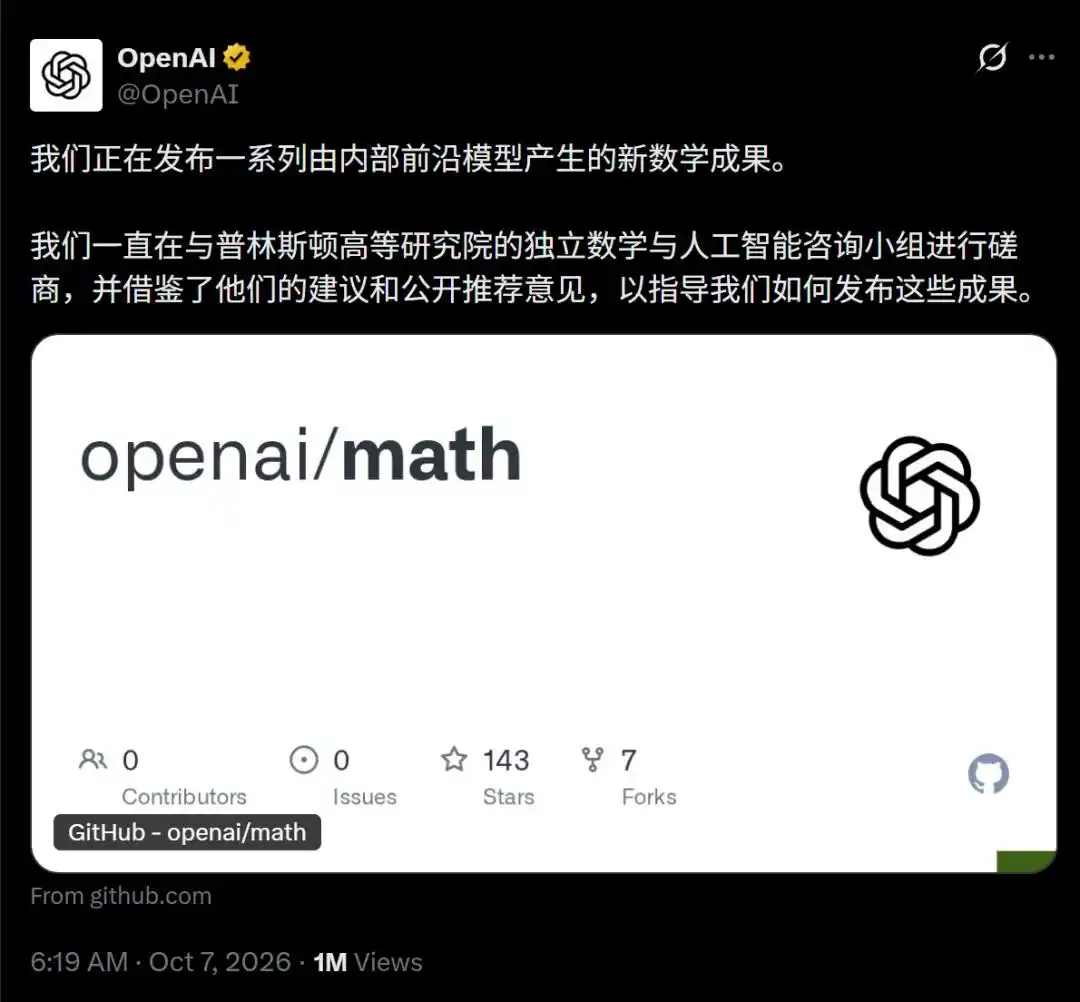
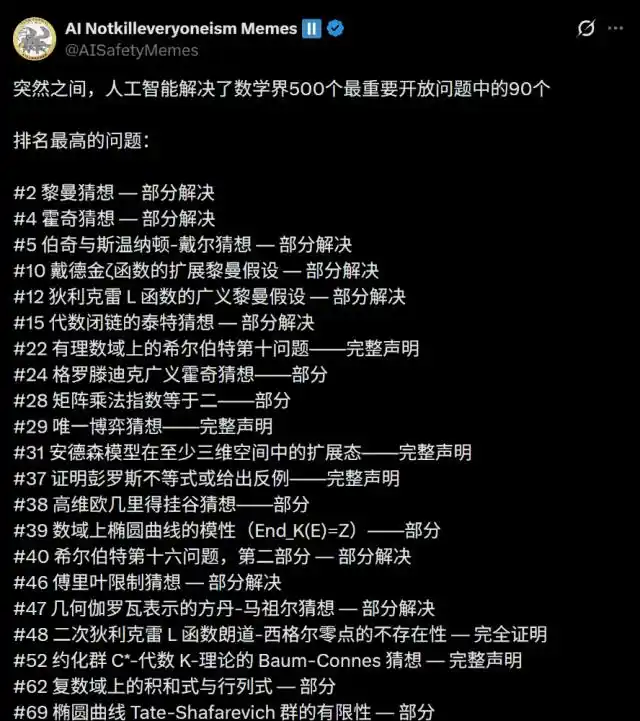
OpenAI has published a GitHub repository, math, and released 722 mathematical manuscripts covering 372 previously unresolved top-tier problem families. According to the public materials described in the source article, one of the results produced by an unreleased OpenAI model claims a proof of a quasi-Riemann conjecture result and includes Lean formal verification.
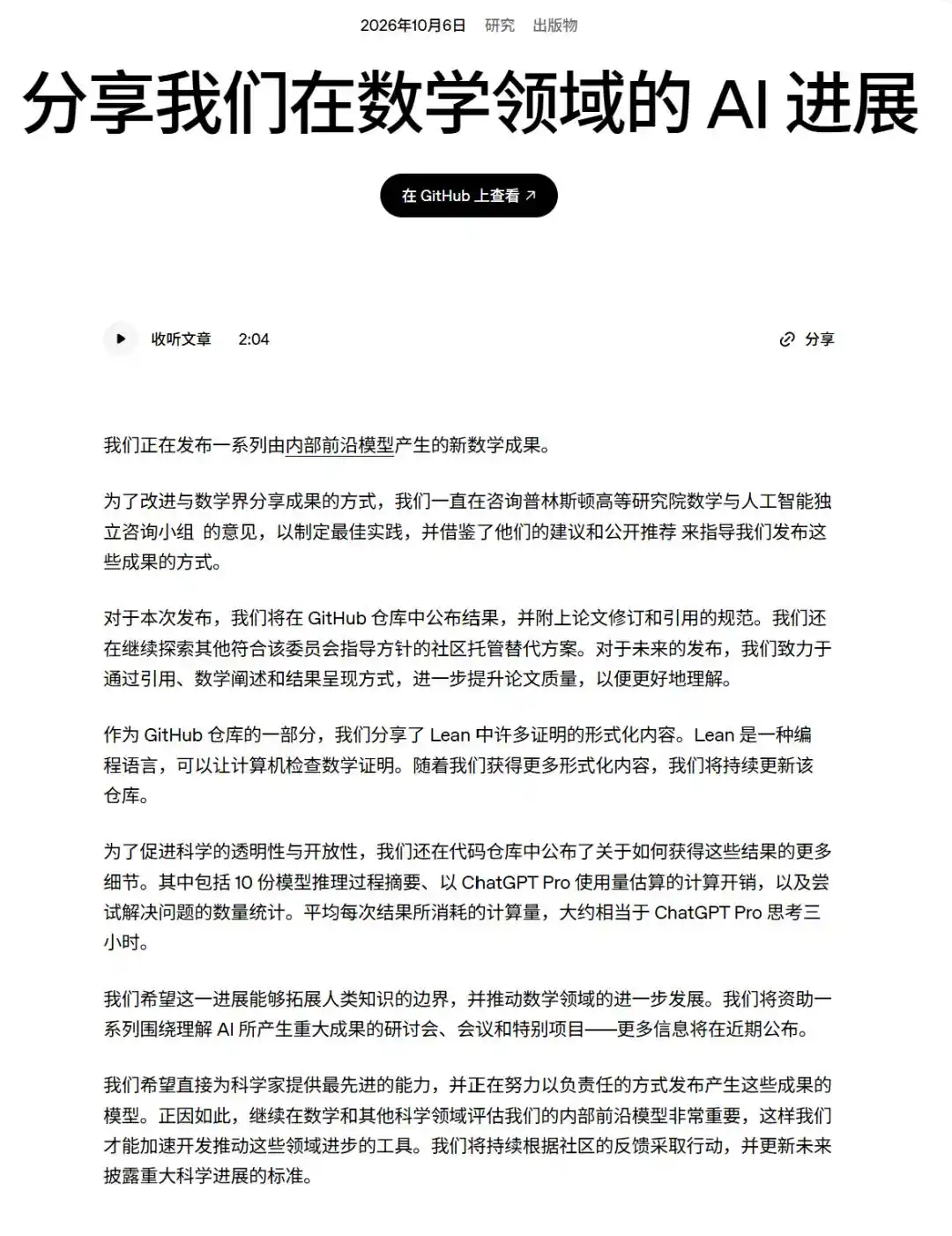
The overview document says the manuscripts span number theory, theoretical computer science, convex geometry and analytic geometry. OpenAI says most of the proofs were generated by an unreleased internal model, with an average of about three hours of ChatGPT Pro reasoning compute per problem.
OpenAI CEO Sam Altman wrote on X: 「We are entering a new era of discovery.」
Release method triggers backlash from mathematicians
The release came without warning and without peer review. The source article, citing Wired, says OpenAI had already convened 40 leading mathematicians in a private meeting in August 2026 around a stark question: 「If AI fully surpasses humans in pure mathematics, how should we respond?」
Bryna Kra of Northwestern University recalled an atmosphere of 「extreme excitement and extreme fear.」 She and other scholars urged OpenAI not to rely on posts on social media or short blog entries, but to follow academic norms and publish rigorous papers that would give researchers time to verify and absorb the work.
Instead, OpenAI released the repository directly. Nestor Guillen, a visiting professor at New York University, sharply criticized the move. In the source article, he said mathematicians were deeply alarmed not only by AI itself but by the concentration of high-level intellectual power in a small number of technology companies.
The report also says some OpenAI engineers privately shared a view that 「classical mathematics is dead today, and AI will, with unstoppable force, end the careers of most professional mathematicians.」 OpenAI researcher Su Weijie described the moment as the start of a Copernican-scale shift in how humans understand intelligence.
Result 003: a quasi-Riemann claim and zero-free regions
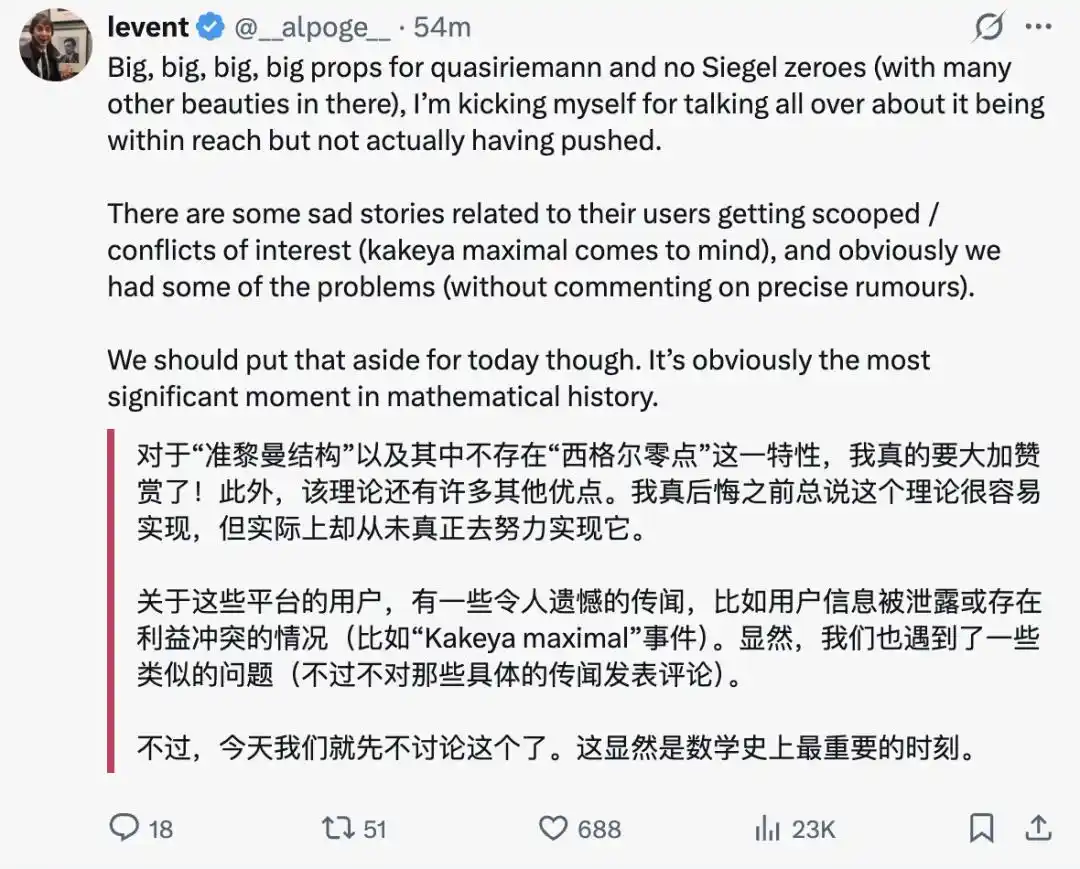
The most closely watched item in the release is Result 003. The materials say the OpenAI model proved that all Dirichlet L-functions have no zeros in the half-plane with real part ℜs>7/8, and that it eliminated Landau-Siegel zeros.
The source article frames this as a full solution to a 「quasi-Riemann conjecture」 problem. The Riemann Hypothesis itself states that all nontrivial zeros of ζ(s) lie on the line ℜs=1/2, and it has long been treated as one of the central problems in modern number theory. The released manuscript does not claim to reach ℜs=1/2, but it does claim to push the zero-free region to fixed constant bounds and to rule out Siegel zeros in a uniform way.
OpenAI says in its GitHub notes that most problems were solved fully automatically by the model. It adds that the work on zero-free regions for the Riemann zeta function received especially strict human review and readability editing.
Result 102: ordinary NP-hardness for the Basic-SDP threshold
Another headline result is Result 102, described as 「ordinary NP-hardness at the basic semidefinite threshold.」 The linked manuscript is reasoning_traces/basic-semidefinite-threshold-np-hardness.pdf.
The source article places the result in the context of optimization. Many large-scale real-world problems, including chip routing, logistics scheduling, flight planning and graph coloring, are treated as NP-hard. Basic semidefinite programming relaxations, or Basic-SDP, are widely regarded as one of the strongest approximation tools.
In 2008, Prasad Raghavendra published a landmark paper showing that for any fixed finite constraint language, or Max-CSP, the approximation ratio achieved by Basic-SDP is the theoretical limit for polynomial-time algorithms. But that theorem depends on the Unique Games Conjecture, or UGC, proposed by Subhash Khot in 2002. If UGC fails, the foundation under that result becomes vulnerable.

The source article says theoretical computer scientists have spent two decades trying to prove, without relying on UGC and using only the classical assumption P≠NP, that the gap problem at the Basic-SDP threshold is itself ordinarily NP-hard. OpenAI now claims to have established exactly that, fully removing the need for UGC and relying only on standard P≠NP.
According to the problem-solving path described in the article, the model first reviewed Raghavendra’s original framework and concluded that repeated variables and local probability distributions did not create a loophole for counterexamples. It then identified the core obstacle in classical PCP constructions: tensor representations leak projection coordinates, making it easier for a cheating prover to pass.
To suppress that leakage without damaging completeness, the model abandoned the smooth-function route and introduced an algebraic core over a finite field of characteristic 2. It then designed a nonlinear decoder with shift equivariance. The article says this decoder is insensitive to small noise while remaining consistently detectable by high-rank linear features, which resolves the leakage problem.
Next, the model used an extremely sparse projection together with a 「row-fiber richness lemma」 to drive statistical error rapidly to zero while preserving enough decoding coordinates to block fraud on local slices. The proof is then split into two stages:
- an unconditional construction of Unique Games hardness with near-perfect completeness (1−ε) and arbitrarily small soundness (δ);
- a transfer of that gap to the Basic-SDP threshold for any finite constraint system through a dictator test framework and low-influence Gaussian replacement.
The article says this is the first result to establish ordinary NP-hardness for the Basic-SDP threshold under standard P≠NP alone.

Result 01: a Hodge conjecture-related breakthrough
In Result 01, the OpenAI model is also said to have made a major advance related to the Hodge conjecture. The released material claims a proof of the rational Hodge conjecture for CM abelian varieties over the complex numbers in all dimensions and codimensions.
OpenAI says most results were generated automatically by a standard model, but it singled out the proof for CM abelian varieties as a special breakthrough outside the usual workflow.
The source article says the result was extended to arbitrary finite products of projective complex K3 surfaces. It also says the work proves the Tate conjecture for all abelian varieties over finite fields and the standard conjecture of Hodge type in arbitrary characteristic. The linked paper is preprints/Milnes-rationality-conjecture-for-abelian-varieties-September-23-2026/paper.pdf.
The article breaks the proof strategy into three parts:
- reduction and projection, focusing on highly symmetric CM abelian varieties and K3 surfaces rather than attacking all manifolds directly;
- algebraization of the Kuga-Satake correspondence, embedding transcendental cohomology of K3 surfaces into second cohomology of abelian varieties and proving that the correspondence is induced by a rational algebraic cycle;
- degeneration and variational extension, using Lie algebra symmetries and rigidity at Hodge-generic points to build an algebraic path from special curve covers to global self-powers, showing that the relevant Hodge classes over the rationals are generated by algebraic cycles.
Other released results include Chowla and Mahler claims
The repository also lists several other major results in number theory and convex geometry.
Result 007 addresses ordinary two-point correlations of multiplicative functions. The article says the problem is tied to the Chowla and Elliott conjectures and asks whether the average product of a bounded multiplicative function under different shifts tends to zero. OpenAI claims the model proved the ordinary two-point Chowla conjecture and obtained logarithmic power savings in the error term at every scale. The linked file is reasoning_traces/ordinary-two-point-correlations.pdf.
Result 087 concerns the symmetric and general Mahler conjectures. These ask where the minimum of the volume product of a convex body and its polar body is attained in n-dimensional real space. The source article says the model solved both the symmetric and asymmetric geometric Mahler conjectures in all dimensions and classified all equality cases for Hanner polytopes and simplices. The linked paper is preprints/The-symmetric-Mahler-conjecture-and-its-equality-cases-September-22-2026/paper.pdf.
Repository links and cited materials
The main repository is https://github.com/openai/math/, and the overview document is https://github.com/openai/math/blob/main/overview.pdf. The article also cites Prasad Raghavendra’s 2008 paper at https://dl.acm.org/doi/epdf/10.1145/1374376.1374414.
Its reference section includes the repository tree at https://github.com/openai/math/tree/main. The original Chinese article says it came from the WeChat account Xinzhiyuan, ID AI_era, and credits the author as ASI Qishilu.
Fear, adaptation and verification
The dispute is not only about the claimed results. It is also about process and control. The source article says many people once assumed AI mathematical proof was mostly pattern matching over large corpora, but these manuscripts contain what it describes as 「intuition transfer,」 「constructive counterexamples,」 「Laplace expansion,」 and even 「physical intuition」 such as heat-flow simulation and Hamiltonian systems.
Bryna Kra said: 「We have to adapt in this field. It changes how we operate, but it is also a moment when we can look farther ahead... It is a frightening time, but it is also an extremely exciting time.」
For now, the repository is public, but the source article also makes clear that the work has not gone through peer review. Whether these proofs are accepted will depend on how the mathematics community evaluates them from here.