

OpenAI has uploaded nine AI-generated mathematics manuscripts to its openai/math GitHub repository, saying the work addresses eight open problems in mathematics and theoretical computer science. The headline claim is that the matrix multiplication exponent is 9/4, or 2.25. The papers also cover the fast Fourier transform (FFT), integer multiplication, the sunflower conjecture, linear programming and other complexity questions. OpenAI released Lean formal proofs for some of the results, but the manuscripts have not been peer-reviewed, and the source says the formal proofs cover only part of the work.

The results concern theoretical complexity, not an immediate speedup for existing hardware. The source warns that the algorithms’ hidden constants may be too large for the asymptotic improvements to matter at practical matrix sizes.
Nine manuscripts across two research families
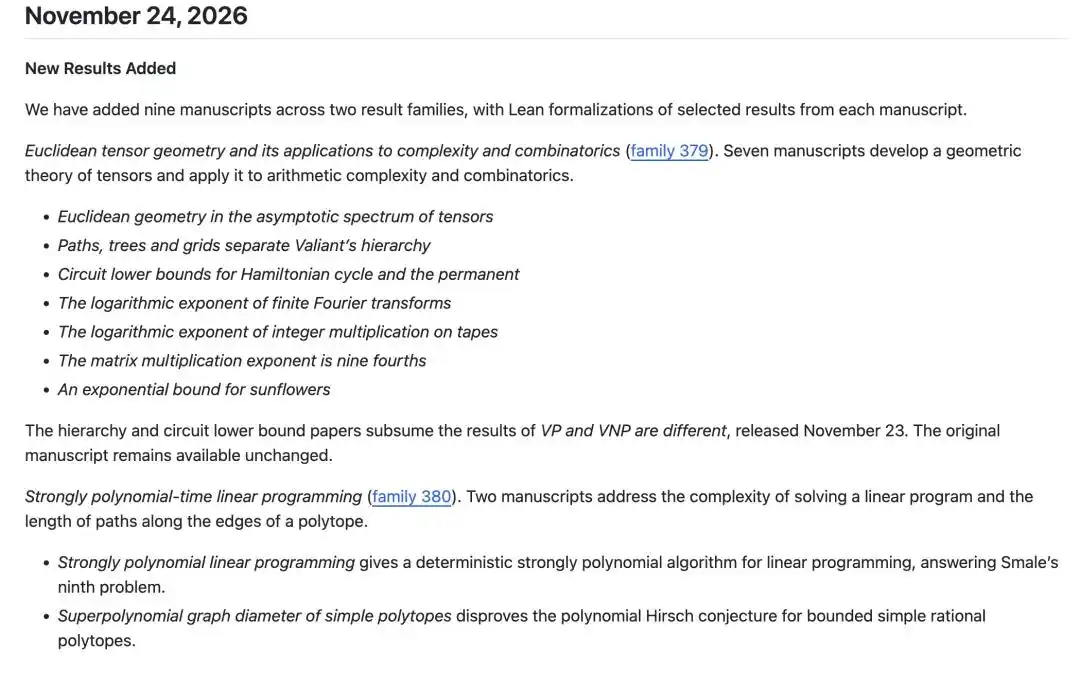
OpenAI’s repository update divides the nine manuscripts into two groups. Family 379 contains seven papers. Their subjects include Euclidean geometry in the asymptotic spectrum of tensors; paths, trees and grids for separating Valiant’s VP and VNP classes; circuit lower bounds for Hamiltonian cycles and the permanent; the logarithmic exponent of the finite Fourier transform; the logarithmic exponent of integer multiplication on a Turing machine; the matrix multiplication exponent; and an exponential bound related to sunflowers.
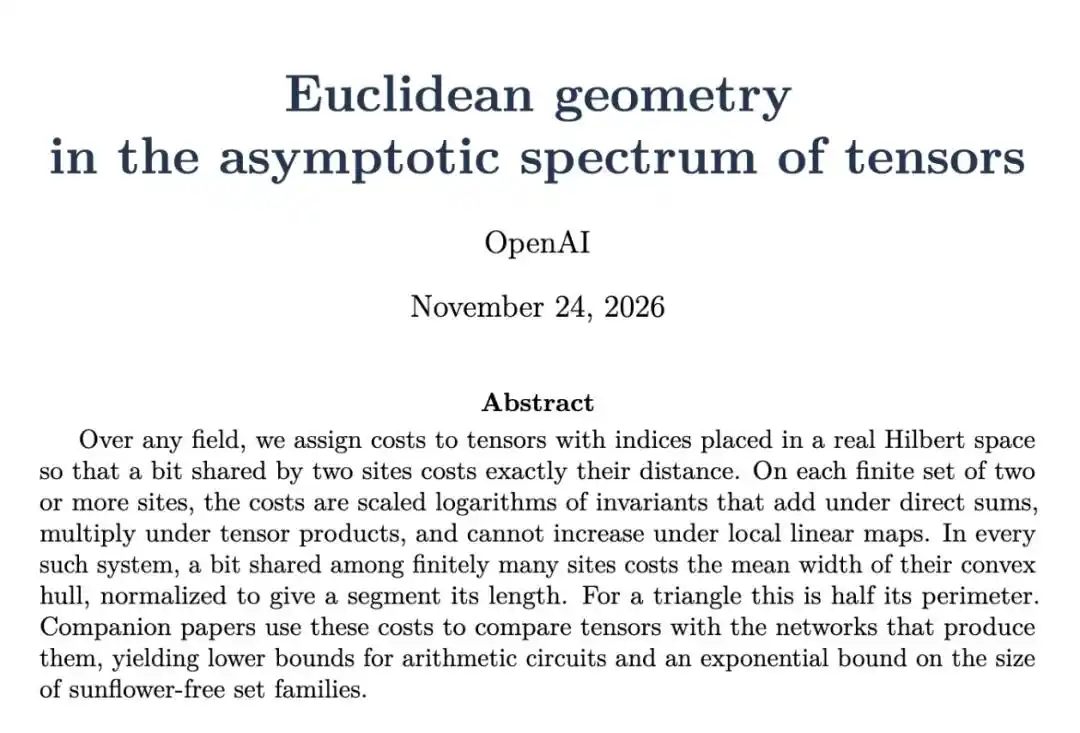
The first paper, on Euclidean geometry in the asymptotic spectrum of tensors, proposes a tool for studying these questions. It treats abstract tensor indices as points in a geometric space and relates computational cost to distance. When two points share one bit, the cost is represented by the distance between them. When three points share one bit, it is represented by half the perimeter of a triangle. The source says the other papers in the family use this framework to examine matrix multiplication, FFT, integer multiplication and Hamiltonian cycles.
The matrix multiplication exponent is claimed to be 9/4
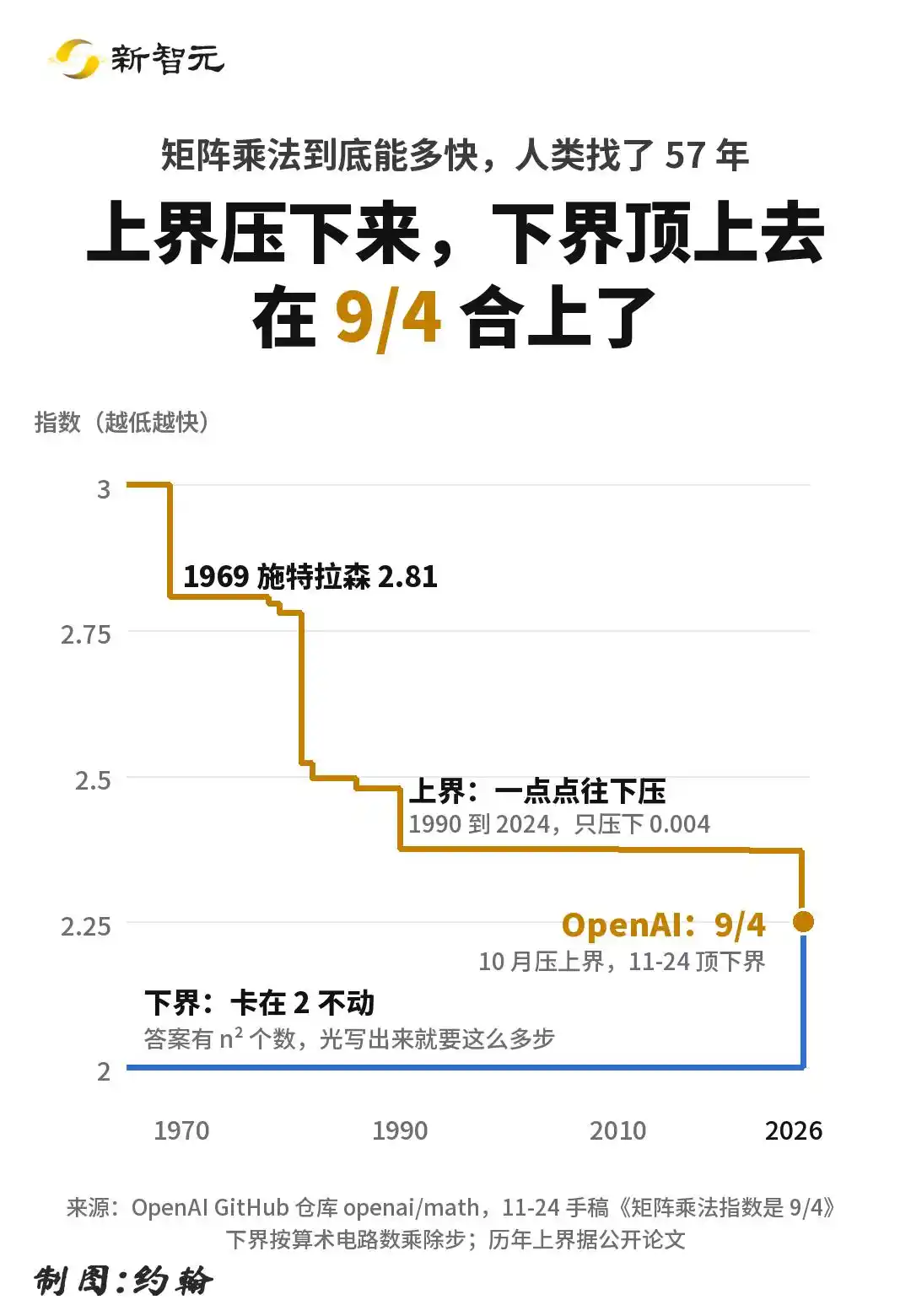
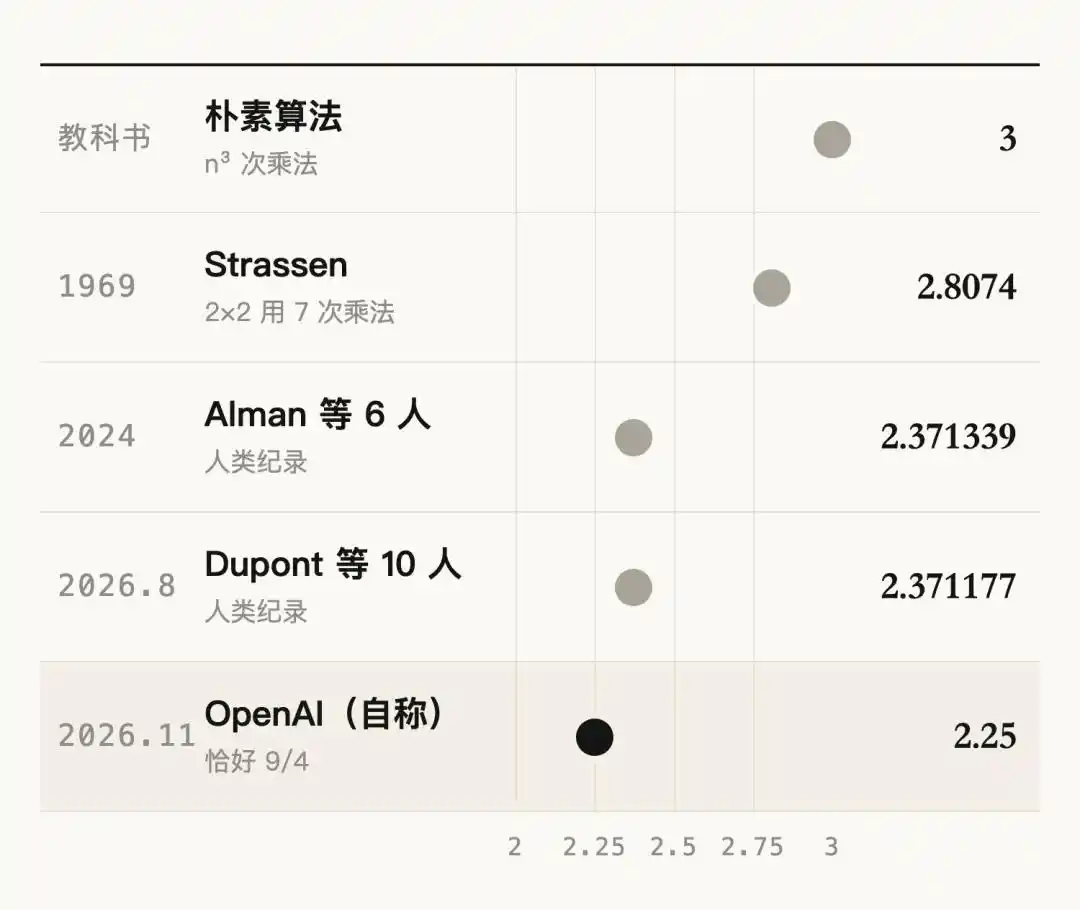
Matrix multiplication is a basic operation in modern computing. The straightforward method takes n³ multiplications to multiply two n×n square matrices, giving an exponent of 3. In 1969, German mathematician Volker Strassen showed that multiplying two 2×2 matrices required seven multiplications rather than eight. That result reduced the complexity to O(n^2.807), with an exponent of about 2.8074.
Researchers have spent decades trying to lower the exponent. Because the output contains n² values, an exponent of 2 is treated as the theoretical lower limit. The source says the record stood at 2.371339 in 2024 and was improved to 2.371177 in August of this year. After 57 years of work, the known range had been narrowed to between 2 and 2.371177.
OpenAI’s paper claims the exponent is 9/4, or 2.25—not 2. MIT complexity theorist Ryan Williams is quoted as saying that Strassen was right and that the matrix multiplication exponent is exactly 2.25.
The source presents the result as the combination of an upper bound and a lower bound. OpenAI proved the upper bound over the complex numbers in October of this year; mathematicians Houxi Lü, Amanov and others later extended it to every field. The latest paper, according to the source, supplies the key lower bound. Its authors use a contradiction argument: a faster method would conflict with known mathematical limits. The specific multiplication-and-division formula for that bound is missing from the supplied text, so it is not reproduced here.
Results on FFT, integer multiplication and sunflowers
The manuscripts also report complexity results for the fast Fourier transform and integer multiplication. Cooley and Tukey introduced the FFT in 1965, and standard algorithm courses commonly describe its operation count as being on the order of N·log N. The source says the new work lowers the number of gates required by an FFT in a linear circuit model that permits only two-way weighted additions, to a scale involving a square root of a logarithmic term. The corresponding formula is missing from the supplied text.
For integer multiplication, the source recalls that mathematicians brought the multiplication of two n-digit numbers down to an n·log n scale in 2019. The new paper claims a running time involving a square-root logarithmic term for multiplication on a multitape Turing machine. It gives an example in which N is one million and log N is about 20, making the related square-root quantity less than 5. The complete complexity expression is not visible in the supplied text.

Another paper addresses Valiant’s complexity classes. OpenAI’s manuscript claims to prove that VP and VNP are distinct, a result the source associates with the algebraic-complexity version of “P versus NP.” The papers also take on the sunflower conjecture. In 1960, Paul Erdős and Richard Rado proposed that once a family of sets exceeds an exponential-size threshold, it must contain a sunflower: a collection of sets with a shared core and pairwise disjoint petals. The source says the problem was still listed as unresolved on November 12, and that the new paper proves the conjecture when the number of petals is fixed.
Strongly polynomial results for linear programming
The second group, Family 380, has two papers focused on linear programming and related optimization problems. Linear programs can describe tasks such as routing logistics vehicles or assigning orders on a delivery platform. In 1947, George Dantzig introduced the simplex method. It views feasible solutions as points of a polytope and moves from one vertex along an edge at a time until it reaches an optimal vertex.
In 1998, Fields Medalist Stephen Smale listed 18 mathematical problems for the 21st century. The ninth asked whether a super-efficient algorithm could solve linear programs in time determined only by the number of variables, regardless of the size of the numbers in the input. The source says OpenAI’s paper, “Strongly Polynomial Linear Programming,” answers yes and gives a deterministic algorithm that works with arbitrary real coefficients. It also reports strongly polynomial-time results for convex quadratic programming and deterministic average-payoff games.
The other paper examines paths taken by the simplex method. Its authors construct a class of polytopes with n facets and claim that, in these high-dimensional structures, the longest distance between two vertices along edges exceeds every fixed power of n. The source says this disproves the polynomial Hirsch conjecture. The two papers thus make separate claims: one gives a strongly polynomial algorithm for linear programming, while the other shows that paths of the traditional simplex type can be too long. The first result does not imply that the paths studied in the second paper reach an optimum quickly.
Why the theory does not make GPUs faster overnight
Complexity exponents describe how runtime grows as matrix size n tends toward infinity. In practice, algorithms also have constant factors. Although the paper claims an exponent of 2.25, the source says the hidden constants in the constructions may be enormous. It compares their possible scale to a number larger than the total number of atoms in the universe and says the new exponent might matter only for extraordinarily large matrices.
That is why the source says the results will not immediately speed up PyTorch or H100 clusters, nor trigger an immediate drop in the cost of training large models. These are claims about asymptotic complexity, not engineering optimizations for current hardware.

Lean formal proofs accompany only some of the nine manuscripts’ conclusions, and the source says those proofs have not been made public. None of the manuscripts has undergone peer review. The article also notes that OpenAI withdrew three papers on October 7 after a symbol error. OpenAI describes the manuscripts in its repository as raw research material and says the mathematics community can decide the order of author credit.
Several groups publish mathematical work within 37 hours
The source places the OpenAI release within a burst of research announcements. It says that within 37 hours, work associated with a vice president at Anthropic’s Claude team first reported VP≠VNP, OpenAI then published nine papers, and Google released six. The article contrasts this with earlier research workflows, in which journal editors and reviewers decided whether a proof was accepted. Researchers can now submit a paper alongside a Lean formalization and post the work on GitHub. The source says the Lean proofs have not been made public and characterizes reviewers’ role as checking whether the submitted results hold up.
The shift also raises a question about who chooses the problems worth solving. The article invokes Ted Chiang’s 2000 work “The Evolution of Human Science,” which imagined researchers turning from original research toward interpreting the findings of posthuman scientists. It argues that if the cost of finding answers approaches zero, people will still need the ability to ask worthwhile questions. It also quotes a line from Chiang’s story: “We need not feel threatened by the accomplishments of posthuman science.”
References and attribution
OpenAI math repository history: https://github.com/openai/math/blob/main/history.md. Open problems reference: https://proofatlas.ai/open-problems/.
The source article was published by the WeChat account Xinzhiyuan (ID: AI_era), with Aeneas David credited as author.



