

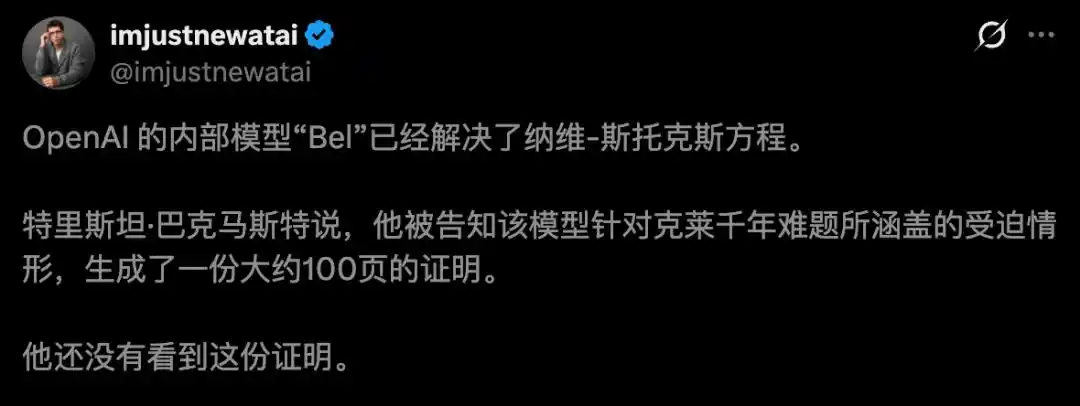
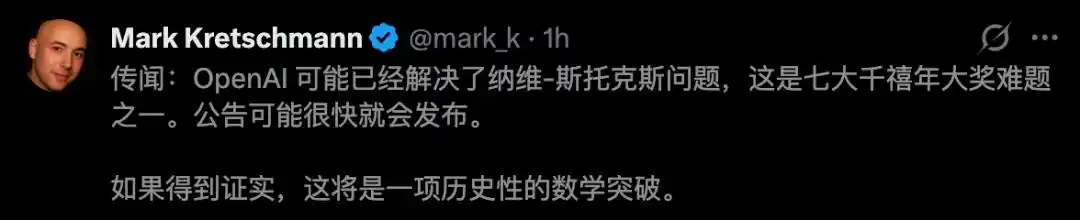
Tristan Buckmaster, a mathematician at New York University working in fluid mechanics and partial differential equations, said an internal OpenAI model has produced what he described as a roughly 100-page mathematical proof on a key Navier-Stokes route: blowup in the presence of forcing. Buckmaster said he has not yet received the AI-generated manuscript itself.
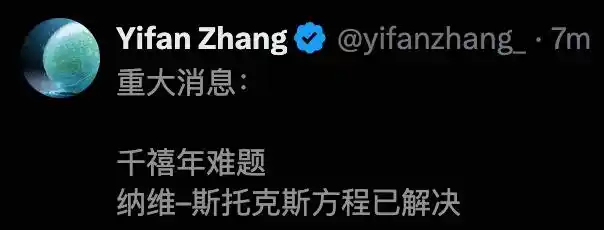
The claim spread quickly across math and AI circles. In Buckmaster’s account, if the OpenAI proof ultimately satisfies the formal conditions of the Clay Mathematics Institute problem statement, the result could fit within one of the accepted pathways for the Millennium Prize problem on the Navier-Stokes equations.
The Millennium Prize problem at issue
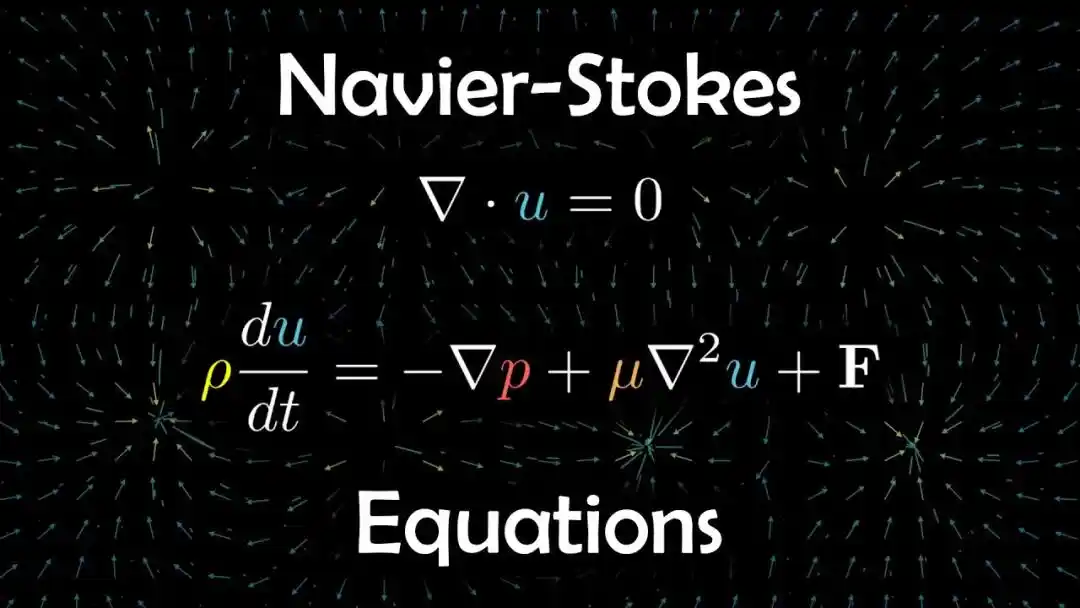
The Navier-Stokes equations sit at the center of fluid mechanics. They describe the motion of fluids such as water and air, from milk foam moving in a cup of coffee to airflow over an aircraft wing and large-scale ocean currents.
In 2000, the Clay Mathematics Institute listed the Navier-Stokes problem as one of its Millennium Prize Problems, carrying a $1 million award for a complete solution.
One of the core unresolved questions is whether solutions remain regular for all time or can break down under certain conditions, producing blowup or singular behavior. The OpenAI result described by Buckmaster targets that question.
The claim focuses on forcing
According to Buckmaster, the OpenAI model generated a proof for blowup in the forced Navier-Stokes setting. That qualifier matters. In this context, forcing is a precisely defined mathematical function, not a loose physical intuition about stirring a fluid from the outside.
The issue is not simply whether forcing makes the problem easier. The more important point is whether the route is allowed by the official formulation. Under the formal statement given by Charles Fefferman, items C and D allow the construction of smooth initial data and smooth forcing that would show there is no global smooth solution meeting the required conditions. If the OpenAI manuscript really meets those requirements, a result with forcing could still count within the official prize framework.
Three other fluid results were released the same day
Alongside that disclosure, Buckmaster and Levent Alpöge announced that, with help from large language models, they had obtained finite-time blowup results under smooth forcing for three classes of fluid equations. The papers and Lean formalization code are now online.
The three results cover:

- the incompressible porous media equation,
- the Boussinesq equation, and
- the three-dimensional incompressible Euler equations.
In plain terms, those systems address fluid flow through porous material, the interaction between buoyancy and flow, and ideal fluid motion without viscosity.
The shared advance is the move from earlier blowup constructions with forcing to the case of smooth forcing. That distinction is important. If the forcing itself is rough, it becomes hard to tell whether the loss of regularity comes from the internal dynamics of the flow or from irregularity built into the external input. Requiring smooth forcing removes that layer of ambiguity.
The research line and the models used
The article says the work draws on a long-running research program developed by Diego Córdoba and Luis Martínez-Zoroa. Buckmaster pushed that line further with assistance from Claude, Codex, and GPT-5.6 Sol. Astra was also used later to help organize the manuscript and review arguments.
Fields Medalist Terence Tao responded quickly, calling it an 「excellent achievement」.

How Tao described the method
In Tao’s reading, the authors repeatedly add very small, highly localized high-frequency perturbations to an existing flow. High frequency here refers to fine spatial structures that vary rapidly, effectively layering increasingly delicate textures onto a large-scale flow.
The mechanism relies on a balance. The large-scale flow amplifies those fine structures, while the feedback from the fine structures back to the large-scale motion remains under strict control. Once a new structure has grown enough, it takes over the local dynamics at the right moment and creates the conditions for the next, even finer perturbation. Repeating that step pushes the activity to smaller and smaller scales and eventually produces loss of control in finite time.
Tao said the hardest part is making every handoff exact: where to place each perturbation, how fast it grows, how large the errors are, and whether the full process can be stitched together without gaps. In the model Boussinesq case, he said the main evolution of amplitudes and frequencies can be reduced to a fairly simple ordinary differential equation. Even so, once spatial cutoffs and other technical details are included, the simplified paper still runs to 76 pages.
Why Euler does not settle Navier-Stokes
The report also stresses that a breakthrough for the three-dimensional incompressible Euler equations does not mean Navier-Stokes is solved. A central difference is the extra viscous term νΔu in Navier-Stokes.
That viscosity smooths out fine structures, and dissipation usually grows stronger as frequency rises. The blowup strategy described above depends on high-frequency structures being amplified. Extending the method to Navier-Stokes would require showing that the blowup mechanism still survives while viscosity keeps damping those structures.
Tao’s view, as cited in the report, is that in principle there does not seem to be anything blocking the route from being extended further, and he did not rule out the eventual removal of forcing. He also made clear that turning that possibility into a proof would involve enormous technical difficulties. That is a judgment about research direction, not a declaration that the proof is already complete.
Buckmaster’s account of his exchanges with OpenAI
Buckmaster’s accompanying statement added another layer to the story by raising questions about how OpenAI arrived at its result.
He said the smooth-forcing route is highly specific and was opened by Córdoba and Martínez-Zoroa. He and Alpöge had been working on it privately, with almost no other teams pursuing the same direction. For that reason, he said, he was especially surprised when OpenAI told him that its internal model had also solved the forced case.
The timeline in the report begins on Sept. 3. That day, claims were spreading online that Anthropic’s Claude had solved a major mathematical problem, said to be Navier-Stokes. Buckmaster and Alpöge’s research progress also reached OpenAI internally on the same day.

Buckmaster then contacted a well-known mathematician at OpenAI to explain the situation and said explicitly that the work was a personal collaboration between him and Alpöge, not something tied to any institution. He received a same-day reply asking for more details and offering compute support.
Buckmaster said he proposed speaking the following week, but OpenAI wanted to move faster. On Sept. 6, Sébastien Bubeck joined the discussion, and the three held two calls that afternoon. It was during those calls, Buckmaster said, that he first heard about the 100-page proof.
Questions over training data and authorship
Buckmaster said he immediately asked whether OpenAI had used project drafts, sessions, or other user data previously placed into Codex. He said he was told the model had not searched user data. When he pressed further on the training question, he said he received no answer.
The two sides then split over publication plans. According to Buckmaster, OpenAI proposed two options:
- Buckmaster’s team would publish the Euler result first, and OpenAI would publish the Navier-Stokes result the next day.
- OpenAI would write its own paper, publish the Navier-Stokes result separately, and state that the result came from an internal OpenAI model.
The sharpest disagreement centered on authorship. Buckmaster said Bubeck twice explicitly asked that Alpöge’s name be removed because Alpöge works at Anthropic.
The proof is still not public
For now, the outside world is waiting to see whether OpenAI will release the full manuscript in the coming days. At this stage, Buckmaster has published his own four-page statement, while the more consequential OpenAI proof remains unavailable for public inspection.
If that 100-page proof stands up to scrutiny and if the research process confirms an independent contribution from AI, the episode would become a major example of AI pushing the boundary of human knowledge. Those conditions have not yet been met. The full proof is not public, and the provenance of the result remains under debate.
The sources cited in the report include a post on X, Buckmaster’s statement PDF, Buckmaster’s Mastodon post, and Tao’s post on Mathstodon.