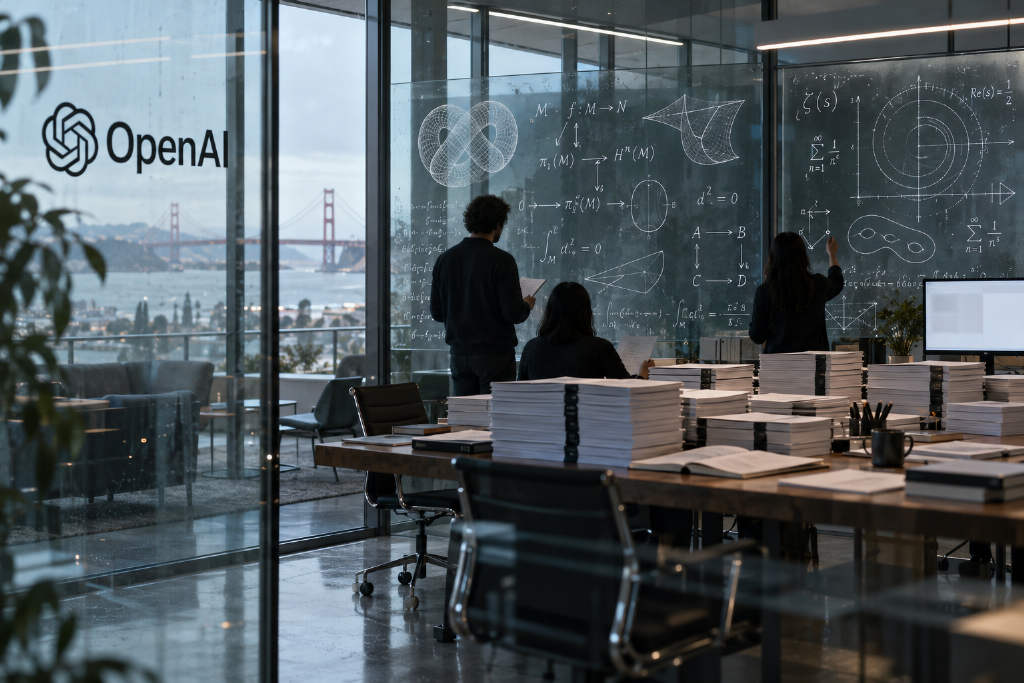
OpenAI has published 722 mathematical manuscripts generated by an unreleased internal frontier model, drawn from evaluations across roughly 4,000 open research problems. Many of the papers cluster around the same underlying findings, leaving 372 related result groups after consolidation. Several of the released results touch long-standing open questions, including a claimed proof of the Unique Games Conjecture, a proof that the Riemann zeta function has no zeros in the region where the real part is greater than 7/8, work on the rational Hodge conjecture for CM abelian varieties, and the free group factor problem, which has remained unresolved since the 1940s. OpenAI said some of the results, including the Unique Games, quasi-Riemann, and free group factor work, come with Lean formal proofs that allow computer verification of the proof steps. The company also cautioned that validation is uneven across the release, and that results without formal proofs may still contain errors. AGMAI, an independent mathematical advisory group involved in the release consultation, said it is not endorsing the findings.
OpenAI has released 722 mathematical manuscripts produced by an unreleased internal frontier model, based on evaluations covering about 4,000 open research problems. Because many of the manuscripts revolve around the same core findings, the set condenses into 372 groups of related results.
Several of the released manuscripts reach into long-standing open problems. According to the release, the model produced a proof of the Unique Games Conjecture; a proof that the Riemann zeta function has no zeros in the region where the real part is greater than 7/8, described as a "quasi-Riemann hypothesis"; work on the rational Hodge conjecture for CM abelian varieties; and the free group factor problem, which has remained unresolved since the 1940s.
Some of those results, including the Unique Games, quasi-Riemann, and free group factor work, were released with Lean formal proofs, allowing the proof process to be checked by computer.
OpenAI said the results should not all be treated as settled. The company stated that the level of verification varies across the release, and that parts without formal proofs may still contain errors. AGMAI, an independent mathematical advisory group consulted for the release, also said it is not endorsing the results.
This article was originally published by Bit.Fan. For more cryptocurrency news and market insights, visit www.bit.fan. Disclaimer:
The market information, project data, and third-party content displayed on this platform are for industry information sharing only and do not constitute any form of investment advice or return commitment.
Cryptocurrency trading carries high risks. Users should fully assess their risk tolerance and make independent decisions. All profits, losses, and legal responsibilities are borne by the users themselves.