


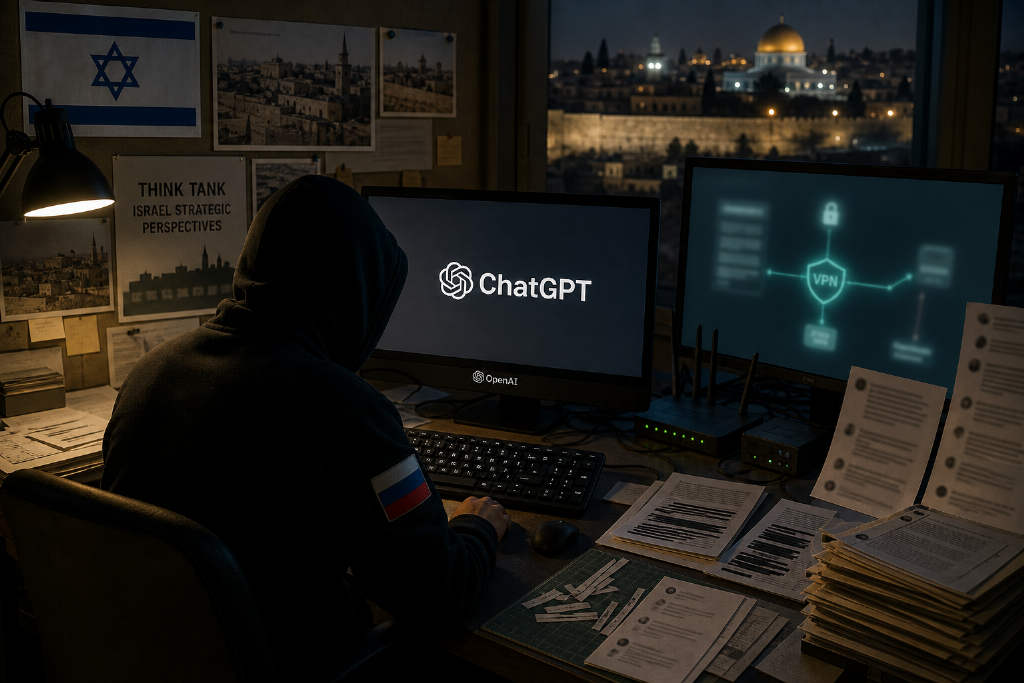
OpenAI said in a report published Wednesday that a network originating in Russia used ChatGPT to promote an organization that presented itself as an academic institute.
The company said it banned a group of accounts whose operators used Russian-language prompts to generate social media posts and comments, mostly in English. OpenAI said the operators also instructed ChatGPT to conceal signs that the content originated in Russia.
“Although the campaign appears to have reached relatively small audiences, its elaborate construction distinguishes it from other Russia-linked influence operations we have disrupted since the start of the war in Ukraine,” the company wrote.
Because ChatGPT is unavailable in Russia, OpenAI said the group used virtual private networks, or VPNs, to disguise its location and gain access to the service.
International Burke Institute used as the campaign’s front
OpenAI said the group used ChatGPT to promote the International Burke Institute, which claimed to be an Israel-based expert group. The effort relied on official-looking profiles as well as accounts posing as regular users.
Of the 36 articles OpenAI reviewed on the institute’s website, 34 were copied, the company said. Some of those pieces were credited to academics who did not write them.
“Some of these articles were years old; others were attributed to the wrong authors,” OpenAI wrote.
As one example, the company said an article on the China-Pakistan Economic Corridor appears to have been copied from a Cambridge University Press original, but was incorrectly attributed to a professor at the University of Nottingham whose expertise is in South Asian politics.
Part of a broader pattern of AI-assisted political and cyber activity
OpenAI said similar political influence campaigns have also used generative AI.
In 2024, the company identified a separate Russia-linked campaign called Doppelganger. That network used ChatGPT to create articles, social media posts, and comments praising Russia while attacking Ukraine, NATO, and the United States.
OpenAI also said Russia-linked groups have used ChatGPT in cyber operations. It named Forest Blizzard, a group tied to Russian military intelligence, as having used the chatbot to research targets, write scripts, and support phishing attacks.
At the same time, OpenAI said it did not attribute the IBI campaign to the Russian government, even though the operators may have used Russian-language prompts.
Role of people in Israel remains unresolved
According to OpenAI, some people in Israel may have represented the institute at conferences or through article submissions. The company said their relationship to the campaign remains unclear.
“We are not in a position to determine the relationship between these individuals, the IBI, and the operators in Russia,” OpenAI wrote.