
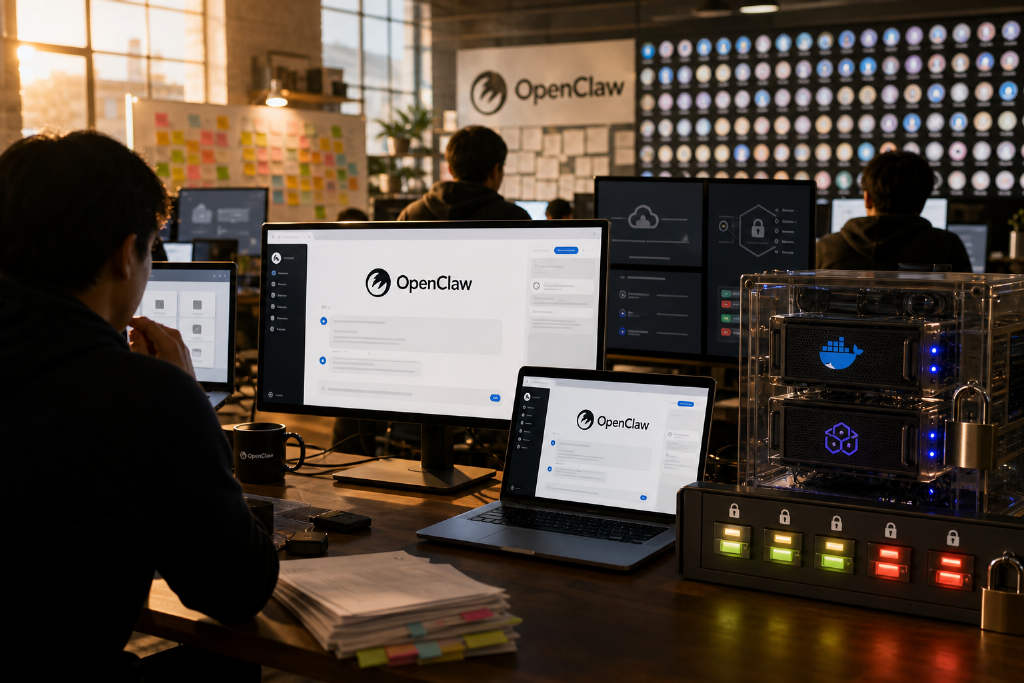
OpenClaw shipped its largest update to date over the weekend, rolling out OpenClaw 2.0 after what the team itself described as an "accidental" expansion in scope.
The release notes span installation, messaging, memory, skills, models, automations, the browser, native apps, plugins and security, covering nearly every area users interact with.
In the announcement post, the team said 933 contributors worked on the project for this release, including 569 first-timers, generating more than 16,000 pull requests. The post said that total represented roughly half of every PR OpenClaw has ever merged, all delivered in a single release.
What OpenClaw is
For readers new to the project, OpenClaw is a self-hosted, open-source framework that turns a large language model into an agent that keeps running after the browser tab is closed. It lives on the user’s machine, wakes up on its own schedule and communicates through WhatsApp, Telegram, Discord or Signal instead of sitting inside a chat window waiting for prompts.
With permission, it can also access email, calendars, files and the shell.
The project was built by Austrian developer Peter Steinberger after he stepped back from his company PSPDFKit. According to the report, OpenClaw picked up 147,000 GitHub stars within weeks and sparked an ecosystem of spin-offs, including an AI-only social network called Moltbook.
Steinberger joined OpenAI in February to lead its personal-agent work. OpenClaw itself did not move into OpenAI. Instead, it shifted into its own nonprofit, the OpenClaw Foundation, with OpenAI listed as one partner alongside Microsoft, GitHub, Nvidia, Atlassian and Tencent.
Why the team called the release "accidental"
The original plan was much narrower. The update was supposed to focus on simplifying installation and rebuilding the browser app.
Once the work started, those changes pulled in memory, models, plugins, messaging and security. Before this launch, OpenClaw had put out 106 releases in 230 days, a pace the report described as close to daily. Going seven weeks without shipping a new version was unusual even by the team’s own account.
That extra time went into making sure existing installs would not break during the upgrade. The release notes carry a visible warning telling users to back up sessions before moving to the new SQLite storage.
In that sense, "accidental" was not being used as a marketing phrase. The report framed it as a public acknowledgment that the scope kept growing. Two intended fixes, onboarding and the browser, ended up dragging in the rest of the codebase because the same areas were already being rewritten.
OpenClaw Community Manager Hannes Rudolph said the team began running its own workflow through multiplayer sessions and found the limitations of the old single-user design too obvious to leave untouched. That, in the report’s telling, is how the project arrived at 16,000 pull requests instead of a pair of small fixes.
What changed in OpenClaw 2.0
Setup now starts by checking what users already have, including an existing Claude or ChatGPT subscription, an API key or a local Ollama model, before asking them to configure anything new. It tests whether the selected model actually works before saving the setup, then takes the user directly into a live conversation rather than a settings page.
The Control UI has been rebuilt around chat instead of a separate overview dashboard. The result puts OpenClaw in the same visual camp as ChatGPT, Claude and Gemini. Files, Git diffs, pull-request status, a browser panel and a terminal now sit around the conversation rather than forcing users to jump between several separate tools.
The team also cited simulated latency-test numbers showing initial JavaScript requests cut from 140 to 45, while startup time fell from 1.6 seconds to 575 milliseconds.
Shared cloud sessions are the headline feature
The centerpiece of the release is shared cloud sessions. The idea is that an agent task no longer stays trapped in one person’s local environment; a colleague can enter in the middle of the job without losing the existing context.
On X, Peter Steinberger said his own team had already dropped individual local coding harnesses in favor of a shared setup at team.openclaw.ai, calling local harnesses "relics of the past."
Security changes were added to match that shift. OpenClaw 2.0 introduces request-specific approvals, command permissions scoped to specific arguments, Docker and Podman sandboxing, role-enforced execution and a team-scoped Secret Store. According to the report, that Secret Store can insert a credential into a request without exposing the credential itself to the model.
There is a limit to that progress. Sandboxing and approvals are still disabled by default. OpenClaw’s own documentation says one Gateway is a single trust domain, not a barrier between people who do not trust each other. Companies that need actual tenant isolation have to deploy separate Gateways, which OpenClaw calls "cells," instead of switching on one setting.
Competition with Hermes is getting tighter
The report said OpenClaw no longer has the space to itself. Nous Research’s Hermes Agent, first tagged in March, built its pitch around not being OpenClaw. Its approach centers on procedural memory that can automatically turn successful workflows into reusable skills, alongside security defaults that do not assume only one person will ever touch the machine.
Architecturally, OpenClaw separates a Gateway daemon from the agents it routes work to. Hermes puts the conversation loop, tool dispatch and memory inside a single agent class, a design the report described as harder to scale cleanly but easier to reason about.
The broad view circulating around the sector this year, according to the report, is that OpenClaw leads on ecosystem depth and breadth of communication channels, while Hermes leads on self-improvement and on not shipping wide open by default.
OpenClaw 2.0’s new sandboxing closes part of that gap, but not all of it. The stricter protections still need someone to turn them on.
How users can get the update
Existing users can upgrade through the usual CLI path. The report noted one caution: sessions created after the SQLite migration will not appear if the user later downgrades without a backup.
New users are directed to OpenClaw’s setup guide, which now includes guided onboarding for Mac, Windows, Linux, iPhone, iPad and Android. It also offers staged imports for people moving over from Claude, Codex or Hermes.
OpenClaw remains free, remains under the MIT license and remains hosted at github.com/openclaw/openclaw.