


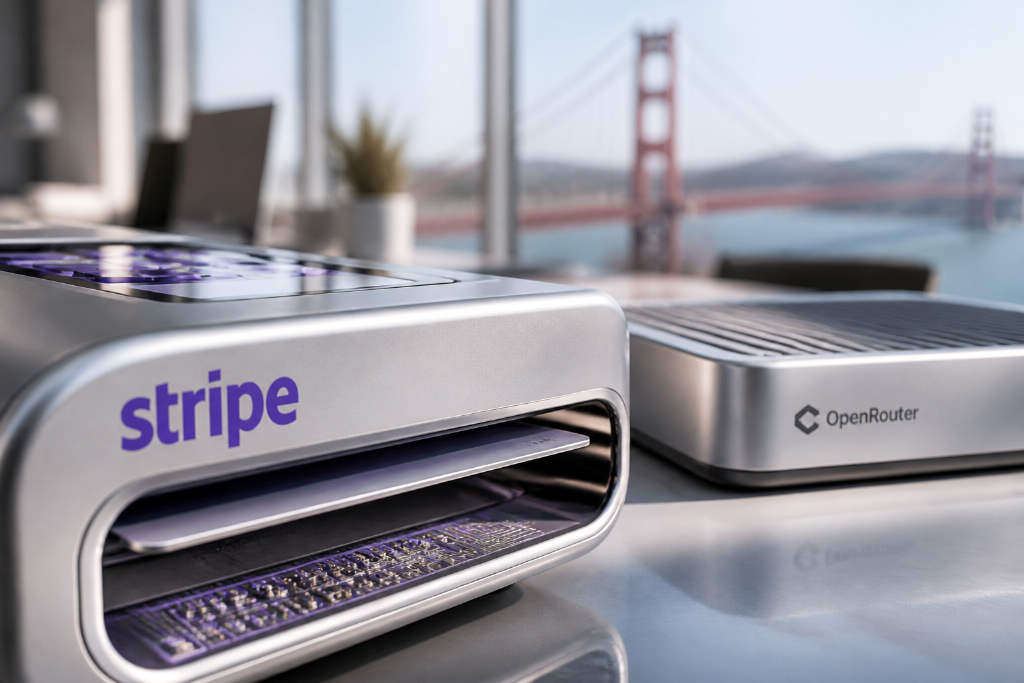
Menlo Ventures published a retrospective on its OpenRouter investment after the company announced that it had entered into an acquisition agreement with Stripe. OpenRouter formally launched in 2023, and three years have now passed since that debut.
At launch, OpenRouter was positioned as 「a unified interface for LLMs」 and supported only four models: GPT-3.5, GPT-4, Together’s GPT NeoXT and Cohere xlarge.
Menlo said the company was built around two core assumptions. First, AI usage would eventually become massive and spread across industries. Second, the market would end up with a large number of different models, each with its own trade-offs, and users would choose among them depending on the task. In Menlo’s telling, both assumptions turned out to be far larger than expected.
Since launch, the number of tokens processed through OpenRouter has increased by roughly 30,000x. The firm said the platform is now running at an annualized pace of more than 45 quadrillion tokens, while spending on the platform has also reached a striking scale. The number of supported models has risen from 4 to more than 500.
Menlo said it joined OpenRouter’s seed round in March 2025 through Anthology Fund, which it established in partnership with Anthropic.
OpenRouter founder and CEO Alex Atallah previously co-founded OpenSea, which at one point reached a $13.3 billion valuation. His co-founders include Louis Vichy, whom he met on Discord, and COO Chris Clark.
In May 2025, Menlo led OpenRouter’s Series A. Matt joined the board, and Deedy became a board observer. Earlier this year, after seeing customer and revenue growth accelerate and reviewing the company’s roadmap to build stronger 「model intelligence」 around model selection and evaluation, Menlo said it added more capital in the Series B.
The firm also pointed to a recent shift in the market. Over the past few weeks, more than 10 companies, from Ramp to Cursor, have launched their own model routing products. Menlo wrote that OpenRouter has become one of the most important companies of the AI era within just a few years.
Why Stripe emerged as the buyer
Menlo said Stripe may not look like the most obvious acquirer for OpenRouter at first glance, but argued that the two businesses are more alike than they seem.
Both companies use a directly accessible API to simplify what would otherwise be a complicated transaction flow, and both take a percentage fee in the process, Menlo wrote. The difference is that OpenRouter handles AI models. Using Stripe’s own long-running framing, the combined effort is still about the same objective: increasing 「internet GDP.」
Menlo added that OpenRouter had already described itself as 「Stripe for LLMs」 more than a year ago.
Why Menlo invested in OpenRouter
According to the firm, OpenRouter was one of the first companies Deedy looked at after joining Menlo in 2024. Menlo said the company sat almost exactly at the center of its AI infrastructure thesis.
In its 2024 enterprise AI report, Menlo laid out two assumptions that needed to hold for an OpenRouter investment to make sense: AI spending would increase sharply, and developers would not rely on a single model but adopt multiple models at the same time.
The firm said that, as investors who also write code and use the models directly, it recognized early that different models show clear differences in cost, latency and performance.
For a simple natural language processing task such as entity extraction, Menlo said, there is no reason to use a frontier model like Fable if a cheaper option can do the job.
The problem is the operational burden. If users have to visit each model company’s website, create an account, generate and store API keys, adapt to slightly different API formats and then manage the models on their own, the process becomes cumbersome.
Menlo said a unified model gateway sounds straightforward, but is much harder as an infrastructure problem than it appears on the surface. Very few teams want to build and maintain that stack over the long term.
The venture industry often talks about moats in technical terms, but Menlo argued that OpenRouter’s moat is a classic scale moat. The more users it has, the better it can predict model demand and handle larger loads. That scale also makes it easier to negotiate larger contracts with model labs, leading to more stable token supply and demand.
Over time, Menlo said, that creates a loop in which new model labs also want to launch on OpenRouter first in order to gain distribution.
The firm said it had also observed another trend. As vibe coding spreads, the number of software startups is increasing quickly. For products trying to move into the enterprise market, the tools that eventually get purchased are often the ones that first win support from developers inside the company.
Menlo cited Anthropic, OpenAI, xAI, Cursor, Cognition, ElevenLabs, Lovable and Fireworks as examples of that pattern. It said OpenRouter is following the same path.
Growth after the investment
Since Menlo invested, the firm said, OpenRouter’s token volume has reached 30,000x its early level. Over the past three years, the platform has maintained about 33% monthly growth and doubled on average every 11 weeks.
The model market has expanded quickly as well. Menlo highlighted Chinese open-source models such as DeepSeek, GLM and Kimi, as well as models from Grok, Meta and Thinking Machines.
OpenRouter now connects to more than 500 models from over 80 model providers and serves about 10 million users.
Menlo said many important new models appear on OpenRouter first, including models from OpenAI, X and Meta. It added that Mark Zuckerberg, who rarely posts and even less often speaks up for outside products, announced that Muse Spark had launched on OpenRouter. Elon Musk did the same, according to the post. Menlo also said OpenAI offers exclusive discounts for models such as Terra and Luna through OpenRouter.
The firm wrote that OpenRouter’s product-led growth motion has translated into the enterprise market. Its enterprise sales cycle is among the fastest Menlo has seen. Enterprises can use the product to allocate model resources, control permissions and manage internal AI budgets through a single system.
Because OpenRouter can negotiate contracts across providers in one place, Menlo said, it is able to deliver very high service availability even for frontier models.
How OpenRouter developed
Menlo wrote that finding product-market fit, or PMF, is never a straight line, and OpenRouter was no exception.
The story, as told in the post, begins on April 5, 2023. The team launched a Chrome extension called Window that let users call multiple models across different chat applications on the internet.
The initial idea was to prevent users from being locked into a single model vendor without forcing them to hand over their API keys to every application they used. Menlo said the product design drew inspiration from crypto wallets, which it linked to Atallah’s background at OpenSea. At that point, Window supported four models.
On April 24, 2023, the name 「OpenRouter」 appeared for the first time in the Window GitHub repository.
About a month later, the team integrated the first Anthropic v1 models. It began automatically assigning prompts to suitable models, built what later became its well-known model leaderboard and started using the OpenRouter name.
On Aug. 10, 2023, the team officially renamed the product OpenRouter, with the slogan 「A unified interface for LLMs.」
At that time, OpenRouter was processing about 3 billion tokens a week. Menlo noted that the models on the leaderboard then looked completely different from the set people know today.
The team later launched Playground, allowing users to receive responses from multiple models through a single chat interface.
By November that year, OpenRouter supported 52 models, had integrated with more than 2,000 apps and was handling about 8 billion tokens a week. Menlo said that was the point when the company truly found PMF.
Menlo’s view of model routing
Menlo argued that many people misunderstand OpenRouter’s core product. In its view, the company is not simply routing tokens. Its central product is an AI gateway built to be broadly usable.
OpenRouter does offer Auto Router for automatic model selection. Still, Menlo said most developers use OpenRouter mainly because it gives them one access point to many models, after which they can decide for themselves how to route requests.
The firm pointed to rapidly rising enterprise spending on LLMs as a practical issue for companies such as Uber, Coinbase and Microsoft. In that context, model routers sound attractive as a cost-control tool.
If an AI agent breaks work into many subtasks, Menlo wrote, not every task needs the most expensive model. Simpler work can be handed to cheaper models.
Over the past few weeks, more than 10 companies, from Ramp to Cursor, have rolled out their own routers. But Menlo argued that selecting a model based only on the prompt itself is not especially effective.
In agent settings, a task can run for a long time. Deciding which model should handle a request requires understanding a large amount of context.
Menlo used a simple instruction as an example: 「find this file in the codebase.」 That could be a cheap and simple LLM task, or it could require a frontier model. The answer depends on the size of the codebase and the context accumulated earlier in the task.
In a multi-step agent workflow, a wrong routing choice at one step can compound through the remaining steps and significantly weaken the final result.
For that reason, Menlo said a differentiated routing product is not built on a simple model selection algorithm alone. It requires a strong unified API and a sufficiently large base of real users.
Those users, the firm wrote, allowed OpenRouter to build a large dataset with little outside attention. That dataset includes what prompts users submitted, which models were chosen, what context was present during execution and what outcomes followed.
Menlo said that is where model routing becomes important. In real production environments, OpenRouter can help enterprises control costs through better routing while trying to preserve performance.
The post offered a future scenario: developers may no longer need to build complex evaluation systems on their own or keep rewriting prompts for different models. Instead, they might log into a dashboard and see a message saying that a summary-heavy part of a codebase could save $100,000 a year by switching from GPT 5.6 Sol to Muse Spark, with the evaluations already completed automatically.
From payments infrastructure to AI infrastructure
Menlo closed by comparing Stripe and OpenRouter as companies that first won developers and then moved into large enterprises, all while maintaining a simple and direct product design language.
Andrej Karpathy has described OpenRouter as a 「switchboard」 for AI, Menlo wrote. Stripe, in Menlo’s view, serves a similar role inside payments processing by acting as a switchboard there as well.
The acquisition, the firm said, is one of the earliest large transactions in AI-era infrastructure, and not the last. Infrastructure for managing models, costs and compute is taking shape, and Menlo said that is accelerating the formation of a new generation of very large companies.