
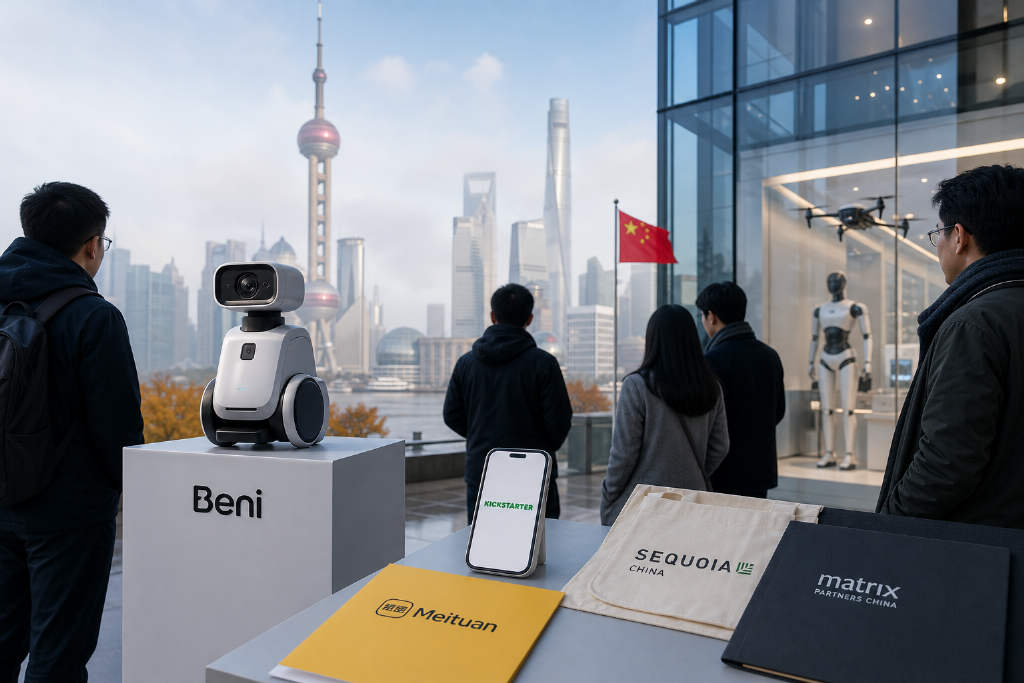
Unitree Robotics officially listed on Shanghai’s STAR Market on Aug. 19, becoming what the article described as the first humanoid robot stock in China’s A-share market. In the wake of that debut, investors noticed another link: Meituan, Sequoia China and Matrix Partners China, identified as Unitree’s three largest outside shareholders, have also all invested in embodied robotics startup Miaodong Technology.

According to the prospectus cited in the report, Meituan is Unitree’s largest outside shareholder. Sequoia China invested early and, after multiple rounds, became the independent private equity fund with the largest stake in Unitree. Matrix Partners China led an early round in Unitree and still holds more than 5% of the company. Their joint appearance on Miaodong’s cap table is presented in the article as a rare occurrence.
A founding team with DJI and Tesla Optimus ties
Miaodong was founded by Gao Jianrong and Yang Shuo. Like Unitree founder Wang Xingxing, both previously worked at DJI. The article also says Yang is the only founder in China’s embodied intelligence circle to come from the core Optimus team.
Gao, Miaodong’s CEO, worked at DJI for nine years. The report says he was an early close assistant to DJI founder Wang Tao before taking on direct operational roles across RoboMaster, DJI’s supply chain, global marketing and an independent business unit, DJI Education. Citing an investor who has followed DJI for years, the article says executives who spanned that many business lines while continuously reporting to Wang were unusual inside the company.
Yang, Miaodong’s CTO, studied under Professor Li Zexiang. He joined DJI during his master’s program and worked as an algorithm engineer on key flight-control modules, contributing to the Phantom line, according to the report. In 2016, Yang and Gao jointly ran the RoboMaster competition, which became the starting point of their partnership. In 2018, Yang left DJI for doctoral study at Carnegie Mellon University, focusing on legged robot control.
After completing his PhD, Yang joined Tesla’s Optimus team. The article describes that group as a gathering place for top robotics talent globally and says Yang quickly became one of the highest-ranking Chinese engineers on the team.
Yang said, 「The Optimus team reported to Elon Musk once every two weeks, and I attended every time. The deeper I got into it, the more I realized robots cannot be separated from China’s industrial supply chain. Rather than building in Silicon Valley, it made more sense to return to China, where iteration is several times faster.」
The report argues that the recent surge of interest in embodied intelligence has been driven in large part by Musk. Against that backdrop, a team combining front-line knowledge of embodied robotics with DJI-style hardware productization attracting top investors early is presented as unsurprising.
Beni launches on Kickstarter
One month before Unitree’s listing, Miaodong launched its first product, Beni, on Kickstarter. The company describes Beni as a two-wheeled-legged robot and the world’s first camera robot.
More than 5,000 people have already paid for the product, according to the article. It also says Beni has become the No. 1 robotics project in Kickstarter history by crowdfunding amount.
During the campaign, YouTube tech creator Marques Brownlee, known as MKBHD, reviewed a batch of recent gadgets and scored more than a dozen products. Beni received the only perfect 10/10 in the lineup, the report says.
The article notes that Brownlee has more than 20 million followers and is widely regarded as the most influential tech creator globally. It also says he is rarely swayed by brands, and that the lowest score in that review episode was 2/10, which the article cites as context for the weight of Beni’s rating.
Miaodong frames Beni as the result of a strategy built on advanced technology and strong product execution. The wheeled-legged robot form factor has existed for years, but the industry had not solved productization, the article says. Miaodong positions Beni as the first wheeled-legged robot built for consumers, drawing on the team’s reading of user demand and its understanding of robotic platforms.
On the technical side, Miaodong chose to train all robot functions with reinforcement learning. The report says that approach has appeared in humanoid robots before, but not in user-facing functions such as follow filming. A bigger challenge was consistency across mass-produced units. The article puts it this way: making one robot jump 25 cm is not hard, but mass production requires consistency across tens of thousands of machines. If jumping performance differs across environments and payload conditions, structural life can be reduced. To address that, the team carried out extensive work in algorithms and hardware to narrow the Sim-to-Real Gap and keep neural-network performance consistent across large production volumes.
Miaodong says it chose low-angle follow filming as its entry point because existing imaging devices are split by viewpoint: drones cover the sky, phones handle everyday capture, and action cameras serve sports, but there has been no product dedicated to a ground-hugging first-person angle. The article lists pets running at floor level, children’s lower perspective, and the impact feel of skateboarding and tennis as examples of footage Beni is meant to capture.
The company describes Beni as the world’s first portable all-terrain follow robot. It weighs less than 2 kg, can jump as high as 25 cm, reach 28 km/h, avoid obstacles autonomously, climb steps and recover after a fall, according to the report. Miaodong says the product is meant to capture those moments people would otherwise miss.
The first users already include pet owners, families with children, and people in running and roller sports, the article says. Miaodong adds that Beni is still being iterated based on tester feedback, and presents that user-led refinement process as one point of difference from peers.
After the crowdfunding campaign ends, Beni is scheduled for a formal global launch and commercial release in October. Miaodong says its internal target is to sell 1 million units in three years. If that goal is achieved, the article says, Beni would become the most popular robot product in history.
From non-humanoid products toward humanoid robots
The report compares Miaodong’s product cadence with Unitree’s, saying neither company started with a humanoid robot. Both began with non-humanoid forms.
Yang says the team approaches the question from first principles. At the hardware level, robot capability depends on motors. Startups without mature motor design and production experience often have to work with suppliers through ODM or OEM arrangements. That can speed development, but it raises costs and makes tight hardware-software coordination harder, according to the article. It argues that Unitree’s strength in robot body performance came in large part from motor design and manufacturing know-how accumulated through shipping quadruped robot dogs at scale.
Miaodong wants to build similar motor capability through Beni. The report says the company has already designed motors whose angular precision and torque density are not inferior to Unitree’s. Under the same cost structure, it says, Miaodong improved motor scheduling precision by one order of magnitude.
For the robot’s “big brain” and “small brain,” Miaodong is sticking with a whole body intelligence route. Yang said, 「Many people gave up on humanoid bipedal robots because they worried they could not solve whole body intelligence.」 In his view, passability is the first test for robots in consumer home settings. 「I find it hard to imagine how a non-humanoid robot would handle house scenarios in Europe and the U.S.,」 he said.
The article says Miaodong made a number of research advances over the past year. Based on a world model, it introduced two “big brain” architectures, DiT4DiT and MotionWAM, to address upper- and lower-limb coordination in humanoid manipulation. On the “small brain” side, its Perceptive BFM is described as the first in the industry to solve human-like gait walking across complex terrain.
At the product level, Miaodong says it works from scenarios and user needs. Gao said, 「We insist on thinking about products based on scenarios and demand. Users do not care how the technology is implemented. They only think about what the product can do and whether its value matches its price.」 Through Beni, the company says it has already entered family segments centered on children, pets and sports. Those core users are expected to become early co-creation users for Miaodong’s first home embodied product.
Beyond the product itself, the company says it values consumer product definition, user experience and a data feedback loop, and plans to extend that framework from Beni to humanoid robots. Subject to compliance requirements, Miaodong says it can obtain user data and keep iterating its products. As scale manufacturing ramps up, the company expects daily data volume to exceed 100,000 records by year-end.
Management says it is not chasing a high valuation
Despite the heat in the sector, the Miaodong team says the market has overestimated the importance of operation models in robotics. The real issues, it argues, are safety, reliability, and the large amount of reliability engineering needed to move from demo units to mass production.
That view also shapes the company’s pace. According to the article, Miaodong is not pursuing a high valuation and is willing to grow steadily over three to five years, proving itself one product at a time. Yang says humanity’s expectation of a mechanical companion resembling itself has lasted for thousands of years, and this is a field worth working on for a decade rather than rushing.
This article was sourced from the WeChat account Touzijie (ID: pedaily2012) and written by Wu Qiong.