
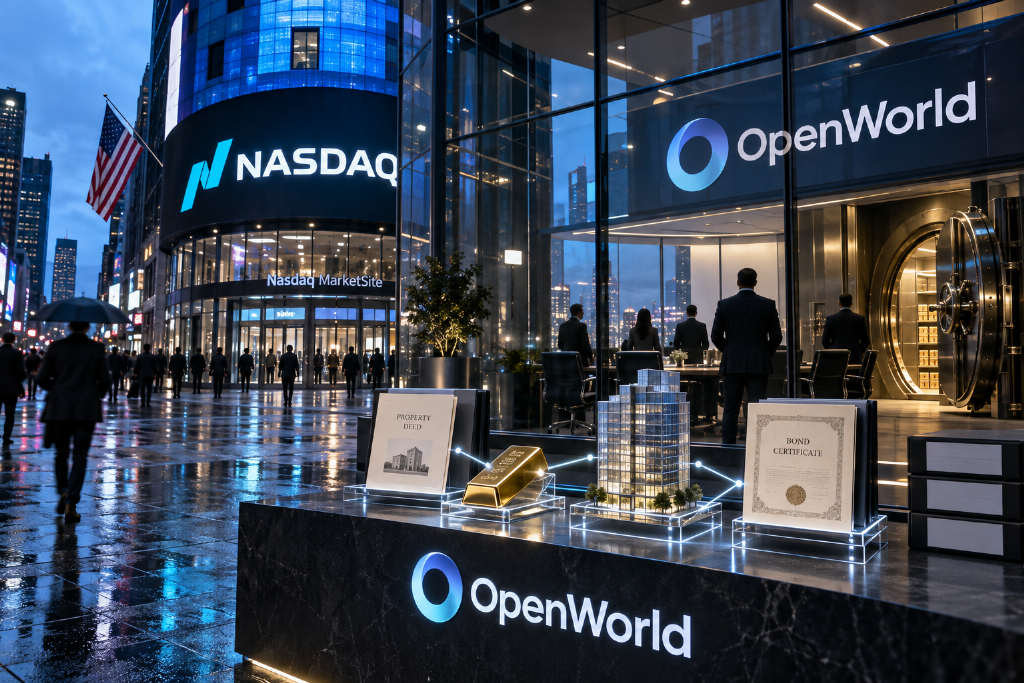
OpenWorld said it has completed its business combination with VerifyMe, with the merged company renamed OpenWorld, Inc. Its common stock began trading on Nasdaq under the ticker OPNW on Oct. 1, 2026.
VerifyMe was originally listed in 2009, and its offering price was about $8.50 after stock split adjustments. On its first trading day after the merger, OpenWorld opened at $8.11. The stock most recently closed at $5.40.
The company said the new business will combine traditional finance and blockchain infrastructure to build a real-world asset platform aimed at institutional investors.
Dual-listing plan includes Figure OPEN
In addition to trading on Nasdaq, OpenWorld, Inc. plans to seek a dual listing on Figure OPEN, a blockchain-based trading platform that is expected to go live before November 2026.
According to the company, the transaction gives former VerifyMe, Inc. shareholders direct exposure to a business with higher growth potential than VerifyMe had on a standalone basis.
OpenWorld said it will turn cash flows from operating businesses and physical assets into transparent, investable financial products, offering institutional investors end-to-end real-world asset tokenization services spanning development, issuance, and distribution.
Management team and operating footprint
Matthew Shaw, described as a digital asset specialist, will serve as chairman and chief executive officer. The company said Shaw previously co-founded several technology and cryptocurrency companies.
Russ McMeekin will serve as group president. He previously held senior management roles at Honeywell International for more than a decade.
Founded in 2023, OpenWorld said it has advised projects representing more than $66 billion in total network value and has supported more than 20 companies backed by venture firms including a16z, Multicoin Capital, Dragonfly, and Founders Fund.
Its business lines include real-world asset tokenization, stablecoin infrastructure, capital markets advisory, and governance structure design. The company said it operates across the Gulf region, Europe, Australia, and Southeast Asia.
Advisers on the transaction
Maxim Group LLC acted as financial adviser on the merger. Latham & Watkins LLP and Harter Secrest & Emery LLP served as legal advisers.