
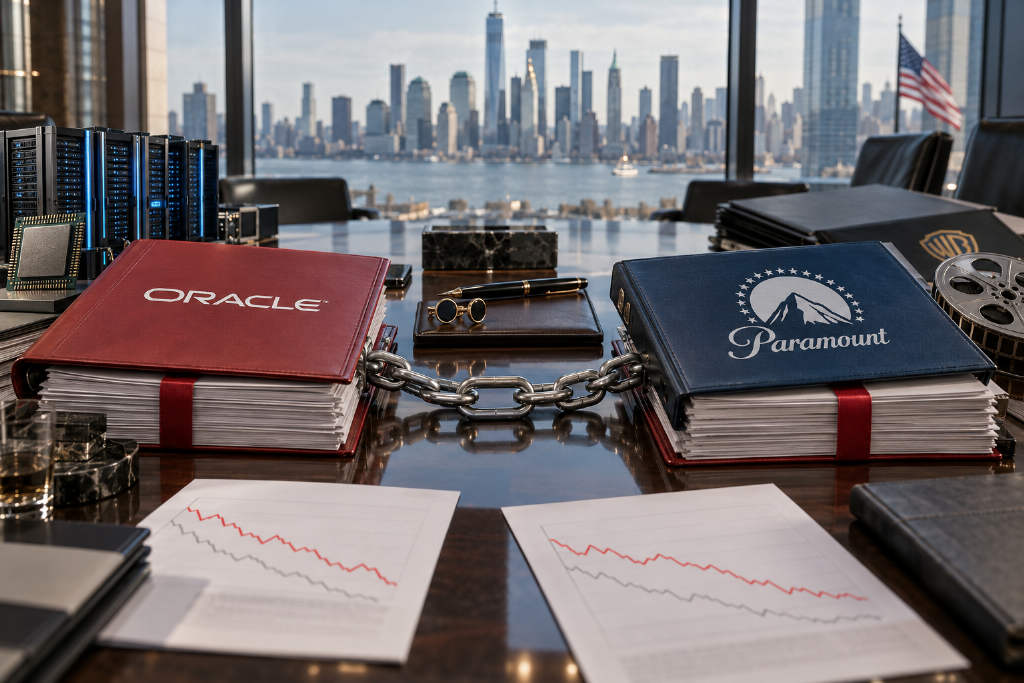
Paramount Skydance Corp. added $52 billion in debt this week to fund its acquisition of Warner Bros. Discovery Inc., sharpening market focus on the company’s leverage. Oracle, meanwhile, has pushed its long-term debt to more than $160 billion as it expands artificial intelligence computing infrastructure, making it the fifth-largest issuer in the U.S. corporate bond market. The two companies operate in very different businesses, but Wall Street is increasingly tying their credit risk together through a shared major shareholder: Larry Ellison.
Investors had previously assumed the Ellison family’s wealth could serve as a last-resort financial backstop for Paramount. That view is being tested because Ellison’s fortune is heavily concentrated in Oracle shares. Oracle stock has fallen more than 50% over the past year, free cash flow has turned negative, and S&P Global Ratings has cut both companies, pushing investors to reassess how much support can realistically flow from one side to the other.
Paramount’s financing package puts leverage and family support in focus
After a lengthy process, Paramount completed the financing structure for its Warner Bros. Discovery acquisition. The package includes $30 billion in investment-grade bonds, $12.4 billion in high-yield bonds, and $9.46 billion in loans.
To help push the merger forward, Oracle founder Larry Ellison used a family trust to back Paramount’s acquisition financing. He guaranteed most of roughly $47 billion in equity financing tied to the deal and told rating agencies he would take necessary steps to help the combined company reduce leverage over the next few years.
That commitment matters because S&P has lowered Paramount’s issuer credit rating to BB, below investment grade. Bondholders are now closely watching whether the Ellison family could still provide capital support or debt repayment assistance if operations run into trouble.
Oracle’s AI buildout doubles debt and pressures its rating
Oracle has been repositioning itself as a provider of AI computing capacity. Over the past two years, its long-term debt has doubled to more than $160 billion. Heavy capital spending has also pushed free cash flow deeply negative.
In July, S&P cut Oracle to BBB-, the lowest rung of investment grade. Its cloud business is still growing, but the debt-funded expansion has raised concerns in the equity market about cash generation. Over the past year, Oracle shares have dropped more than 50%, reducing the paper wealth of co-founder and chairman Larry Ellison by nearly $200 billion to about $192 billion.
CDS pricing shows investors are treating the risks as connected
According to Bloomberg, the spread on credit default swap protection for Paramount and Oracle has been converging and moving in the same direction. That pattern suggests fixed-income investors are no longer looking at the two issuers as fully separate credit stories.
Ellison owns about 40% of Oracle and has expanded borrowing backed by his personal stock holdings. If Oracle shares remain under pressure, his ability to support Paramount could come under strain as well.
Institutional investors cited in the report said this financial linkage means weaker Paramount debt could end up drawing on stronger Oracle credit resources, leaving creditors on both sides exposed to cross-asset execution risk. In practice, that means investors assessing either company’s credit profile now have to examine Ellison exposure across both issuers, not just each balance sheet on its own.