
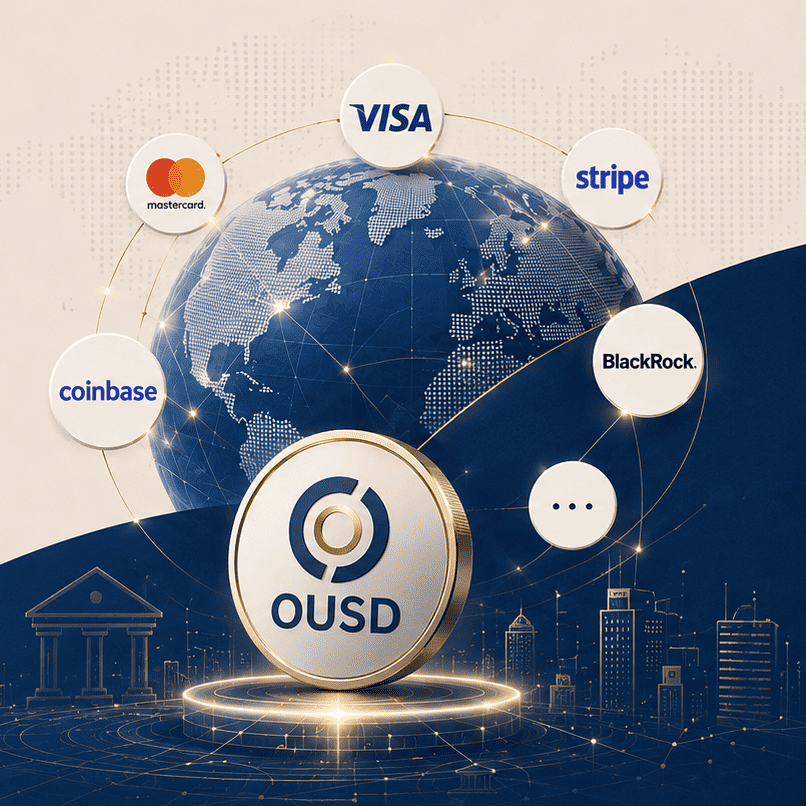
Open Standard announced on June 30, 2026 that it would launch Open USD, or OUSD, a new dollar-pegged stablecoin. The release drew immediate market attention. On the same day, shares of Circle, the issuer of USDC, fell about 15% to 18% on the New York Stock Exchange under the ticker CRCL. OUSD had not gone live and had no circulating supply at the time, yet the market reaction was swift.
Behind OUSD is a network of more than 140 institutions, including Visa, Mastercard, Stripe, BlackRock, Coinbase and Google. The project is not framed as the proprietary product of a single company. Its stated ambition is to rework the business logic of stablecoins and push them toward a form of shared financial infrastructure, closer to a bank clearing system or a card network that multiple institutions maintain and build on together.
OUSD is built around a different split of reserve income
The global stablecoin market is now worth more than $300 billion, according to the article. It is still dominated by Tether’s USDT and Circle’s USDC. USDT is put at roughly $184 billion to $186 billion in market capitalization, while USDC is put at about $73 billion to $74 billion. Together, the two account for about 86% of the market.
In the prevailing model, issuers take in user funds and place reserves into assets such as short-dated U.S. Treasuries. The interest on those reserves is the core source of revenue. The article cites Circle as an example, saying about 94% to 96% of its total revenue in the first quarter of 2026 came from reserve interest. In other words, the most valuable part of the stablecoin business today is often not issuance itself, but control over the yield generated by the reserve pool.
Open Standard designed OUSD around three main mechanisms.
Free minting and redemption
OUSD says it will offer enterprise members free minting and redemption with no transaction-volume cap. Minting refers to exchanging fiat currency for an equal amount of stablecoins through the issuer. Redemption is the reverse process, turning the stablecoin back into fiat. Because that conversion is the main gateway in and out of blockchain-based payment rails, Open Standard is positioning low-friction conversion as one of OUSD’s core features for commercial settlement at scale.
Shared reserve yield
All income generated by OUSD’s reserve assets, after a small management fee for technical and compliance operations, would be distributed proportionally to ecosystem partners. That is a direct departure from the structure in which the issuer keeps the interest income. Under the OUSD model, companies that provide payment access, merchant distribution and liquidity would also receive an economic share of the system.
Consortium governance
OUSD also adopts a governance structure led by a board made up of corporate representatives. The board would vote on rules, fee adjustments and future development, rather than leaving control in the hands of one issuer. On major decisions, the network is meant to operate through collective governance by participating institutions.
That arrangement challenges the current profit map of the stablecoin sector. The article points to Coinbase as a key example. Coinbase currently holds about 25% of the circulating USDC supply and receives a corresponding share of reserve interest from Circle under the existing agreement between the two companies. That revenue-sharing deal is due for renewal talks in August 2026. Coinbase is also listed as a founding member of the OUSD network, making it one of the 140 institutions in the consortium. In practical terms, that gives Coinbase another point of leverage ahead of negotiations and adds pressure to the legacy model in which the issuer sits at the center of reserve economics.
Competition is shifting from issuance scale to network control
The article argues that OUSD represents a broader strategic reset by payment companies and technology firms in digital finance. The key question is no longer just which company issues the largest stablecoin. It is increasingly about who controls the payment standard and the distribution network that others use.
Stripe’s move from payments interface to money movement infrastructure
Stripe is described as one of the core forces behind OUSD. Zach Abrams, the current chief executive of Open Standard, previously co-founded Bridge, a stablecoin infrastructure company that was later acquired by Stripe. Stripe’s active role in building OUSD suggests an expansion in strategy, from serving as a payments interface to helping shape the underlying network through which funds move.
The article links that shift to the rise of agentic commerce, a model in which AI programs carry out price comparisons, purchases, subscriptions and settlement across platforms with minimal human input. In that setting, machine-to-machine transactions require very high frequency and very low friction. OUSD’s open standard is presented as infrastructure designed for that sort of automated settlement environment.
Card networks move beyond fiat on-ramps
In the current stablecoin system, Visa and Mastercard largely function as on-ramp and off-ramp providers, connecting fiat currencies such as the U.S. dollar or euro with crypto assets on blockchain networks. Under that arrangement, their role is limited and much of the economics come from transaction fees.
By joining the OUSD network as founding members, those card companies would take part not only in connectivity, but also in governance and value distribution. The article’s point is that this changes their strategic standing in the digital payments era. They would no longer sit only at the edge of the system.
Coinbase hedges while preserving bargaining power
Coinbase occupies a particularly delicate position in this shift. It remains a deep partner of Circle and is tied to USDC through a major profit-sharing agreement. At the same time, it has chosen to join the OUSD alliance publicly. The article interprets that as a commercial hedge. Coinbase can avoid being sidelined if the stablecoin market becomes more fragmented, while also backing a rival standard ahead of its August 2026 renewal talks with Circle.
Viewed more broadly, this is where the competitive center of gravity is moving. The market is looking less at which issuer has the larger token and more at which network can become the accepted standard for settlement and distribution.
Its compliance design is tied to a changing regulatory framework
The article links OUSD’s structure closely to recent regulatory developments in the United States and elsewhere. It presents the project as an attempt to carve out commercial room inside a more defined legal framework, rather than outside it.
Timing alongside the GENIUS Act
According to the article, the United States formally passed the GENIUS Act in July 2025. The law was written specifically to regulate stablecoins at the federal level. It requires one-to-one reserve backing with dollars or other low-risk assets and imposes strict audit and disclosure standards. In the article’s reading, that law reduced legal uncertainty for large financial institutions and made joint stablecoin issuance more feasible from a compliance standpoint.
Yield is not paid to token holders directly
One important provision in the GENIUS Act, as described in the article, is that issuers are barred from paying yield to token holders. That means reserve income cannot be passed directly to ordinary retail holders, a line meant to keep stablecoins from being treated as securities on the basis of interest-bearing features.
OUSD’s response is to route value differently. Instead of paying end users, it would distribute reserve income, after management fees, to distribution networks and infrastructure participants that help circulate the stablecoin, such as payment companies and merchant platforms. The structure is meant to preserve economic sharing while staying inside the limits set by the law.
Europe and other markets still present licensing challenges
The alliance model may fit one part of the U.S. regulatory environment, but it raises harder questions elsewhere. The article points to Europe’s Markets in Crypto-Assets framework, or MiCAR, which tends to favor a clearly identifiable single authorized issuer for a stablecoin. OUSD, by contrast, is organized around a loose network of more than 140 institutions.
That creates practical issues. Who would apply for the license as the single legal entity, and who would take unified responsibility for anti-money laundering compliance? Those questions are not easily resolved in a structure designed around multi-party governance. For OUSD, the challenge is not only whether a consortium can work commercially, but whether it can fit legal systems that require clearly assigned responsibility.
Industry reaction has split, and execution risks are already visible
Despite the novelty of the model and the presence of large institutions on the partner list, the article says OUSD still faces heavy pressure from existing market structure, from internal coordination demands, and from credibility issues around the alliance itself.
Circle and Tether responded very differently
Circle chief executive Jeremy Allaire openly questioned the model. He said the stablecoin market has strong winner-take-all dynamics, where the leading players capture nearly all market share and weaker competitors struggle to survive. Allaire also argued that sending nearly all reserve income back out into the network would amount to “starving the infrastructure,” leaving too little capital for compliance, security and ongoing technical development. He added that consortium structures have often suffered from slow decision-making and misaligned incentives.
Tether chief executive Paolo Ardoino took a lighter tone. He said publicly, “Welcome OUSD. Player number 2 has entered the game.”
Zach Abrams, chief executive of Open Standard, restated OUSD’s positioning as a stablecoin designed for the internet economy and built by the companies that help drive that economy.
Questions emerged around the partner list
Not long after the announcement, OUSD also ran into a trust issue over the way its initial list of 140 partners was presented. The article says several South Korean companies named on that list, including Samsung Electronics, Dunamu and K Bank, later clarified that they had not signed any formal partnership agreement with Open Standard. They said they were only at an early stage of understanding the project and were surprised to see themselves included.
In the United States, advisers to relevant institutions also said some companies indicated they had never agreed to anything. That dispute pushed the market to look more closely at how firm the listed relationships actually are and how much operational alignment exists behind the branding of the alliance.
Liquidity moats and the Libra precedent remain central hurdles
The article argues that OUSD’s biggest obstacle may be the liquidity moat and trading-pair advantage of the current leaders. A stablecoin becomes more useful as more trading pairs are built around it, including pairs that let users buy bitcoin directly. A newly issued token such as OUSD would need time to persuade the market to establish comparable liquidity depth.
History also offers a warning. In 2019, Facebook led the Libra project, later renamed Diem, with a high-profile corporate alliance that also included Visa, Mastercard and Stripe. That effort was eventually dismantled under regulatory pressure and internal disagreement. OUSD now faces a similar test: whether more than 140 institutions, many with overlapping or competing interests, can stay aligned on governance, standards and rule enforcement.
OUSD is asking who should share in the economics of stablecoin infrastructure
The article’s conclusion is not that Open USD will quickly replace USDC or immediately dislodge USDT’s lead in circulation. Instead, it argues that OUSD has already forced a deeper question into the open. If stablecoins are going to become part of the infrastructure of global commerce, should the companies that provide the use cases, the distribution channels and the users also share in governance and system revenue?
That is why the significance of OUSD, in this analysis, goes beyond launching another dollar stablecoin. It is a direct challenge to the current logic of value capture. The model shifts attention away from reserve income being monopolized by the issuer and toward a broader sharing arrangement across the ecosystem.
Whether OUSD succeeds in building a global payment standard or runs into the coordination problems that often burden alliances, the article argues that the logic of competition in stablecoins has already changed. As Wall Street institutions and global payments companies move in directly, the market is shifting from asking whose token is more compliant to asking which platform can distribute value more fairly.