
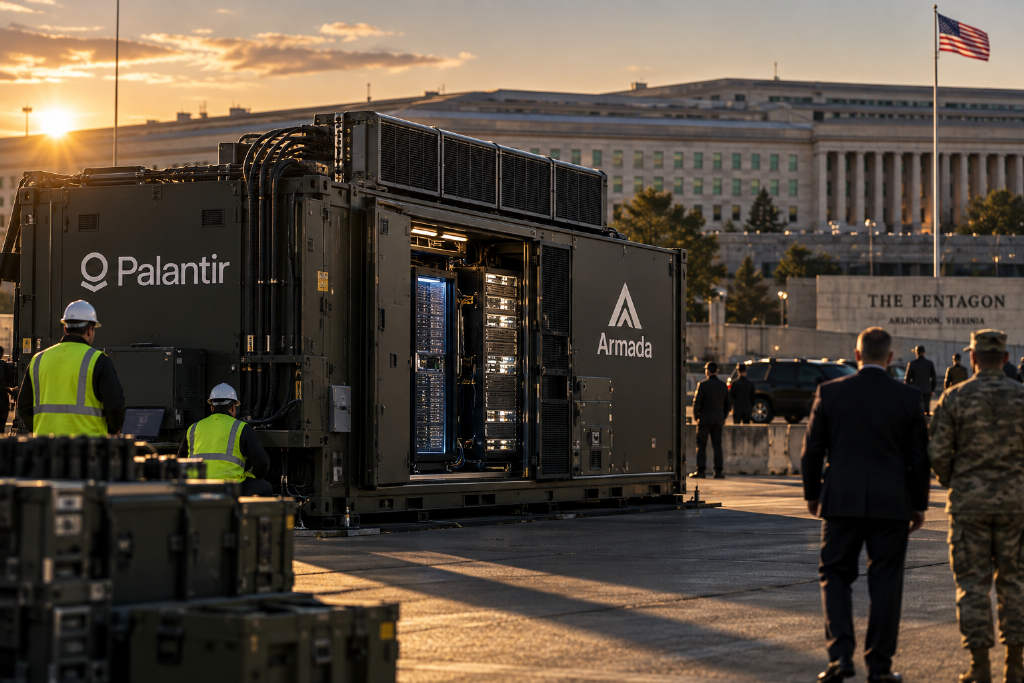
Palantir Technologies (PLTR) has formed a strategic partnership with edge computing and distributed infrastructure startup Armada, combining Palantir’s Sovereign AI Operating System with Armada’s hardened modular data centers to target sovereign AI demand from defense organizations, allied governments, and heavily regulated industries.
The move comes as geopolitical competition intensifies and concerns around data sovereignty grow, driving demand from governments and enterprises for AI computing capacity they control directly.
Focus on controlled AI infrastructure
The report says traditional generative AI deployments rely heavily on hyperscale public cloud providers such as Microsoft Azure, Amazon Web Services, and Google Cloud. For the Pentagon, NATO allies, energy grids, and multinational financial institutions, uploading sensitive private data to multi-tenant cloud environments can create data leakage risks and compliance problems tied to cross-border data rules.
The joint solution is built around three parts. First is the software and ontology layer. Palantir is providing a sovereign AI operating system centered on AIP, Ontology, Foundry, and Apollo, allowing customers to manage data and deploy or fine-tune open-weight AI models inside a fully controlled environment.
Second is the hardware layer. The system uses Armada’s Galleon modular data centers, with hardware restricted to manufacturing in the United States and allied countries, a design meant to reduce geopolitical and supply-chain backdoor concerns.
Third is support for highly isolated deployment settings. Paired with Armada Platform and the Sovereign AI Grid mesh architecture, the modular compute units are designed to operate with a high degree of autonomy. The report says internal power, cooling, GPU clusters, and AI inference pipelines can continue running even if outside network connections are completely severed.
Palantir co-founder and CEO Alex Karp said, 「Sovereignty is not something you rent. Sovereignty means you must own the model weights, the data, and the hardware that runs those models — and you must know where that hardware was made.」
Deployment timeline cut from years to months
Speed of deployment is another selling point in the partnership. According to the report, large centralized data centers around the world are often constrained by substation capacity approvals, grid expansion, and land development procedures, and a new facility can take 2 to 5 years from construction to launch.
Armada’s Galleon uses a standardized hardened form factor similar to a shipping container and is described as drop-in infrastructure. If a target site has basic power access or a microgrid, high-performance GPU compute nodes can be brought online within months.
Armada co-founder and CEO Dan Wright said the combination of Palantir’s software stack and Armada’s distributed hardware can help governments and critical infrastructure operators reduce dependence on external public clouds while deploying the latest AI compute to the front lines at unprecedented speed.
Extending beyond software
Armada was founded in late 2022 by former DataRobot CEO Dan Wright. The company is backed by investors including Founders Fund and Lux Capital. It previously drew attention for combining SpaceX’s Starlink low-Earth-orbit satellite communications with edge computing nodes built for offshore oil platforms and remote mining sites.
From a commercial standpoint, the report says Palantir had already worked with NVIDIA on a sovereign AI reference architecture. The Armada partnership points to a broader push from software into physical, drop-in tactical data center infrastructure. The report also says the tie-up expands Palantir’s reach into disconnected industrial control environments, offshore mining, and frontline tactical edge deployments.