
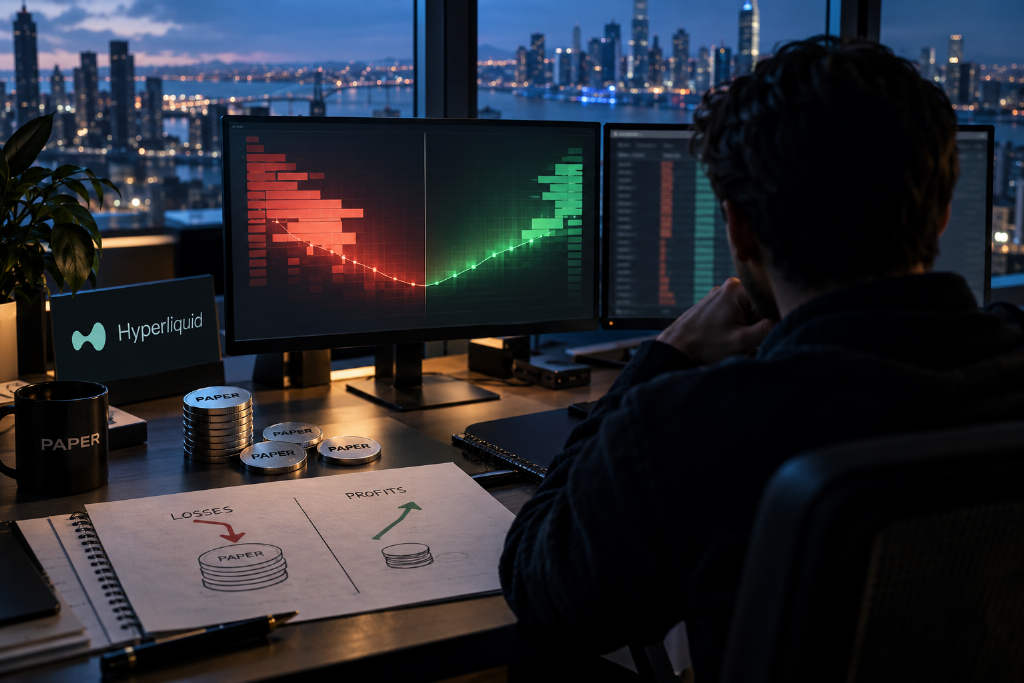
Paper Trade has an unusual emission model for $PAPER: tokens are created only when a trader realizes a loss, and the minted PAPER goes straight into that account.
At the current rate, every $1 of loss mints 16.6 PAPER.
How fees and haircuts work on Paper Trade
The position itself carries no fee and no funding fee. Instead, fees are charged on profitable positions.
Those fees move through a tiered structure. First, any profit below 2 bps is treated as zero, a rule the author says is meant to protect the protocol from manipulation of the Hyperliquid, or HL, mid-price.
After that, profits are subject to a graduated haircut. The size of the haircut depends on the gap between entry and exit prices: the wider the gap, the smaller the haircut.
The farming approach described by the author
According to @degentradingLSD, the most efficient way to farm $PAPER under the current setup is to keep the net cost basis as low as possible. In practice, that means trying to reduce the haircut applied to profitable trades.
There is a tradeoff, though. Waiting for bigger moves means longer intervals between cycles, especially if the strategy is run manually.
The post also says the PAPER mint rate decays as more PAPER is created. At some point, the author writes, traders may prefer to accept a higher upfront cost, together with staking rewards.
Delta-neutral setup and liquidation risk
To run a delta-neutral farming strategy, the author suggests opening both long and short positions at 100x or 200x leverage, the maximum. Once the loss becomes large enough, the trader first realizes and closes the losing side, then realizes and closes the profitable side, and repeats the process.
The warning is clear: even a single liquidation can sharply increase the cost of farming. That is because the trader takes a liquidation fee hit and also needs to close the winning leg immediately.
Because liquidations take priority over normal position closing, the long and short legs may end up being closed at very different prices rather than in the same block.
The author also says congestion is more likely during sharp market rallies, which is why leverage above 100x is not recommended.
Manual execution versus automation
The strategy can be run manually or through an automated farming bot. According to the post, the bot charges only 10% of the farming cost, which the author says is well below the slippage cost that can come with manual trading.