
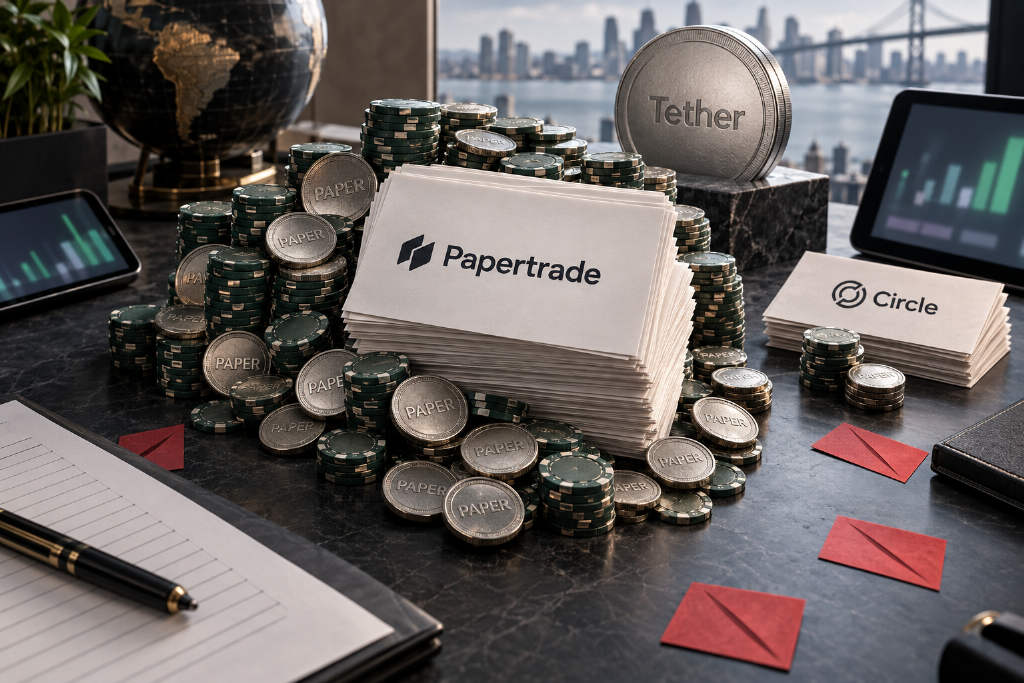
On Oct. 16, DeFiLlama revenue data showed that derivatives wagering protocol Papertrade recorded $7.49 million in daily protocol revenue. That put it ahead of stablecoin issuer Circle for a second straight day and ranked it second among all protocols and blockchains, behind only Tether.
The data also showed that within seven days of launch, Papertrade posted $57.16 million in nominal revenue and distributed about $52.76 million to holders staking the platform token PAPER. That represents a payout ratio of 92.30%.
What counts as protocol revenue in DeFiLlama’s framework
According to the report, the cash flow counted as “protocol revenue” for Papertrade under DeFiLlama’s methodology includes three distinct parts: a 2% fee when traders close positions and realize profit or loss, a 2% liquidation fee deducted from margin when users are liquidated, and excess funds that are directly transferred to stakers once the liquidity pool balance exceeds the $5 million threshold.
That definition means the protocol’s headline revenue, despite repeatedly hitting record levels, is not mainly made up of standard service fees generated by matched trading activity. A much larger share comes from principal lost by counterparties during liquidations in high-leverage trading.
When retail traders or leveraged participants are liquidated on either side of the market, those losses flow into the protocol’s underlying liquidity pool. Once the pool rises above the $5 million cap, all surplus principal is treated by the system as current-period “revenue” and moved into the dividend pool.
How the first seven days break down
Using the figures cited in the report, of the $57.16 million in total revenue generated in the first seven days, $52.76 million flowed back to the staking side. That works out to an average of about $7.537 million a day and accounts for 92.30% of the total. Developers kept roughly 7.70%, or about $4.4 million.
The article said the large numbers reflect an accounting profile in which fast-turnover speculative capital is rapidly converted into distributions.
The redistribution loop built into Papertrade
Based on Papertrade’s official mechanism design, the report said the protocol uses tokenomics to build a closed negative-sum loop.
At the trading layer, users who lose margin receive governance token PAPER in proportion to their losses. In practical terms, the design gives losing traders a form of “equity” in the platform, which may encourage them to move those tokens into the staking pool in hopes of recovering losses through future distributions.
On the allocation side, profitable traders withdraw counterparty funds from the liquidity pool. The protocol charges a fixed 2% fee on all profits. Half of that, or 1%, goes to developers. The other 1%, together with all liquidity above the $5 million threshold, is distributed to all users who lock PAPER for staking.
The report described the resulting cycle this way: winners take liquidity from losers, the platform skims part of winners’ profits, and stakers split the losses generated by later liquidations.
Fragility if liquidation-driven payouts slow
The article argued that a model relying on continuous trader liquidations as its main source of distributions depends heavily on a constant inflow of new trading principal.
In a strongly one-sided market, or if positions become heavily skewed in one direction, a wave of profitable withdrawals could put intense pressure on the base liquidity pool, which is fixed at $5 million.
If market activity cools and liquidations become less frequent, the pool may fail to stay above that threshold. In that case, the funding source for excess distributions to stakers would stop immediately, and annualized yields that had appeared exceptionally high could fall sharply.
If yields drop to zero, holders who obtained PAPER through loss compensation and then staked it may rush to unstake and sell. The report said this exposes the internal fragility of decentralized derivatives wagering when there is no durable base of real counterparties.
More on-chain evidence may emerge later this week
As on-chain arbitrage activity deepens, whether Papertrade can maintain surplus payouts in the millions of dollars per day remains to be seen. The report said its actual contract value locked and the retention of trading counterparties should become clearer in on-chain trading records after this week.