
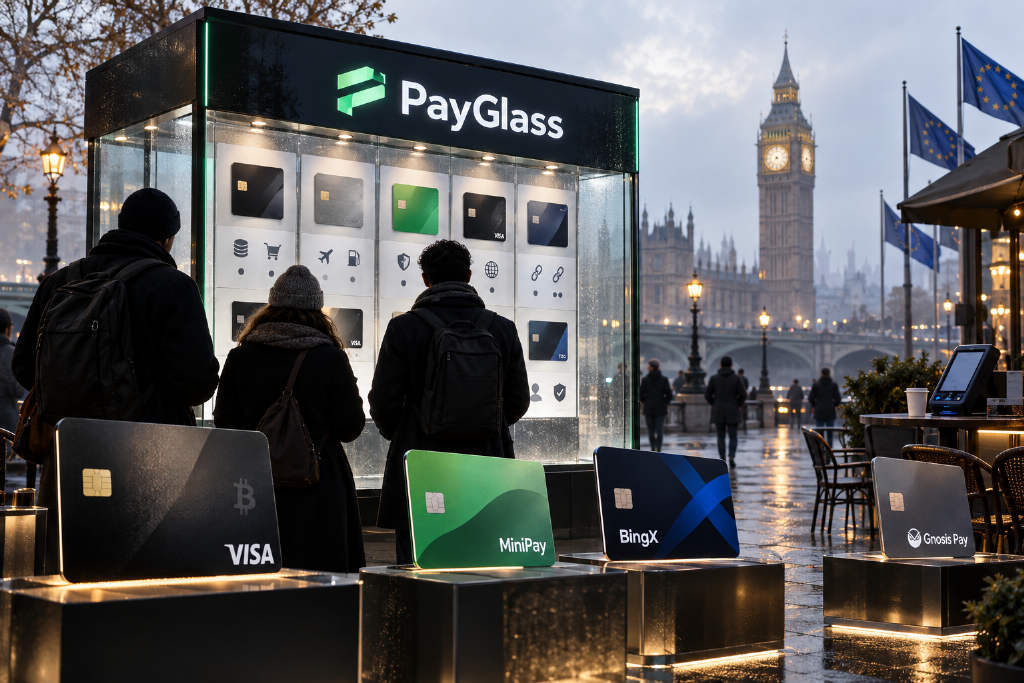
Crypto cards are scaling quickly, but the information users need to compare them is still scattered. According to CoinDesk in August, monthly payment volume for crypto cards has surpassed $1 billion, up more than threefold year over year. In October 2023, that figure was still below $1 million.
That growth has turned crypto cards into one of the fastest-expanding segments in the digital-asset market. Issuing a card is now a race of its own, with wallets, exchanges and even blockchain projects joining in.
In June, self-custodial stablecoin wallet MiniPay said it would launch the MiniPay Card with Visa, with Gnosis Pay providing the technology and Monavate acting as the regulated issuer. Users in Europe, Africa, Latin America and Southeast Asia would be able to spend stablecoins held in the wallet directly. In July, BingX announced the BingX Visa debit card. In September, Telegram Wallet rebranded to Walt and said it planned to roll out a crypto card. In October, Gate said it would work with Visa to launch a crypto card in more than 40 markets.
Visa said in an update in March that more than 130 stablecoin card programs were already running on its network across over 50 countries, and that the number was expected to double again by 2026.
Supply is expanding faster than user understanding.
Headline rates often hide the real cost
Compared with traditional credit cards, crypto cards carry a more layered fee structure. The article describes three cost layers: the card network, the issuer and the blockchain. At a minimum, users need to check four figures: the application fee, foreign exchange fee, cashback rate and then a longer list that can include annual fees, top-up charges and refund fees.
Each line item looks manageable on its own. Together, they are harder to read. Application fees range from $0 to $100: RedotPay charges $10 for a virtual card and $100 for a physical card; Tria charges $25; Solayer Pay charges $20; Bitwala charges $1.1; and more than a dozen cards charge nothing at all. FX fees range from 0 to 1.75%, with Solayer Pay at the top end, while Moto, imToken Card and KAST are listed at 0.
Some costs sit in the fine print. RedotPay charges $0.2 for small transactions, $0.5 for refunds and 2% for ATM withdrawals. imToken Card charges 1% every time crypto assets are topped up, which means the balance is reduced before the card is even used.
In a spending environment where the average ticket is $86, those small charges are not trivial. A 1% FX fee on an $86 purchase comes to $0.86. Add a $0.2 small-ticket fee and the effective cost rises again.
Cashback is the easiest figure to misread. RedotPay advertises 3%, but the note says it is available only to Pro members and capped at $18 per month. At a 3% rate, rewards stop increasing once monthly spending passes $600. Tria’s 1.5% applies only to the first $1,000 of monthly spending, then drops to 0.5%. Gate Card and COCA both advertise "up to 8%," while OKX Card lists 2% to 10%; in practice, the article says those rates depend on VIP tiers.
A card with 0 FX fees may still take 1% at the top-up stage. A card marketed with "up to 8% cashback" may reserve that rate for users spending more than $10,000 a month.
Annual fees sit at the other extreme. The article says Moto is the most expensive card in PayGlass’s database on that measure, charging $2,500 a year or $250 a month. In return, it sets base transaction fees, FX fees and crypto-to-fiat conversion fees at 0 and gives cardholders unlimited airport lounge access. Using a $2,500 annual fee and 5% base cashback, the break-even point comes at $50,000 in annual spending, or about $4,167 a month. The point made in the article is that this is a product built for a specific user group, not something that should be lined up next to a no-fee card without context.
KYC is another filter. Availability varies by region: some cards are limited to the U.S., others are mainly available in Asia, and users may not discover they fail a card’s KYC policy until they begin the application process.
PayGlass wants to put every layer of card data in one place
Against that backdrop, PayGlass is taking a simple approach: place the key data for crypto cards into a single table and present it under one framework.
On PayGlass, a card is not just a block of marketing copy. It becomes a set of fields that can be compared line by line. The platform currently lists more than 35 crypto card projects and organizes each card around four main data tracks.
Fees and rules
The first track covers fees and rules. It includes application fees, monthly and annual fees, base transaction fees, FX charges, crypto top-up fees, refund fees, ATM withdrawal fees, small-ticket fees, cashback rates and all attached conditions.
That means notes such as RedotPay’s "Pro membership required" and "$18 monthly cap" appear directly next to the 3% cashback figure instead of being buried elsewhere. It also means imToken Card’s 1% top-up fee remains visible even though it is not technically a swipe fee.
Card specifications
The second track covers the card itself: whether it is debit or credit, whether it is self-custodial or third-party custodial, which network it runs on, which assets it supports, where it is available, whether it supports Apple Pay and Google Pay, and whether a physical card is issued.
Those fields answer a basic question: can this card actually work for a given user? The article gives two examples. Moto is described as a non-custodial Solana credit card. imToken Card, by contrast, is provided by Fiat24 and comes with a Swiss IBAN as a multi-currency debit card. Their target users barely overlap.
Transaction data
The third track is transaction data. PayGlass tracks on-chain transaction volume, 30-day month-over-month changes and trend lines for card projects, so users can see both what a card charges and whether it is gaining or losing usage.
As of Oct. 24, 2026, cards on the platform with complete 30-day transaction data had generated a combined $825 million in volume. RedotPay, ether.fi and KAST accounted for 80.4% of that total.
Project background and user perception
The fourth track covers project background and user perception, including team members, investors, recent news and user ratings. The article says those data points are meant to reflect the overall strength and background of the project behind a card and can serve as a reference when assessing development prospects and downside support.
More than a comparison table
The article says PayGlass is aiming at more than a product directory. It wants to become an information layer for the crypto card sector.
First, it wants to build a common comparison framework. Issuers currently describe their fee systems in their own language, often using different terms for similar charges and placing the least favorable item where it is hardest to notice. PayGlass says it wants to translate those systems into a common format. The article compares that role to DeFiLlama in DeFi and CoinMarketCap for exchanges, arguing that a market matures not when it has more products, but when those products become comparable.
Second, it wants to make the market verifiable. Fee disclosures come from issuers; transaction volume comes from the chain. The article argues that the two only become meaningful when shown together. By placing on-chain payment flows next to issuer-stated fee schedules, PayGlass is trying to give users a way to test marketing claims against behavior. The example used in the article is a card advertising 4% cashback but posting only a few million dollars in 30-day volume; in that case, the reward may look more like a subsidy budget than a durable business model.
Third, it wants to reduce search costs. As more cards enter the market, the time required to compare official websites rises in a straight line, and so does the chance that users stop comparing and simply apply for one at random. PayGlass offers filters for country or region, supported assets and physical card issuance, along with sorting by application fee, FX fee, cashback and rating, plus watchlists. The stated goal is to compress a process that once required checking more than a dozen websites into a task that can be completed in minutes.
Fourth, it wants competition to return to the product itself. Once fees, perks, transaction volume and project background are laid out in one table, the article argues, issuers are left to compete on actual product quality: whether fees are really lower, whether cashback can really be earned and whether service is actually stable. In that framing, a transparent market benefits the products that perform better, not the ones that market themselves better.
A fast-growing market still lacks its information layer
The article closes by returning to the growth curve. Crypto cards went from less than $1 million in monthly volume in October 2023 to $1 billion today in under three years, showing that stablecoins can already be spent through Visa terminals around the world.
The next question is different. If the market ends up with 100 cards or more, how can users find the one that fits them with the lowest possible decision cost and the fewest barriers?
The article’s answer is that market maturity is not only about having more products. It also depends on whether information is searchable, comparable and verifiable. The payment rail is getting there. What the sector still lacks, it says, is the infrastructure that helps people understand the cards themselves.



