
PayPal used its latest quarterly results to give PYUSD a more central role in its payments story, even as the stablecoin’s on-chain supply has pulled back from earlier highs and a separate industry model begins to take shape through Open USD.
The company reported second-quarter revenue of $8.68 billion, ahead of the $8.47 billion market expectation cited in the article. Adjusted earnings per share came in at $1.38, above the expected $1.28, while GAAP EPS was $1.26 and slightly below expectations. Total payment volume reached $486.4 billion, up 10% year over year, or 9% on an FX-neutral basis. PayPal also raised its full-year adjusted EPS outlook to about $5.38.
On those headline measures, the quarter came in slightly ahead of expectations. But the figures tied to margins, crypto exposure and PYUSD’s underlying supply tell a less straightforward story.
PYUSD moved closer to PayPal’s core merchant stack
During the quarter, PayPal created a new “Payment Services & Crypto” unit and placed PYUSD in the same line as merchant processing. The company also described PYUSD as a “major enabler” for the PayPal World platform and stressed its role as a “commerce-first” stablecoin designed for mainstream consumers and merchant use cases.
On the earnings call, CEO Enrique Lores said PayPal plans to roll out more merchant products supported by PYUSD and agentic payments powered by AI. The organizational change matters because it shows PYUSD is no longer being framed as a side project or a standalone experiment. It is being built into PayPal’s core merchant payments system.
What PayPal still has not disclosed is just as important. The company has not broken out PYUSD’s direct contribution to revenue, merchant retention or transaction margins, leaving investors to infer its real business impact from aggregate data and management language.
Margins weakened and crypto assets weighed on profit
PayPal’s GAAP margin fell to 16.4% from 18.1% a year earlier. In the earnings materials, the company attributed an $81 million net loss to strategic investments and crypto assets held for investment purposes, then excluded that amount from non-GAAP results.
That means crypto assets did create pressure on reported profit during the quarter. The article notes that it is still difficult to tell whether the loss mainly reflects temporary mark-to-market weakness during a market decline or an intentional cost PayPal is absorbing while expanding related businesses.
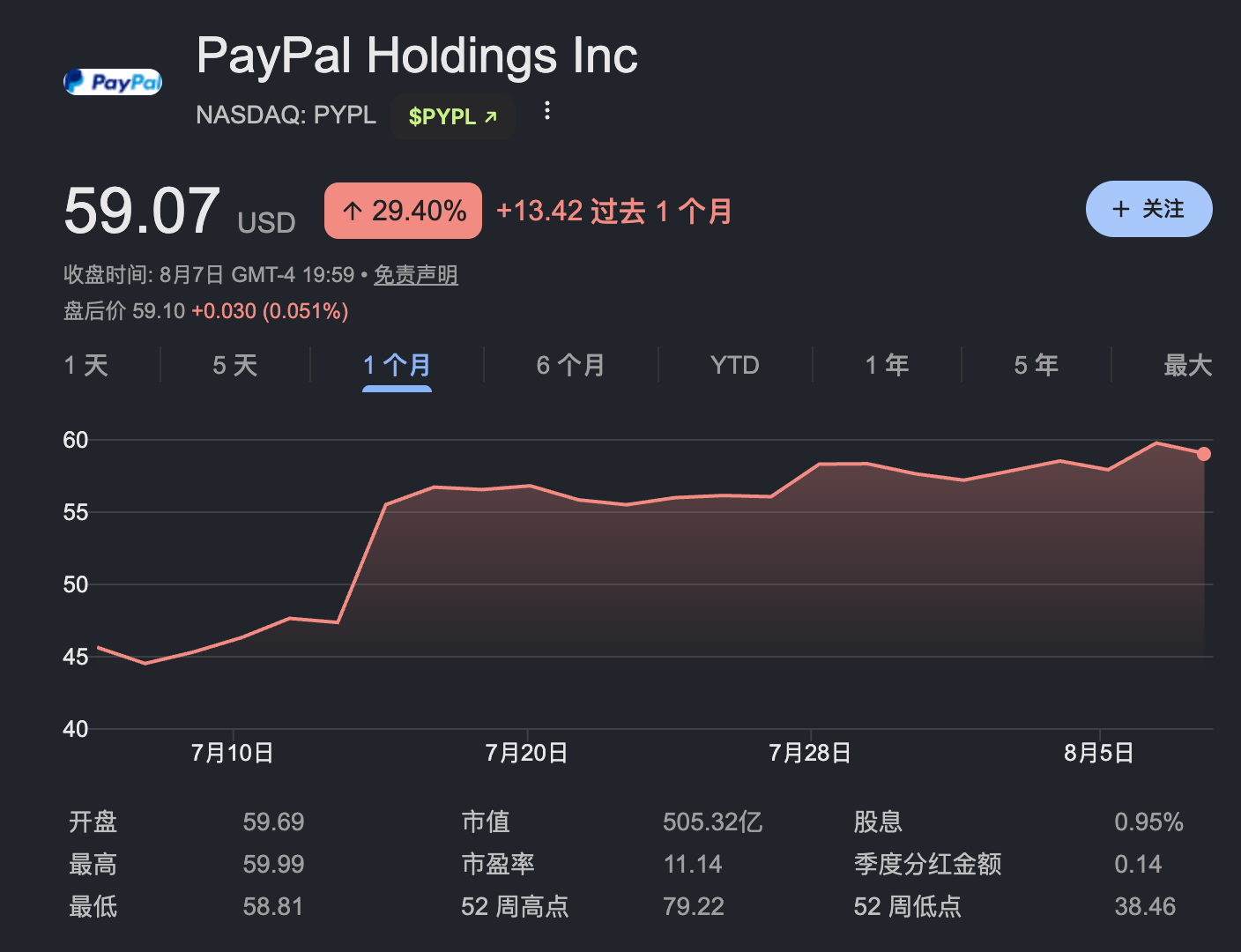
The article also says PayPal shares had been rising over the past month, citing Google as the source.
Expansion came through market coverage, multichain distribution and payment rails
Since launching in August 2023, PYUSD has gone through a period of expansion followed by contraction.
In March, PayPal expanded PYUSD coverage to 70 markets. Supply at one point climbed to about $4.2 billion, with year-over-year growth nearing 680%, making it one of the fastest-growing major stablecoins in that period. As of now, PYUSD has been deployed on nine public blockchains: Ethereum, Solana, Arbitrum, Stellar, Avalanche, Aptos, Sei, Tron and Abstract. In February, PayPal also set Solana as the default payment processing network.
On July 9, PYUSD launched natively through Polygon’s Open Money Stack, integrating wallets, fiat on-ramps, compliance tooling and on-chain settlement. The stated target was enterprise-grade cross-border payments. PayPal and MoonPay also introduced the PYUSDx framework, which allows developers to issue application-specific stablecoins backed by PYUSD reserves. The move points to a broader ambition: turning PYUSD into infrastructure that others can build on, not just a payment token used at the edge.
Kraken recently said it would support PYUSD deposits and withdrawals on Stellar, adding another exchange-side access point.
Taken together, those steps show how PayPal wants PYUSD to evolve. The token is being positioned less as a balance tool for PayPal users and more as a payment infrastructure layer that third-party wallets, exchanges and developers can use directly.
The article describes the business logic in practical terms. A company handling global collections could use a PYUSD-based tool, or build one, to receive payments internationally. Fiat paid by one side would be converted into PYUSD in the background and then exchanged into another fiat currency for the recipient. PayPal also linked PYUSD to its AI efforts in the earnings narrative, saying it is using machine learning to improve fraud detection, reduce processing costs and support automatic conversion between fiat and stablecoins based on exchange rates and user behavior.
On-chain supply fell after the March peak
The strategic pitch has not been matched by supply growth.
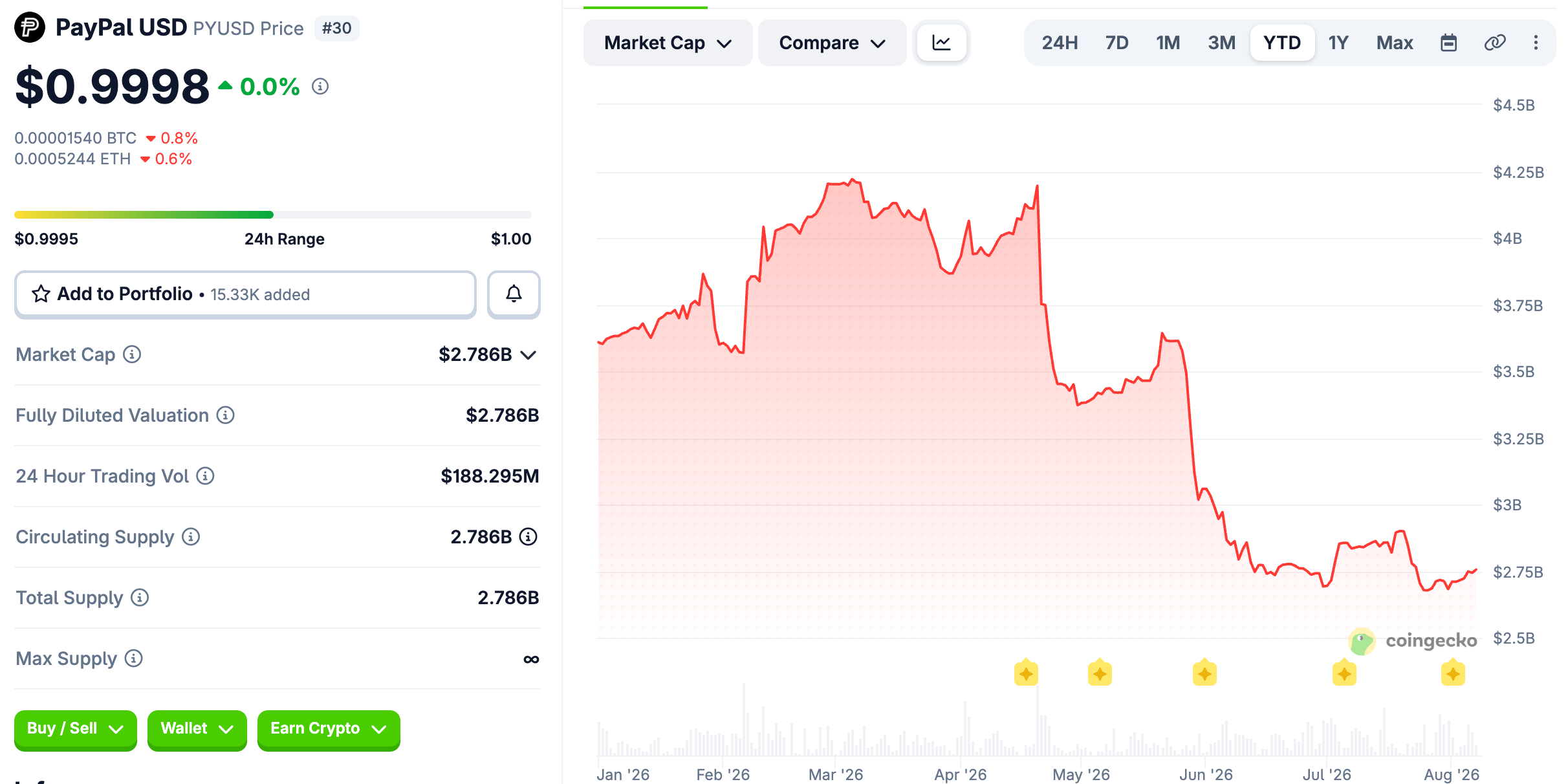
After reaching a peak of about $4.2 billion in March, PYUSD supply fell about 31% by the end of the second quarter to roughly $2.7 billion. The article says this was the first major decline since launch and attributes it mainly to weaker incentives and capital rotating into other assets.
As of early August, PYUSD’s circulating supply stood at about 2.7 billion tokens, giving it a market capitalization of around $2.72 billion. On CoinGecko, it ranked at roughly No. 32 among stablecoins.
The disconnect is clear: while PayPal is highlighting broader distribution, chain integrations and infrastructure utility, actual circulating scale shrank by nearly one-third over the same period. The article argues that unique regulatory positioning and market access do not automatically translate into lasting demand.
It also notes that PYUSD is the first dollar stablecoin issued by a federally regulated entity, Paxos, and says that position was reinforced when Paxos moved to OCC federal regulation at the end of 2025. Even so, the earlier expansion in supply did not convert into steady organic usage after incentives faded, and the gap with USDC remains meaningful.
Open USD introduces a different model
If PYUSD represents the single-issuer stablecoin model, Open USD points to a structurally different path. The project appeared on June 30, less than a month before PayPal released its second-quarter results.
Open USD is operated by a newly formed independent company, Open Standard. Its founding CEO is Zach Abrams, co-founder of Bridge, a Stripe company. The project has not launched yet and is expected to go live in the second half of 2026. According to the article, it has signed more than 140 partners across payments, finance, technology and crypto.
- Payment networks: Visa and Mastercard
- Payment infrastructure: Stripe and Shopify
- Asset managers and banks: BlackRock, BNY and Standard Chartered
- Technology platforms: Google and IBM
- Crypto-native participants: Coinbase, Solana and Aave
The key difference between Open USD and PYUSD lies in economics and governance. The article reduces that contrast to one line: PYUSD pays one party, while Open USD spreads the benefits across participants.
Under the PYUSD structure, Paxos is the single issuer that holds reserve assets and earns the floating yield, while PayPal as the brand owner leads product strategy and distribution. That is the model long used by USDT and USDC. Open USD flips that arrangement. Minting and redemption are free for partners and come with no cap, reserve income is returned to participating distribution partners after a small management fee, and governance sits with a board made up of partner institutions rather than a single company.
The article cites industry commentary comparing that setup more to ACH or SWIFT than to the current governance logic of USDC or USDT.
PayPal joined Open USD while continuing with PYUSD
One detail stands out. PayPal itself is among the more than 140 Open USD signatories, even though PYUSD will continue to exist as an independently issued asset.
That means PayPal has not tied itself entirely to PYUSD. It is keeping exposure to both stablecoin paths: pushing PYUSD as its branded asset while also securing a place in Open USD in case the industry shifts toward a consortium structure.
By contrast, Circle and Tether were not listed among Open USD’s partners. The article says Circle shares fell more than 16% at one point on the day the news was announced. Circle CEO Jeremy Allaire later responded publicly by emphasizing USDC’s network effects and distribution depth. He also cited USDG, another consortium-style stablecoin under Paxos, saying its supply reached only about $3 billion more than two years after launch, well below earlier optimistic expectations.
What PYUSD still has to prove
Looking across PYUSD, USDC and Open USD, the competitive field facing PayPal is getting more complicated.
PYUSD has a first-mover advantage relative to some newer entrants and has already built a level of brand recognition plus a multichain base. But in absolute size it remains only about one-twentieth of USDC, according to the article, and recent supply contraction has raised new questions. If Open USD succeeds, its most important effect may not be taking PYUSD’s current holders. The bigger issue is whether it can rewrite the economics of distribution across the stablecoin sector. If distributors at the scale of Stripe, Visa and Mastercard can share reserve income through a consortium model, the single-issuer structure could face a much harder test.
PayPal’s decision to participate on both sides reflects that uncertainty. For PYUSD, the next few quarters may matter less for how many markets it reaches or how many chains it supports, and more for whether the distribution network it has built can turn into durable demand without subsidies. The article’s closing view is blunt: if that does not happen, $2.7 billion may prove to be PYUSD’s current peak.