

Pendle-backed funding-rate trading protocol Boros has rolled out a product aimed at turning cross-exchange perpetual funding spreads into a directly tradable instrument.

On Oct. 15, Boros officially launched Spread Markets, with BTC and ETH included in the first batch. The product allows users to trade the difference in perpetual funding rates between platforms through a single position. In its promotional material, Boros described the setup as the next opportunity on the scale of the "Kimchi Premium." In practice, though, the product is better understood as a way to compress a multi-venue arbitrage structure into a cleaner execution layer.
How Boros turns two funding markets into one trade
Because perpetual futures do not have an expiry date, exchanges use funding rates to balance long and short positioning. Even for the same asset, those rates often differ across venues.
Take BTC as an example. If exchange A has an annualized funding rate of 20% and exchange B is at 8%, the spread between the two is 12 percentage points on an annualized basis. That gap can come from trader composition, market sentiment, liquidity conditions, and differences in how each platform calculates funding. As long as long-short demand is not fully synchronized between the two markets, the spread can persist.
That creates an arbitrage incentive, but the traditional version is operationally messy. Traders usually need to open perpetual positions on two exchanges, deal with separate funding schedules, margin systems, and liquidation rules, and then keep monitoring changes in the rate environment if they want to preserve a targeted return profile.
Boros had already introduced products that let users trade the funding rate of a single market. Spread Markets go one step further by combining the rate differential between venues into one tradeable product.
For example, BTC Spread A-B represents the floating rate calculated as exchange A’s BTC funding rate minus exchange B’s BTC funding rate. Instead of managing both legs manually across platforms, users can simply go long or short that spread on Boros.

Long and short positions are a fixed-versus-floating rate swap
Boros supports trading the spread in both directions.
- Going long the spread: the trader expects the average funding-rate difference between the two markets to end up above the implied annualized rate at entry.
- Going short the spread: the trader expects the average funding-rate difference to come in below the implied rate locked in at entry, or uses that position in combination with perpetual legs on both exchanges to lock in a funding arbitrage return.
That distinction matters. A Boros position does not mean the user simply receives the raw funding-rate difference between two exchanges. Economically, the position is an exchange between a fixed rate and a floating spread, and the final profit or loss is settled against the realized floating spread versus the rate implied when the trade was opened.
So what the new product reduces is execution complexity. It does not fully automate every step of cross-exchange arbitrage into a push-button trade.
What trading opportunities does this create for retail users?
Directional bets on funding spreads
The most straightforward use case is to trade the funding spread as a standalone instrument.
If the current implied annualized rate is 10% and a trader believes the average funding-rate difference between the two platforms can reach 20% over a period of time, a long spread position could generate a positive settlement outcome. If the implied annualized rate is 20% instead, but the trader thinks the spread will cool to 5% as market sentiment fades, a short spread position may be the better expression.
This approach does not require the user to hold perpetual positions on both venues at the same time, so it avoids taking the full underlying crypto price exposure purely to capture the funding differential. That can make capital use more efficient. The trade-off is that funding spreads themselves can move sharply, so leverage risk still needs close attention.
Carry-style fixed-income arbitrage
For users more focused on yield than on a directional view of the spread, the more interesting setup is a three-leg structure that combines the Boros market with exchange perps.
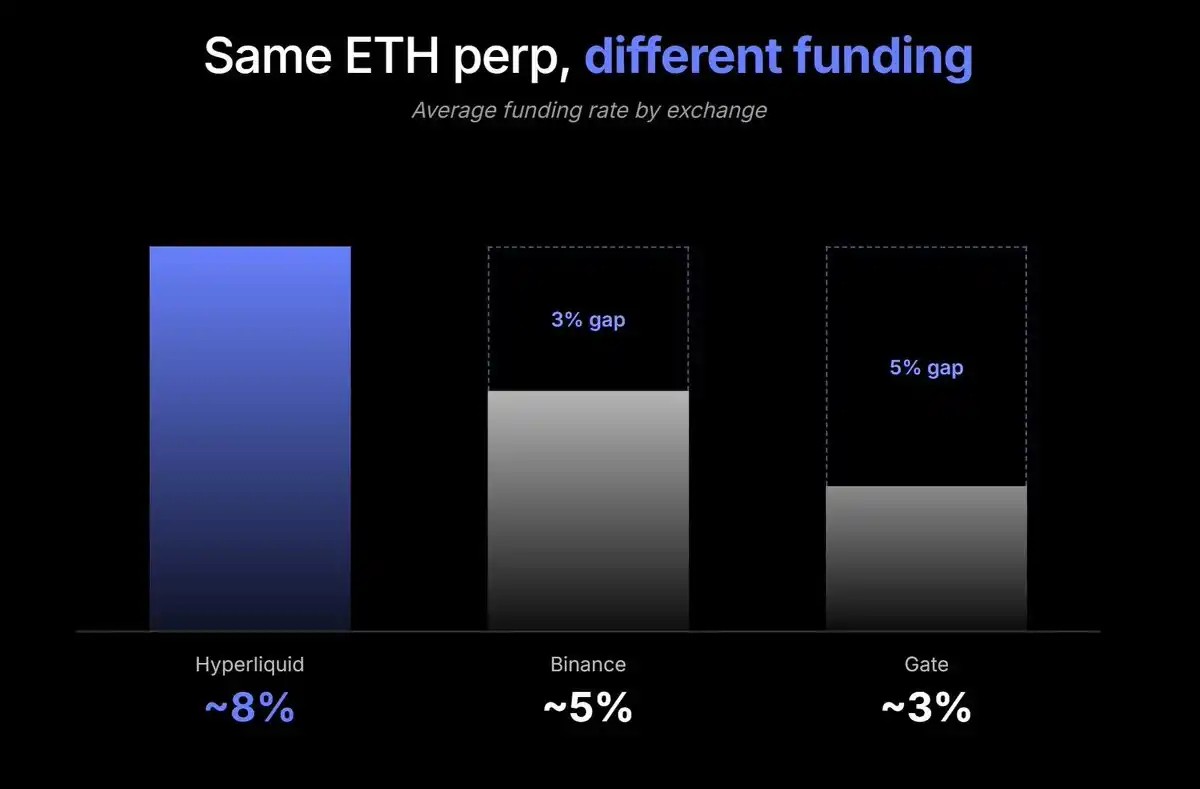
Suppose exchange A’s BTC funding rate is meaningfully higher than exchange B’s. A trader can short BTC perpetuals on the higher-rate venue and take an equal-sized long BTC perpetual position on the lower-rate venue to offset as much directional price exposure as possible. At the same time, the trader shorts the corresponding Spread Market on Boros, converting the floating funding-rate differential into a fixed-rate position. The reverse structure works the same way in the opposite direction.
Taken together, those three trades can lock in the spread between the two markets. Boros’s own arbitrage tools are built around that idea. Where a Spread Market exists, two separate funding-rate exposures that would otherwise need to be managed independently can be collapsed into one spread position.
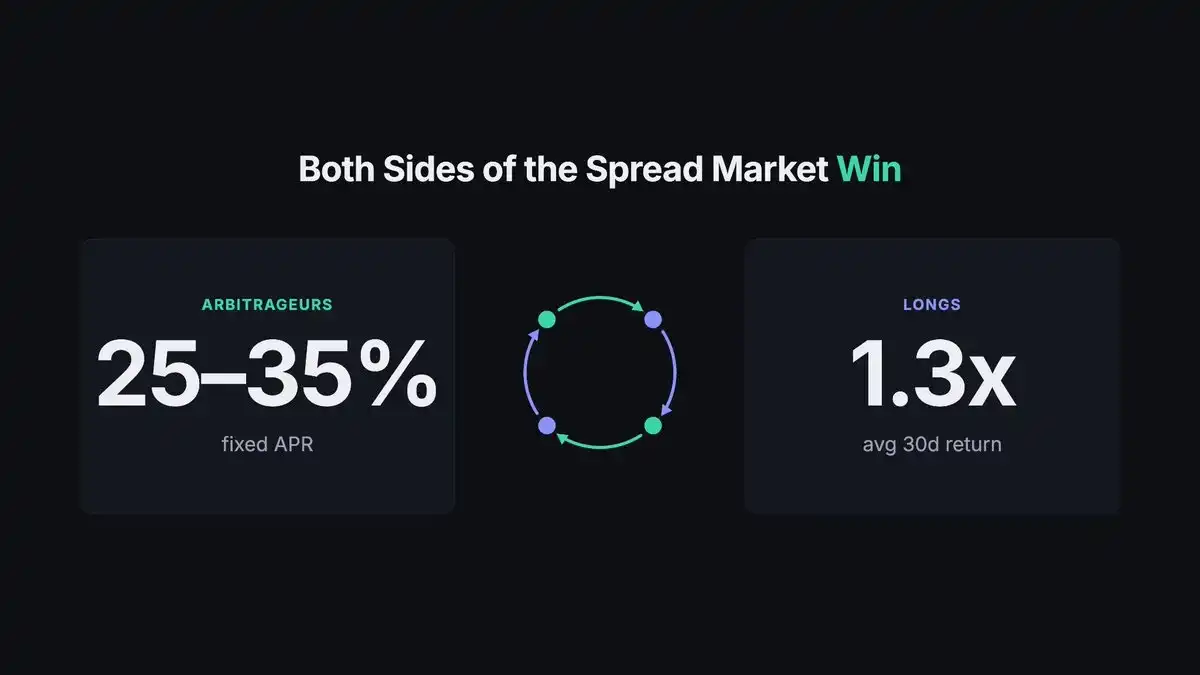
In its promotional material, Boros cited examples showing 25% to 35% fixed returns. Those numbers should not be read as the net yield an ordinary user can automatically earn. They also cannot be compared in isolation from the entry rate, holding period, leverage used, and total trading costs.
For retail traders, the real question is not the highest annualized figure shown at a single moment. It is whether the spread can persist, whether the entry level makes sense, and how much return remains after fees and execution costs are deducted.
Where the hidden risks sit behind the headline yield
High volatility: historical patterns do not lock in future results
Funding rates across exchanges do diverge on a regular basis, and those spreads may show recurring patterns over larger samples and longer time frames. That history can help frame a view, but it does not guarantee future settlement results.
A reversal in market sentiment, changes in trader positioning, or a sudden wave of longs or shorts on one venue can all move funding rates sharply. A spread that looked attractive can widen rapidly, compress just as fast, or even flip negative, directly changing the outcome for either a long-spread or short-spread strategy.
Underlying venue risk still matters
Packaging cross-exchange arbitrage into a single spread trade reduces the burden of handling multiple funding exposures, but it does not remove the underlying risks. The strategy still depends on how the relevant exchanges settle funding, and on Boros’s own liquidity, settlement, and liquidation framework.
If one of the underlying exchanges runs into abnormal volatility, a liquidity crunch, or a trading halt, the arbitrage structure may not be adjustable in time. Even if the underlying asset’s price exposure has been hedged in theory, actual risk is not fully neutralized. In stressed market conditions, liquidation on one leg or pricing dislocations across venues can still create additional losses.
Capacity is not unlimited
Boros has made cross-exchange funding spreads easier to trade, but the opportunity itself is not an infinite resource.
As more traders move into the same market, arbitrage capital will tend to compress the rate differential that made the trade attractive in the first place. Boros refers to this as premium narrowing. As the spread tightens, the return that new entrants can lock in also declines.
Simpler tooling does not make the strategy simple
Spread Markets give funding-rate arbitrage a more direct wrapper. They isolate the rate gap between two markets, lower the complexity of handling multiple funding exposures, improve capital efficiency, and add a new tool for both spread trading and carry-style fixed-rate structures.
But the core drivers of return remain the same: the funding level at entry, the durability of the spread, the full cost of trading, and the quality of risk management across the position set.
For ordinary traders, chasing a headline annualized yield before understanding the mechanics would be the wrong order of operations. The more practical path is to first understand the traditional cross-market arbitrage framework, then decide whether a product like this actually improves execution.