

Perp DEX growth has leaned heavily on token incentives
In a market analysis published by Foresight News, the outlet argued that the expansion of perpetual decentralized exchanges has depended to a large extent on token incentives. The question, in its view, is not whether platforms should incentivize participants. It is how those incentives are structured, and whether the return actually matches the value created by traders, liquidity providers and order-flow channels.

Before a token generation event, platforms commonly use points programs, airdrops and trading mining to exchange expectations of future token value for current trading volume and liquidity. That can accelerate user acquisition, but the fees users pay are real while the payoff still depends on future token allocations and market pricing. After TGE, fee revenue is more often directed to buybacks, burns and staking rewards. Value starts to circulate back into the ecosystem, yet the mechanism usually still runs through the platform token.
The article says the problem is not incentives themselves. It is that existing systems often reward a user’s ability to accumulate points or hold tokens, rather than rewarding who actually keeps the market running. Traders create demand and fee revenue. Liquidity providers contribute depth and execution. Wallets, trading terminals and communities deliver recurring order flow. Foresight Ventures said this has been one of the key questions in its investment and incubation work around PopDEX: can a platform build a more direct and more sustainable path for value to flow back to those who create it?
Why tokens became the default tool for early-stage coordination
Cold-start platforms need traders, liquidity and distribution all at once
The analysis says a Perp DEX in its early stage must solve several problems at the same time. It needs traders, liquidity and distribution channels, while usually lacking stable revenue and the ability to sustain large cash subsidies. Tokens offered an efficient coordination mechanism. Platforms could convert the contribution of traders, market makers and early participants into claims on future upside, using future value to acquire present-day volume, liquidity and market attention.
dYdX was presented as an early example of a more complete token incentive model. In its initial token supply, 25% was allocated to trading rewards, 7.5% to historical users and 7.5% to liquidity rewards. Trading rewards were calculated based on fee contribution and open interest. Liquidity rewards were tied to metrics including quoting uptime, two-sided depth, bid-ask spread and the number of markets covered. User acquisition, market-making subsidies and early ownership distribution were folded into one token framework.

Later platforms adapted that framework in different ways:
- Hyperliquid combined points, Referral and HLP to attract traders, expand order flow and build protocol liquidity.
- Aster adopted multi-season trading mining, using recurring points cycles and phased token distribution to keep participation and activity going.
- Lighter lowered the barrier to entry with zero fees and separated retail points from market-making points, distinguishing trading activity from liquidity quality.
Foresight News said these platforms do not rely only on tokens, but tokens remain the central coordination tool in a cold-start system. Their strength is not just reward distribution. They allow different forms of contribution to be translated into future rights while pushing much of the customer acquisition and liquidity cost back to TGE. The exact mechanics vary, but the exchange is broadly the same: a platform uses future rights and early subsidies to buy current trading volume, liquidity and attention.
Volume attracted by points does not automatically become long-term trading demand
Airdrop expectations can change why users trade
The article says points and airdrop programs affect more than platform entry. They also reshape the reasons users trade in the first place. Under ordinary conditions, traders compare exchanges by liquidity, execution stability, fees, asset coverage and risk management. Once points and airdrops enter the equation, those criteria do not disappear, but the weighting changes. Users also begin to ask how many points they can earn per unit of trading cost, whether a potential airdrop can offset fees and capital usage, and when rewards may be realized.
That does not mean users participating in points systems are not professional traders. Many are, and they may evaluate the expected return from points rationally. The issue is that once points become an important variable in trading decisions, platform volume no longer reflects only product competitiveness. It also reflects how users price future rewards.
The analysis separates trading behavior into two broad categories. One comes from ongoing product demand: users stay because the platform’s liquidity, execution, cost profile and asset coverage fit their needs. The other is driven more by reward expectations: whether a user keeps trading depends on whether points still matter, whether the airdrop still has upside in the user’s eyes and whether the cost-benefit equation still works.

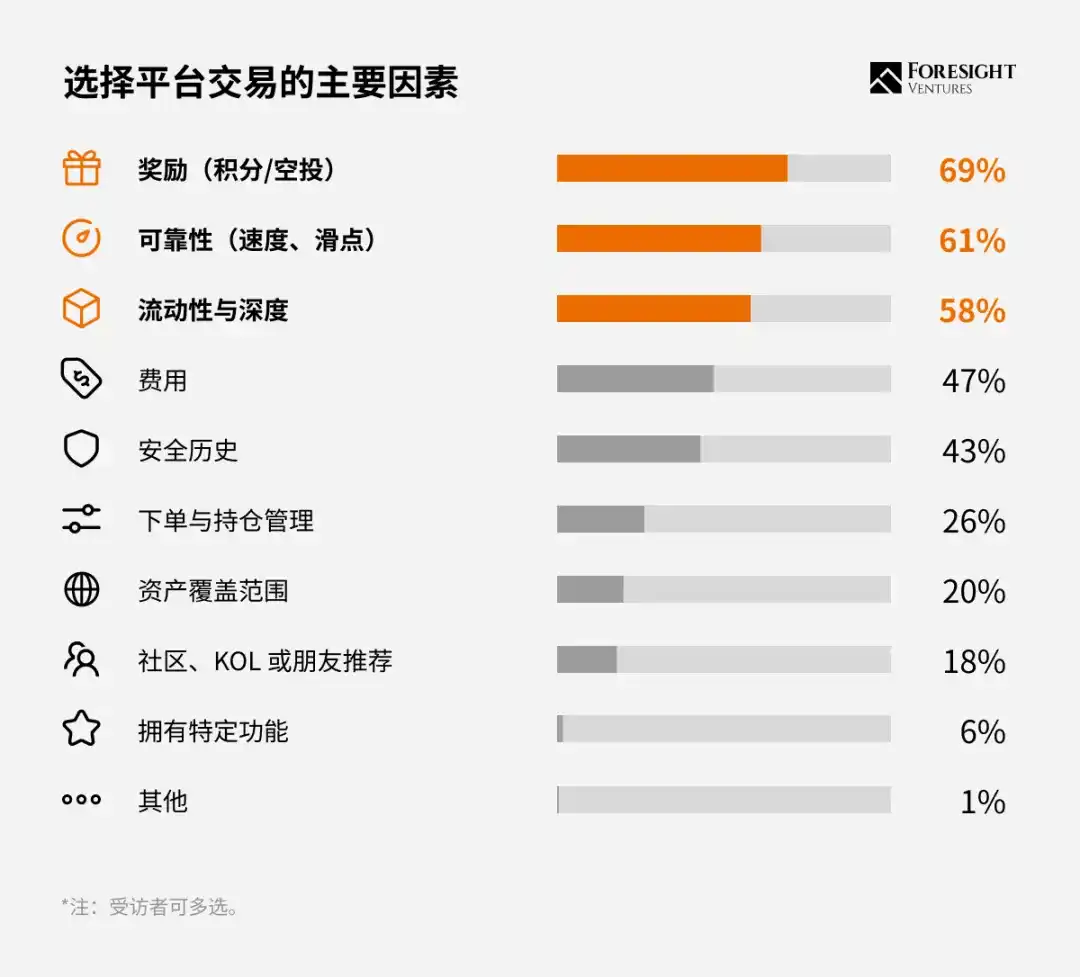
In an earlier retail survey on Perp DEXs conducted by Foresight Ventures, 69% of respondents listed points or airdrops as an important factor in choosing a trading venue. That ranked above reliability at 61%, liquidity and depth at 58%, and fees at 47%. The article says this shows points and airdrops are no longer merely add-ons outside the product. They compete directly with reliability, liquidity and fees as a core input in platform choice.
That changes the nature of order flow a platform acquires. If users arrive primarily because of reward expectations, the platform is not building a relationship anchored in product habit and high switching costs. It is building a trading relationship that needs continuing subsidies. Rewards can lower the barrier to entry. They can also lower the barrier to exit.
TGE is the first real pressure test of demand
During a points cycle, the article argues, platforms are not only purchasing volume. They are also purchasing users’ willingness to wait for future rights. As long as the airdrop story still has room to run, users may keep trading, paying fees, tying up capital and tolerating a product experience that is not yet fully mature.
That makes pre-TGE data impure. A trade may reflect actual market demand, or it may reflect expectations of an airdrop. A new user may turn into recurring order flow, or may stop trading once tasks are completed. On the surface, both count as growth. Once all of these motives are bundled into one points-and-token framework, it becomes difficult to tell what the platform has really retained.
For that reason, the article says post-TGE data should not be read simply through rises and declines. Three questions matter more:
- Did volume remain after rewards faded, or is it still being maintained by another round of incentives?
- Did market share improve, rather than merely moving with broader Perp DEX market cycles?
- Has the platform entered a natural retention phase, or is it still inside another incentive cycle?
| Platform | TGE date | Average daily volume, 30 days before TGE | Average daily volume, 30 days after TGE | Market share change |
|---|---|---|---|---|
| Hyperliquid | Nov. 29, 2024 | About $2.41 billion | About $5.08 billion | +18.6% |
| Lighter | Dec. 30, 2025 | About $6.64 billion | About $3.72 billion | -7.5% |
| edgeX | March 31, 2026 | About $2.55 billion | About $1.70 billion | -2.9% |
The article notes that the table includes only platforms for which comparable 30-day pre- and post-TGE volume and market share data were available. Aster was excluded because publicly available data were not complete under a unified methodology.
The point of the comparison, Foresight News wrote, is not to ask which platform had higher volume after TGE. It is to ask which platform turned airdrop-driven attention into an ongoing trading relationship. If a fresh round of points, mining or subsidies is still active after TGE, then volume still contains an incentive component and cannot be treated as pure retained demand. The real dividing line comes when the marginal pull of reward expectations fades: do users still want to trade because of the platform itself?
Put another way, the article says pre-TGE data test whether a platform can get users in the door. Post-TGE data test whether it can keep them there. Incentives may solve the first problem. Product capability and value distribution determine the second.
Value starts flowing back after TGE, but still through the exchange token
From distributing tokens to supporting tokens
After TGE, incentive structures often shift from handing out tokens to supporting token value. Platforms direct fee revenue into buybacks, burns, staking yield and token-holder discounts. Value begins to flow back, but the basis of distribution also shifts from trading contribution to token ownership.

That means traders first create revenue through trading, then may need to buy or stake the platform token to qualify for a share of that revenue. In effect, a platform has to run two markets at once: the trading market and the token market. The two can reinforce each other, but they are not always aligned. A professional trader may generate fee revenue over a long period while having little interest in taking token price risk. In that setup, the platform gradually rewards not only trading activity itself, but also capital committed to the token.
The analysis says comparisons across platforms should go beyond whether buybacks exist. The key questions are how much revenue enters the token system, what happens to tokens after buyback, and who ultimately captures the value.
| Platform | How fee revenue is handled | Buyback ratio | Use after buyback | Main value recipient |
|---|---|---|---|---|
| Hyperliquid | Fees go into the Assistance Fund and are used to buy HYPE | About 99% | Burned after purchase | HYPE holders benefit indirectly through supply reduction |
| Aster | Most platform fees are used to buy back ASTER | 99% | Handled under the tokenomics design | ASTER holders and participants in ecosystem incentives |
| Lighter | Trading fee revenue is used for programmatic LIT buybacks | About 97% | Permanently burned after repurchase | LIT holders benefit indirectly through supply reduction |
Holding the token, using wealth products and trading perps are not the same demand
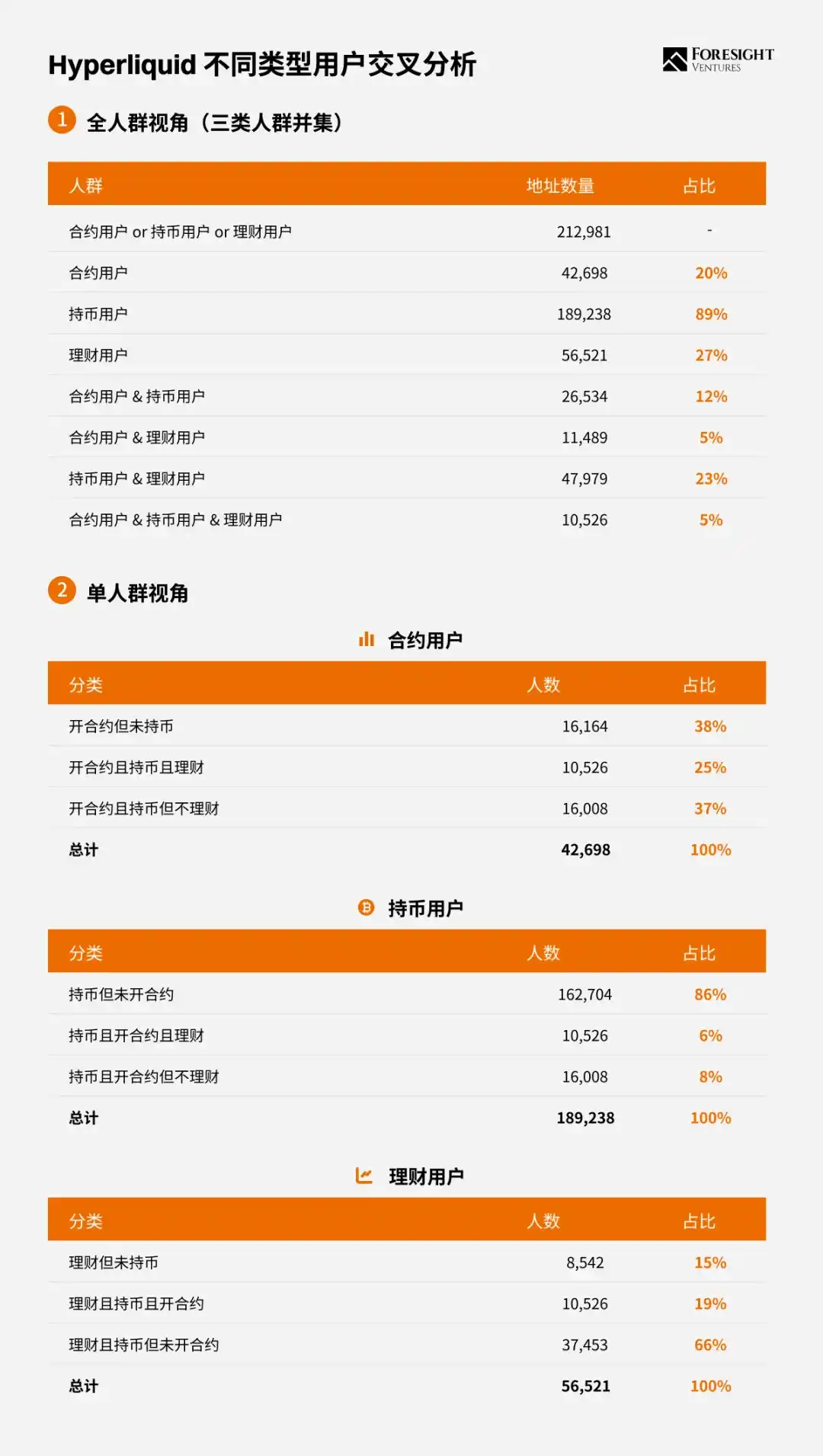
To illustrate the gap between broader ecosystem participation and actual derivatives demand, the article cross-analyzed Hyperliquid addresses holding HYPE, addresses using wealth-management products, and addresses trading perpetual contracts.
Across the union of those three user groups, HYPE holder addresses accounted for 89%, wealth-management users for 27%, and perpetual trading users for just 20%. Users active across all three categories at the same time represented only 5% of the total.
A closer breakdown showed:
- Among perpetual users, 62% held HYPE, but more than 70% did not participate in wealth-management products.
- Among HYPE holders, 86% had never traded perpetuals.
- Among wealth-management users, 85% held HYPE, but only 19% also traded perpetual contracts.
The article says these figures suggest the platform token can broaden asset ownership and ecosystem participation, but token holding, yield products and trading do not reflect the same kind of demand. Token holding may come from portfolio allocation or price expectations. Wealth products map more closely to yield strategies. Perpetual trading is what directly reflects trading demand and order flow.
Once token-holder addresses, asset balances and wealth-product users are all folded into one ecosystem-growth narrative, capital participation can easily be misread as growth in the trading market. For a Perp DEX, the article argues, market quality is still determined by sustained trading, effective liquidity and real fee revenue. The platform token can widen participation, but it cannot replace trading demand itself.
One platform, two growth goals
When revenue sharing, fee discounts and product access are all tied to the platform token, a Perp DEX ends up managing two separate growth agendas at the same time: one for the trading market and one for the token market. The article says that creates a basic tension. Is the platform serving the trading product first, or is it serving a value loop built around the token?
Those goals do not always move together. The trading market is centered on execution quality, liquidity and cost, and depends on long-term product capability. The token market is centered on demand, scarcity and price expectations, and depends on creating reasons to hold the token on an ongoing basis. The risk is not only that resources get spread thinner. It is also that the evaluation standard begins to shift. Trading volume, fee revenue and user growth no longer serve only as measures of product health. They also start to support the token narrative. In that setup, the article says, a platform may end up chasing data that strengthen token demand rather than focusing only on more real trading.
PopDEX as an alternative answer to the incentive question
From the investment perspective of Foresight Ventures, the article says what makes PopDEX notable is not a simple debate over whether a platform token should exist. The team, it says, did not make token expectations the starting point of growth, nor did it make token ownership a prerequisite for trading-related rights. Instead of collecting platform value into the token first and then redistributing it through the token, PopDEX is described as starting directly from real market contribution: those who create value should receive value back.
On that basis, PopDEX has built what the article calls a 100% value-return system. The 100% figure refers to distributable value created by trading fees, not to sending every fee dollar straight back to traders. The core design is that distributable value generated by trading fees is no longer used first to support the platform token. It enters a return framework built around real contribution.
Under this structure, PopDEX’s value return would cover two groups. One is ecosystem contributors, including Referral, Affiliate, trading campaigns and joint Campaign efforts that continue to bring in users, order flow and market attention. The other is real trading users, with the project exploring a more direct, periodic, transparent and verifiable way to return value based on actual trading contribution.
As for the final form of distribution, the article says PopDEX will disclose more in later product stages.
Foresight News said this should not be read as a rejection of current models. It is presented as a different attempt at incentive design, one in which incentives are not used only to acquire growth, but can also become a mechanism for continuous returns to the ecosystem. The article adds that there is no single standard answer for how incentives should evolve, and that the market will ultimately make that judgment.