

Peter Thiel said artificial intelligence may be the strongest evidence yet for a point he has argued for two decades: the West has been living through a long technological slowdown, and AI could be one of the few developments large enough to break it.
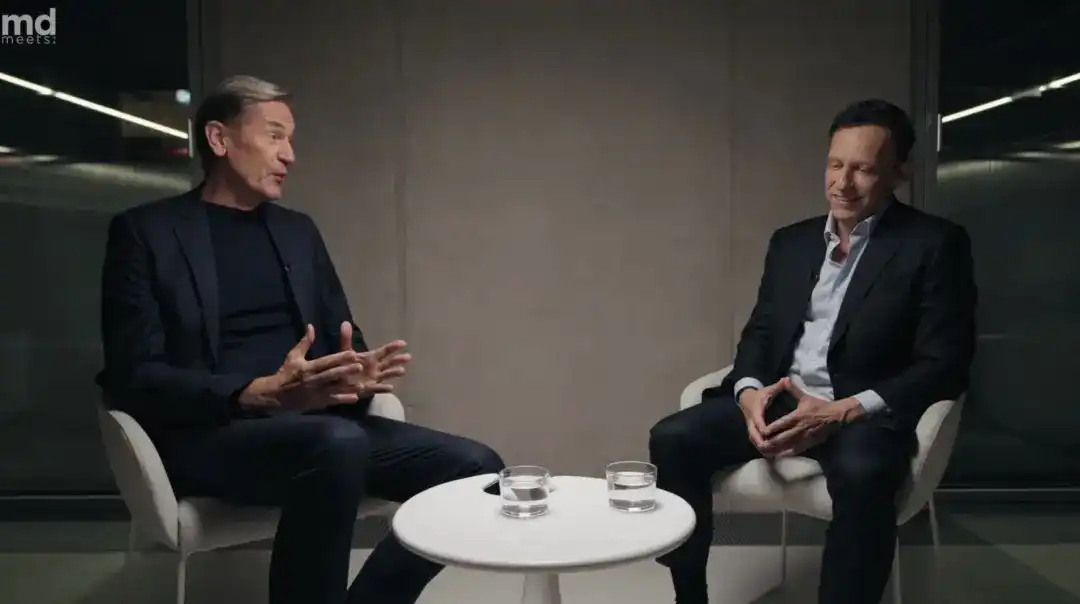
Speaking on Axel Springer CEO Mathias Döpfner’s interview program "MDMeets," Thiel tied together AI, political polarization, Europe’s economic drift, generational stress, global governance and his own views on longevity. His basic claim was blunt. Since the 1970s, he said, progress has been fast in bits and weak in atoms.
Stagnation in the physical world
Thiel said measuring technological progress across the whole economy is difficult, but the broad pattern is clear to him. Computers, the internet, mobile internet and software show rapid gains in the digital realm. In the physical world, he said, breakthroughs have been far more limited.
He pointed to engineering fields tied to the material economy, saying they no longer attract young people in the same way. Mechanical engineering, chemical engineering and aerospace have all faded as prestige paths, he said, while nuclear engineering had already become widely seen as a bad career choice by the 1980s.
That slowdown, in his telling, sits behind a wider set of structural problems. When growth disappears, every winner implies a loser, and politics turns into a zero-sum fight. He said the internet boom of the late 1990s was a major growth engine, larger than many earlier waves of innovation, but still failed to push civilization into a new phase change.
AI may be different, he said, or at least large enough to reopen the possibility of renewed growth, whether the result turns out to be "honey or poison." He added that AI’s arrival has made it harder for critics to dismiss his earlier claim that the previous decades were largely spent standing still.
Extinction risk and the case against a permanent brake
Asked about recent warnings from Dario Amodei, Sam Altman and Elon Musk that AI could slip beyond human control, Thiel said the debate spans many layers. He does not personally assign a high probability to extreme disaster scenarios associated with films like "The Matrix" or "Terminator." Even so, he said, a 5% or 10% chance of destruction would still be chilling.
His bigger concern is what that discussion does to public psychology. In his view, it can push societies into a defensive and deeply conservative dead end built around precaution.
Döpfner cited an experiment in which six leading large language models were asked whether AI poses a risk of human extinction, with answers ranging from 1% to 10%. Thiel said one can assume for argument’s sake that the threat is real. No one can guarantee the probability is exactly zero. But that still does not justify slamming on the brakes forever.
He argued that a civilization that stops evolving in the name of absolute safety would quickly come apart. The middle class in Europe and the U.S., he said, still endures current pressures because it believes the next generation will live better. That intergenerational bargain depends on gradual gains in wealth, health and upward mobility. Once it breaks, society enters disorder in distorted ways. Zero growth, he said, is not neutral, and time does not run backward.
Why a global slowdown would be hard to enforce
On whether AI development can realistically be slowed, Thiel said a true brake would require deep coordination on a global scale. The hidden premise behind that idea, he said, is a single world government with real power and coercive enforcement capacity.
That strikes him as more dangerous than the disease it is meant to treat. A more likely outcome, he said, would be a fake version of global governance built on endless international meetings and empty declarations.
He also warned about asymmetry. The West could slow itself while "the other side of the ocean" keeps moving at full speed. Thiel cited a recent papal encyclical on AI, calling it more precisely an anti-AI encyclical. Leaders on the other side, he said, will not listen to the pope, but many in the West will, leaving the pope as what he called a "useful idiot" for the opposing camp.
Döpfner said two founders of major AI platforms had told him they had evidence that rivals were spreading anti-AI fear through U.S. social platforms. Thiel said he had not studied the evidence chain in depth, but was inclined to believe it. Even so, he said the deeper problem lies inside the West itself.
He made a similar point when Greta Thunberg came up. He said it would be easy to treat her as an agent of an opposing camp, but in his view she is a product of Western society itself. Her peak may have passed, he said, yet the West has repeatedly generated this kind of self-defeating dynamic on its own.
Why the U.S. fears AI more than Europe
Thiel said the stronger anti-AI mood in the U.S. reflects where the real technological break is happening. Europe, in his view, has already fallen too far behind to catch up.
American companies, he said, face intense pressure to rebuild their businesses around AI. Referring to Palantir, he said sales growth among U.S. enterprise customers is surging and companies feel they must accelerate or risk being left behind.
Europe looks different to him. He described it as trapped in a deep inertia, where people still think they can wait and postpone what should be done tomorrow until the day after.
Not evil, but bad and incompetent
Thiel said the public no longer believes life will improve tomorrow, and that loss of confidence turns distributional conflict into a harsher zero-sum struggle. AI is not a cure-all, he said, but without renewed growth the political extremes on both left and right will keep expanding.
He also argued that societies moralize technology too easily. On a moral scale, he said, the opposite of good is evil. On a functional scale, the opposite of good is simply bad or incompetent.
His example was a Ferrari versus a Trabant. A Ferrari can be called evil because of its fuel consumption, he said, but the East German Trabant was bad because it could barely function on the road. An evil person, he added, at least has the capacity to carry out a will and achieve an end.
He then turned to Faust. In Christopher Marlowe’s version, Faust is a fraud dealing in low-grade pseudo-science and ends in hell. In Goethe’s version, Faust makes a pact with the devil but still produces something real and is ultimately redeemed.
For Thiel, the deeper collapse in society today is not evil but incompetence. "99%" of politicians, business leaders and corporate executives are not evil, he said. They are simply incompetent.
Polarization, youth radicalization and Germany
Thiel revisited an old libertarian essay he wrote late at night for an online publication linked to the Cato Institute, saying he issued a formal clarification two weeks later. What he had really wanted, he said, was a degree of depoliticization and a reduction in the intensity of public life. His criticism was aimed at libertarians who believed winning elections was the master key to remaking the world.
He said moderate political elites underestimate the structural crisis created by technological stagnation and a broken intergenerational bargain. Britain, he noted, has had seven prime ministers in ten years without producing a real answer to social decline.
Döpfner cited Berlin election results in which Die Linke won 25% overall but 47% among voters aged 16 to 24. Thiel said that pattern reflects real material pressure. Rents in Berlin are extremely high, new housing is blocked, and young people see little path upward.
Germany, and much of Europe, has become a gerontocracy in his description, dominated by and organized for older generations. Extreme parties gain ground, he said, because they at least speak openly about problems moderates prefer not to confront, even if their prescriptions do not work.
On Alternative for Germany, or AfD, Thiel said its rise mainly exposes the incompetence of establishment parties. They have failed to produce an inclusive economic blueprint for Germany and cannot even balance a budget, he said. He added that Ukraine, China and Israel all deserve serious public debate, but in his view AfD’s answers on all three are wrong.
Trump, Vance and the limits of political leadership
Looking back at his public support for Donald Trump in 2016, Thiel said Trump’s rise was a predictable result of establishment failure under long-term growth stagnation, the aftereffects of globalization and the geopolitical morass of the Middle East.
He said Trump’s first administration was consumed by endless bureaucratic factional fighting. In the second administration, he said, the correction went too far in the other direction, with loyalty tests elevated above all else and a resulting crop of executors who lacked professional competence.
Asked why he backed J.D. Vance early, Thiel said he has always favored genuinely smart minds. He described Vance as thoughtful, open-minded and personally charismatic. Vance worked at Thiel’s Mithril fund, wrote "Hillbilly Elegy," and received Thiel’s support in his 2022 Ohio Senate run.
When asked who might become the central contenders in 2028, the interview moved on without a specific answer.
Milei, deficits and Europe’s strategic place
Thiel said Argentina offers a mirror for what happens to a society after a century of below-average mediocre growth. In 1900, he noted, "rich as an Argentine" was a common expression.
Javier Milei now faces a survival-level problem, he said. For Western countries trapped in uncontrolled deficits, Thiel sees only three broad options: cut spending aggressively as Milei has tried to do, accept a socialist-style tax stagnation, or keep borrowing and push the debt burden into the future.
He said moderate politicians such as Germany’s Friedrich Merz have effectively chosen the third path.
On Europe’s place in U.S.-China rivalry, Thiel said Europe should be a reliable ally of the United States. Restarting Europe’s economic engine and preserving a healthy business cycle would serve U.S. strategic interests, he said.
He contrasted Europe’s current position with the late 1960s, when the continent built the Concorde and briefly overtook others in high-end aerospace. In AI, he said, Europe’s failure is even worse than France’s attachment to Minitel in the 1990s.
Why Germany has not produced a global tech giant
Thiel said Germany’s problem is not only a conservative fear of failure. More deeply, he said, it is a fear of success. European founders and investors do not push companies to their outer limits and do not build giant disruptive machines in the style of Elon Musk or Mark Zuckerberg.
He backed that up with a wealth comparison. Among the 50 richest people in the U.S., he said, 12 belong to Generation X or younger, and nine of those 12 are self-made founders. Among Germany’s 50 richest, 20 are from Generation X or younger, but all 20 are heirs to family fortunes.
Over decades, he said, Germany has not produced even one new trillion-dollar technology giant that scaled from scratch.
Founders, chess, children and longevity
Thiel said Germany remains emotionally important to him because he grew up speaking German at home with his parents and grandparents. Germany, he said, sits at the core of continental Europe and Western civilization, and any attempt to save the West has to take Germany seriously.
Asked about his co-founders Alex Karp and Max Levchin, Thiel said top founders often combine a rare insider-outsider tension. They have access to elite institutions while retaining the raw drive of outsiders. Karp, he said, graduated with him from Stanford Law School and fits the insider mold, yet still carries a rebellious streak. Levchin arrived alone in Chicago from Ukraine at age 16 and brought an almost ferocious desire to break through barriers.
On contrarian thinking, Thiel said the point is not to be contrary for its own sake. It is to defend independent thought in a technical society shaped by narrow specialization of the Adam Smith pin-factory kind. Generalists who can connect history, science, economics and psychology still need room to operate, he said.
His non-commercial passion, he added, is chess, which he described as both intellectually beautiful and dangerously addictive.
His four young children have also changed his time horizon. By 2100, he said, his eldest daughter will be 81. That fact forces him to think about what civilization may look like in the 22nd century.
On health and longevity, Thiel traced his interest back to the optimism of Bacon, Franklin and Condorcet. Science, he said, was meant to relieve the human condition and ultimately defeat terminal disease and death itself. He called the abandonment of that ambition a striking civilizational retreat.
If biology is understood as an information science at the base layer, he said, aging is in principle computable and reversible. His current top priority is to defeat brain atrophy, cognitive disorders and Alzheimer’s disease.
He also rejected the idea of uploading his mind into the cloud. His sense of identity, he said, is rooted in the physical body and shaped by Christian tradition. What he wants is the real extension of bodily life, not a digital copy of consciousness in code.
The Antichrist and emerging global authoritarianism
At the end of the interview, Thiel returned to a question he is known for asking others: what important truth do you believe that almost nobody agrees with?
He said he began giving public talks about the Antichrist three years ago and initially thought the subject would be maximally provocative and fringe. He now believes it is less fringe than he expected. Many people, he said, privately admit that the world is moving toward an emerging system of global authoritarianism.
The strange part, in his view, is the split between public and private speech. In public, people dismiss talk of the Antichrist as madness. In private, he said, many quietly agree.
Thiel did not end the conversation with a neat answer or a reassuring line. He left the central question unresolved: if technological acceleration cannot be stopped, and if human institutions remain dominated by mediocrity and incompetence, is the path to the 22nd century a path toward redemption or toward something darker?